
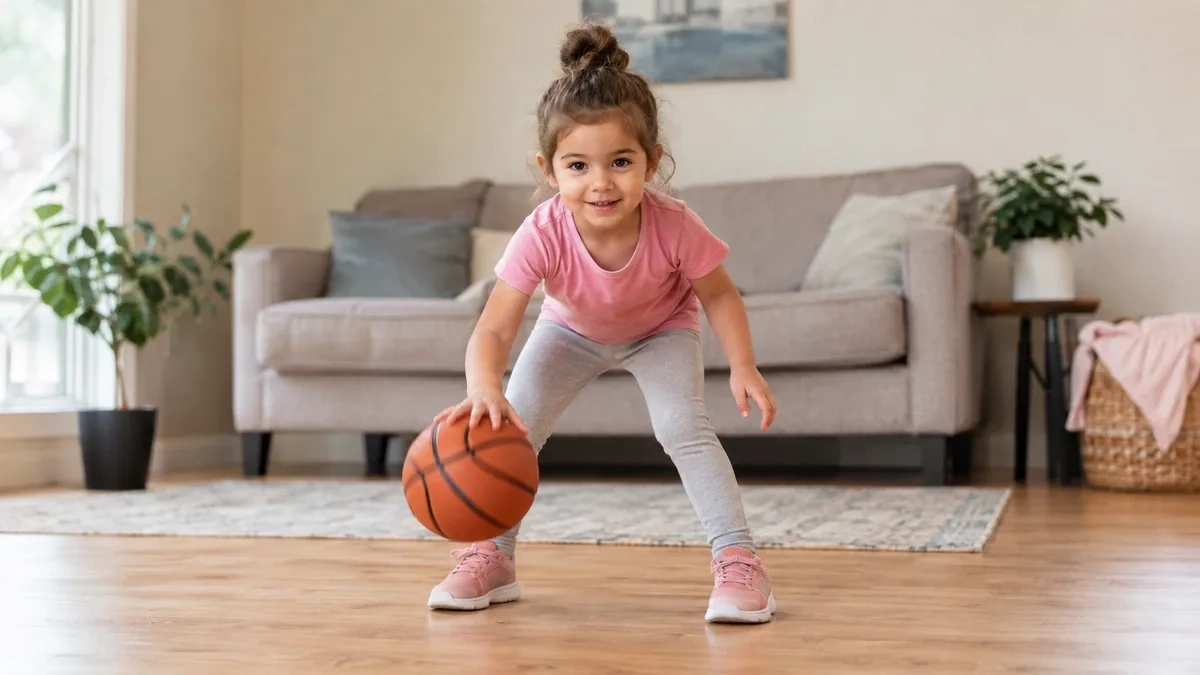
At ages 4–6, basketball is about handling and dribbling with the fingertips. Catching and shooting on a hoop come later. It’s all about ball control and getting a feeling for the ball, while also being able to control your own body movements.
Key takeaways
- Start with the ball in your hands, not the ball in the hoop: fingertip control and a stationary dribble come first.
- Match the skill to the age — reliable catching and real shooting arrive around 7–8, so don’t rush them at 4–6.
- Movement first, basketball second: balance, coordination, and body control make every basketball skill easier.
- Get age-appropriate gear: a women’s/kids’ ball, a hoop set between 5–8 feet, and gym shoes.
Almost every parent’s instinct is to buy a little hoop and start shooting. It’s a lovely picture — but for a 4-year-old it’s the last step taught first. Basketball, taught well, is built from the ground up: a feel for the ball, then a dribble, then passing and shooting once the body is ready. This page lays out the whole by-age path so you know what to teach now and what to save for later.
For the broader cross-sport picture — how basketball fits alongside soccer and movement, and how to pick a first sport — see our parent’s guide to teaching kids sports by age. Here we go deep on basketball itself.
This is the home base for Sunfield Basketball, LudoLogic’s basketball series. LudoLogic is our company; in Sunfield, kids become “Guardians” who learn the fundamentals with Coach Tina and her sidekick, Scout, across five episodes.
What is the right way to start teaching a young child basketball?
The right way to start is with ball handling, not shooting: teach a 4–6 year old to control the ball on her fingertips and dribble it in one place before anything reaches a hoop. Ball handling builds the touch every other skill depends on, and it’s something a preschooler can actually succeed at, which keeps her coming back.
What we believe:
Shooting on a hoop is the reward the whole internet points kids toward first, and it’s exactly backwards for this age. A 4-year-old who can’t yet control the ball will miss ten shots, feel like she’s bad at basketball, and quit. The same child who spends two weeks learning fingertip control and a seated dribble feels like a natural — because we handed her a win she could reach. Trust me, learning how to dribble at this age is just as fun as shooting. Competence first; confidence follows.
Why teach movement skills before basketball?
Teach movement first because basketball is built on general athletic skills — balance, coordination, agility, and body control — that a child needs before sport-specific moves make sense. A preschooler who can stop, change direction, and balance on one foot learns to dribble and pivot far faster than one who can’t. The sport sits on top of the movement, not the other way around.
What the research says: These general athletic building blocks are often called the “ABCs” — agility, balance, and coordination — and long-term athletic development frameworks put them first, before sport-specific training. This is the same idea behind “physical literacy,” which Sport for Life defines as the motivation, confidence, physical competence, and understanding to stay active for life. Basketball is one happy expression of it, not a substitute for it.
What basketball skills should a 4–6 year old focus on?
At 4–6, focus on two things: controlling the ball with the fingertips and dribbling it in one place. Everything else — catching, real shooting, passing on the move — builds on those two. Keep sessions short, keep a real hoop optional, and treat a few controlled reps as real success.
Here’s the early skill order we use:
- Fingertip control. The ball rides on the finger pads, never the flat palm. Practice this first as the foundation for later dribbling and passing.
- Stationary dribble. Begin seated, then progress to standing once the child can send the ball repeatedly to one spot.
- Jump-stop and triple threat. Stopping under control and holding a ready position — balance and body control, basketball-style.
- Passing as a “send.” Step and pass, either bouncing or a chest pass — working on aim and stepping while throwing. Catching comes later in the process.
- Shooting with power from the legs. When a hoop enters the picture, the power comes from bending and lifting the legs, not throwing with the arms. We teach “load and explode” to reinforce bending the knees.
Our basketball age-tier hub lays out how to weave these into a simple daily routine.
Why don’t we teach catching and shooting first?
We hold off because reliable catching is typically a 7–8 year old milestone — often called the “Catch Gate” — so a 4-year-old’s hands simply aren’t ready to track and grab a moving ball yet. Push it too early and she mostly experiences dropping the ball. Instead, at 4–6 we teach passing as a “send” to a target, which builds the same aim and touch without the frustration.
What the research says: Ball skills like catching develop gradually, with more predictable catching emerging in the early school years as hand-eye coordination matures, according to Cleveland Clinic’s overview of gross motor skills. For the full explanation of the Catch Gate and why “send, don’t catch” is the right call at this age, see our top pillar guide.
Shooting waits for a related reason: a young child doesn’t yet have the leg-driven mechanics to get a ball to a real rim, so early “shots” are all arm and all miss. When shooting does come in, the cue is power from the legs — bend and lift, or “load and explode” — which is why we teach it later, once balance and strength are there.
How does basketball change from age 4 to age 11?
Basketball changes from a handling-and-balance game into a true team game as the body matures. At 4–6 it’s individual ball skills and body control; at 7–8 catching becomes reliable and shooting on a lowered hoop makes sense; by 9–11 kids can combine skills at speed and play real team basketball. Meeting each stage where it is keeps the game fun and the confidence intact.
A rough by-age map for basketball:
- Ages 4–6: Fingertip control, stationary dribbling, stopping and balancing, passing as a “send.” Hoop optional. Goal: touch, control, familiarization, gear IQ, and fun.
- Ages 7–8: Reliable catching arrives, so real passing and catching begin; shooting on a lowered hoop with leg-driven power; dribbling while walking. Goal: combine skills slowly.
- Ages 9–11: Skills come together at game speed — dribbling under pressure, shooting form, and genuine team play. Goal: apply skills in games and basic strategy.
Because we’re anti-early-specialization, none of this means basketball-only. The strongest young athletes keep sampling movement and other sports right through these years.
What age can a kid start playing basketball?
A child can start playing with a basketball as young as 3–4 — handling and rolling a junior-size ball — but organized, competitive basketball generally fits better at 7 and up. Early on, “playing basketball” means fingertip control, dribbling, and fun, not games with a score. Match the ball and the goals to the child, and there’s no such thing as too early for playful handling.
What worked in our house: Because both my wife and I played basketball, we have an extensive network of friends still involved in coaching and the youth-sports industry. One of them runs an incredible little-ballers program for 3–5 year olds that was a great introduction to the game — a 45-minute session where the kids rotate station to station, with shooting, agility, passing, dribbling, ball control, and defense all taught in bite-size pieces. It got my kids familiar with the game, and from there we translated it to home. If you don’t have a program like that nearby, start with a junior ball or soft indoor bouncing ball and practice basic handling between the hands and seated dribbling until your child is comfortable. An indoor hoop can be added for playful shooting, but it is optional at this stage. General socialization is valuable no matter how young they are.
Common mistakes parents make (and easy fixes)
- Starting with shooting on a hoop. Start with fingertip control and a dribble instead; bring in a hoop later.
- Using a full-size ball. Drop to a junior ball that fits little hands, or even a soft ball to start.
- Teaching catching too early. Teach passing as a “send” to a target until about 7–8.
- Long, drill-heavy sessions. Keep it to 5–10 playful minutes; short and frequent wins.
- Correcting every rep. Give one cue per skill and let her explore; over-coaching kills the joy.
Frequently asked questions
Does my child need a real basketball and a hoop to start?
No. At 4–6, a junior ball — or even a soft ball or stuffed animal for the very first reps — is all you need. A hoop is optional and honestly gets in the way early, because it pulls kids toward shooting before they can handle the ball. Add it around 7–8.
Is basketball safe for a 4-year-old?
Playful handling and dribbling can be age-appropriate with simple precautions. Keep a clear space bubble, use soft household props or a ball that fits the child’s hands, and supervise young kids. Stop for pain, dizziness, or distress, and consult a professional for medical concerns.
My child would rather just shoot. Should I let her?
Let her have fun with it, absolutely — but weave in a couple of minutes of fingertip control and dribbling too. Framing it as “we get the ball ready first, then we shoot” usually works, and the handling skills make her shots better anyway.
Ready to start?
Watch the free first episode of Sunfield Basketball, “Scout’s Hide-and-Seek”, with your child, then explore our basketball age-tier hub for the daily routine and the full skill index. When you’re ready to go all in, the Basketball bundle includes all five episodes, the Field Book workbook, and the collectible cards.
About the author
Lincoln Gunn is the Founder & CEO of LudoLogic and the author of the Sunfield Basketball and Rainbow Riders curricula. He and his wife are both former Division I basketball players raising two young daughters, and his guiding motto is to “build the ultimate athlete, not the elite basketball player.” LudoLogic’s programs are grounded in recognized physical-literacy frameworks and pediatric developmental guidance.
Sources
- The ABCs of movement and long-term athletic development — NSCA Coach: https://www.nsca.com/education/articles/nsca-coach/abc-of-long-term-athletic-development/
- Physical literacy — definition and framework — Sport for Life / IPLA: https://physicalliteracy.ca/physical-literacy/
- Gross-motor development and how catching becomes reliable with age — Cleveland Clinic: https://my.clevelandclinic.org/health/articles/gross-motor-skills