
Key takeaways
- Movement first, sport second. Build the ABCs — agility, balance, coordination — at 4–6; layer the sport on at 6–8.
- Reliable catching is a 6–8 skill (the "Catch Gate") — if your 4-year-old can't catch, she's on time.
- Ten to fifteen playful minutes a day, one cue at a time, beats any early drill or scoreboard.
If you've ever watched your four-year-old wander off two minutes into a "real" practice and quietly wondered whether she's just not a sports kid, here's the reassuring truth: she's probably right on schedule — and you don't need to be an athlete to help her. I'm the dad of two girls — a five-year-old and a two-year-old — a former Division I athlete who grew up in a sports-obsessed household, and my wife played D1 basketball too.
Our family motto is "build the ultimate athlete, not the elite basketball player." Almost everything I know about this I learned on our living-room floor and in the backyard, at the park, and on the sidelines of a gymnastics class watching my daughters. Teaching kids sports isn't about early drills or keeping score. It's about building the movement foundation that sits underneath every sport, in the right order, at the right age, in short bursts that feel like play.
This guide walks you through what to teach at each age from 2 to 11 — backed by research and grounded in what's actually worked with my own kids — which sport to start with, and how to coach it in 10–15 minutes a day. Wherever your child is today, there's a simple next step — and it can start tonight with a single free first episode of Rainbow Riders.
(Quick note on names: LudoLogic is our company, Rainbow Riders is the video series, and the Discovery Crew are the characters your child follows through it.)
What age should kids start playing sports?
What the research says. There's no single "right age" to start sports — movement play can begin as early as 2–3, but structured, sport-specific skills usually click between 6 and 8. The early years are for building foundations, not competition.
It helps to separate two things parents often blur together: movement and organized sport. Movement is the running, jumping, balancing, and ball-handling that every sport is built on — what coaches call the ABCs of athleticism: agility, balance, and coordination. Organized sport adds rules, positions, a scoreboard, and a coach — think basketball, soccer, volleyball.
The research is consistent that early childhood is the window to build those foundations. The National Strength and Conditioning Association has published that if kids don't work on these basic fundamentals by age 8 they can hit a "motor skill proficiency barrier", which can limit their ability to pick up sports later. On the flip side, push a child into competitive, sport-specific structure before those foundations exist and she often concludes she's "bad at it." That's why starting with movement is so important — and so key for eventual sport development.
Movement is often intertwined with the term physical literacy. Sport for Life and the International Physical Literacy Association define it as "the motivation, confidence, physical competence, knowledge, and understanding to value and take responsibility for engagement in physical activities for life." Notice that confidence is built into the definition — and research backs up why: a leading developmental model argues that motor-skill competence is a primary driver of staying active, closely tied to a child's perceived competence, her own sense that she's capable. Confidence isn't a personality trait a child is born with or without; it grows once she feels capable. That's why the order matters so much.
This is one of our core theses at LudoLogic: competence builds confidence. We go deep on the research behind it in our confidence article.
What worked in our house. Both of my girls started early with local Gymboree classes and ballet school. They were great foundational movement classes that exposed early motor skills — spinning, hopping, climbing, arm twirls. If you can't swing the cost or the logistics of classes, a local park with age-appropriate equipment is just as good: letting young kids climb and balance is hugely beneficial for development, so get out to your local park.
Swim lessons were another good early investment. Our eldest started at 2.5 — she was a good listener, curious, and comfortable in the water (we could tell early by how long she wanted to stay in the bath). And we saw the payoff in order: we introduced her to soccer at 4, but only after a summer of gymnastics camp and learning to swim. Establish the foundations first, and I can say first-hand it helps them excel once they're in the sport — they navigate it so much more easily. The bottom line: a child's first experience with movement shouldn't be a sport.
How do I start teaching my young child sports?
How we coach it. Start with movement, keep sessions short and playful, and teach one thing at a time: watch a quick demo together, then practice that single skill for 10–15 minutes.
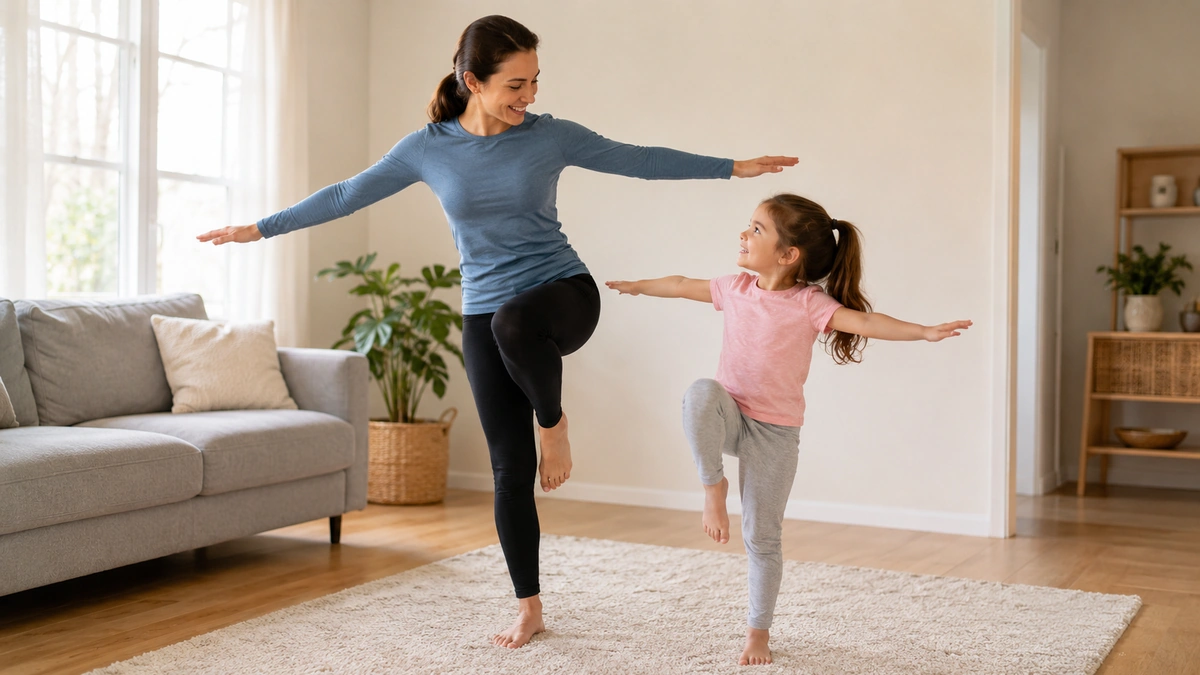
Here's what tends to work in real living rooms, parent to parent. The most effective setup at home is "co-watch, then do": watch a short skill demo side by side, then get up and try that one move together. Keep it simple — 10–15 minute sessions, max. A few principles hold across every age and sport:
- One idea per session. One move, one cue, one feeling. "Fingertips, not palms" beats a five-step lecture every time.
- Normalize the wobble. Falling over, missing, looking silly is learning, not failure — and at this age that's as important as the skill itself. Move her off "I can't" by stacking little wins, because confidence follows from feeling capable, not the reverse. Never shame, and never compare her to a sibling.
- Make it a mission, not a lesson. Lean on imagination and play. In our house that means "jump like a jaguar," "balance like a flamingo," and "show me the ready position" — silly cues that buy ten happy tries where "practice your landing" buys one.
- Stop while it's still fun. End on a small win so she wants to come back tomorrow.
What worked in our house. Some of my favorite "sessions" aren't sessions at all. On the BART train, when it starts to slow, I'll say "ready position!" and my five-year-old drops into a low, knees-bent, eyes-up stance to ride the stop without grabbing a pole — balance and timing practice disguised as a game. Growing up, nobody called any of this "physical literacy"; we just played outside until dark. The only difference now is that we can be a little intentional about it.
You don't need a curriculum binder to do this — you need one skill and ten minutes. If you want a guided starting point, the free first episode of Rainbow Riders walks you and your child through a single foundational skill together.
Teaching kids sports by age: a stage-by-stage guide
Here's the sequence, age band by age band — the same one I'm following with my own kids. Each stage builds the one before it, so the goal is never to rush ahead; it's to give your child a deep, confident base at her current stage.
Ages 2–3: Movement play (the warm-up years)
What the research says. Free, imitative movement — walking, running, climbing, chasing, rolling, and tumbling — plus the basic words that go with it ("stop," "jump," "balance," "fast/slow"). No rules and no scoreboard. At this age the entire goal is joy in moving, basic body coordination, and learning the vocabulary of movement. Play alongside, mirror what they do, and narrate it ("big stomp! now tiptoe!").
What worked in our house. My two-year-old's whole "program" is climbing the same playground steps on repeat — and that's perfect. The rest of what's worked for us at this age: water safety and an intro to swimming; playground visits two to three times a week; copy-and-mimic games (hop on one foot, run down the hall, simple yoga poses, big arm movements); tricycles and scooters; tag; jumping into piles of pillows; rolling and starting to toss a ball; a first, low-key intro to live sports (sitting at a local baseball or soccer field, pointing things out and explaining them); and just getting in the pool with them.
Ages 4–6: The foundation window (the Discovery Crew years)
What the research says. This is the most important stage, and the one most often skipped. Ages 4–6 are the foundation window for fundamental movement skills — the ABCs of athleticism (agility, balance, coordination) — which fall into three families:
- Locomotor (moving the body): running, jumping, hopping, galloping, and the side shuffle.
- Stability and balance: balancing on one foot, stopping under control, and changing direction.
- Object control: rolling and sending a ball, and light first touches with hands or feet.
The right move here is variety, not specialization. National guidance for this age (SHAPE America's Active Start) emphasizes reinforcing a wide range of fundamental skills rather than pushing a child toward mastery of one sport, and the same logic anchors long-term athlete-development frameworks, which place the ABCs in these early stages.
But movement isn't the whole story at 4–6 — this is also where sport familiarization begins. It's the age kids start showing up to soccer or basketball, and that's a good thing. The point isn't team play or competition; it's a first touch on the ball, learning what a soccer ball or a small hoop even is, getting comfortable with the gear, and building a little competence and confidence around a sport — all framed as play. Two tracks run together: the movement ABCs underneath, and a gentle, low-pressure introduction to one or two sports on top.
Start with the beginner tier for each: Teaching Movement to 4–6 Year Olds, Teaching Soccer to 4–6 Year Olds, and Teaching Basketball to 4–6 Year Olds.
What worked in our house. Gymnastics camp was honestly one of the best investments we made for our oldest. My wife and I are both tall, ex-basketball players, so our daughter probably doesn't have a future in gymnastics by simple natural selection — but it gave her an unbelievable movement foundation. Body control, hanging, balance, agility: all taught in gymnastics, and all transferable to every sport.
And then there are parks. We go every weekend, sometimes two or three times a week — she's a total park rat. Climbing, going up and down stairs, and (at five) inventing games like "capture the water bottle" all built her gross motor skills without a single drill. From there we introduced the sport-specific stuff at 4: basketball as a parent-and-child experience, soccer coach-led. She was young for both, but it was never about the sport — it was the positive environment, being around other kids, and doing it with her dad. If you can find a soccer team with kids from her school, even better; at this age, being with friends is half the magic. This was also when I took her to her first basketball game. Her attention span had grown enough to take it in, and seeing a real game — the arena, the hype — taught her that basketball is more than something you do in the driveway with Dad. There's a game, and there's a stage.
Ages 6–8: First real sport skills — and the Catch Gate
What the research says. Around 6–8, children can begin true sport-specific skills — a controlled first touch, a stationary dribble — and an important milestone finally arrives: reliable catching.
Reliably catching a ball is a 6–8 skill, not a 4–6 one. Pediatric milestones show kids typically trap a ball against the body around age 3, catch with the hands only around 5, and throw and catch predictably around 6 — later than running and jumping.
We call this the Catch Gate, and it's one of the most reassuring facts a parent can know. If your four-year-old can't catch, she isn't behind — she's exactly on time. Below the gate, teach catching as a "send" (rolling and bouncing back and forth) and teach ball control with the fingertips, not the palms. Expecting a preschooler to catch like an eight-year-old is one of the fastest ways to convince her she's no good at sports.
This is also a great age to broaden exposure. Once the basics are coming together, sample more than one sport rather than locking into a single one — the American Academy of Pediatrics encourages kids to vary their activities and notes there's plenty of time to specialize later.
What worked in our house. Full honesty: I'm not here yet — my oldest turns 6 soon. But the consistent message I hear from parents a step ahead of me is simple: the more exposure to sports you can give them at this age, the better.
Where we're headed. Here's the plan I'm building toward. Keep investing time and energy in gross motor development — that has to stay the foundation. This is also when kids start to understand competition, and where I see LudoLogic fitting in: keeping this age group engaged through fun, interactive daily activities and challenges. On top of soccer and basketball, we'll add exposure to as many sports as we can — tennis, golf, softball — and look at whether the swim team fits our schedule. Exposure is everything; they're sponges, so socialize them as much as possible and give them room to absorb. And honestly, this is exactly the problem LudoLogic exists to solve — how is any family supposed to keep up with six different sports? If she can't make it to basketball practice, we bring practice to her at home, with her parent as the coach.
Ages 8–11: Sport-specific skills and game sense
What the research says. Now you can combine skills, add simple positions and tactics, and introduce light competition. A child who spent 4–6 building movement and 6–8 learning first skills arrives here with something powerful — confidence that's already earned. The poise you see on the field at this age was built years earlier, on the living-room floor.
This is also when team sports generally start, and a basic understanding of strategy and competition is key to staying in the game. If your child is trying out for a team sport like soccer or basketball, make sure she has a basic grasp of the strategy side — out-of-bounds, offense versus defense, scoring, fouls and penalties. A little game knowledge goes a long way at a first practice or tryout.
What local coaches tell us. Again, not here yet with our own kids — but what I hear from a lot of youth coaches is that the most advanced girls usually come from families that invested in movement-skill development through other sports, like swimming or gymnastics, or from active families where they're playing with older siblings in a way that quietly teaches sports concepts. You'd be surprised how many girls show up to a tryout or first practice at 8 or 9 with no prior experience and are expected to pick it up fast enough to compete and make the team. It even happens at the high-school level.
Which sport should my child start with?
What the research says. At 4–6, the specific sport matters far less than building movement — choose based on your child's interest and what's easy to access, and keep it broad before specializing.
Great first sports share a few traits: they're movement-rich, individual-friendly (no complex team tactics required), and forgiving for little bodies. Soccer, basketball, martial arts, and gymnastics all fit — gymnastics and martial arts in particular are terrific for balance, body control, and coordination. Early single-sport specialization is one of the most common, and counter-productive, instincts in youth sports; the AAP recommends delaying it, partly because about half of youth sports injuries are overuse injuries. At this age, broad movement beats narrow expertise every time. The three tracks we cover each build slightly different things:
- Movement — builds first: run, jump, balance, coordination. Good first age: 4–6. Start here: the Movement pillar.
- Soccer — builds first: ball familiarity, light foot touch, agility. Good first age: 4–6. Start here: the Soccer pillar.
- Basketball — builds first: hand control, dribbling, send/catch. Good first age: 5–6+. Start here: the Basketball pillar.
Soccer travels well for the youngest kids because the feet do the work and there's no catching required. Basketball asks a little more hand control and tracking, so it often clicks slightly later.
What worked in our house. We started with ballet, gymnastics, and swimming. That gave our kids the basic movement foundation we could build on. Her first introduction to a team sport was soccer in a very casual environment — with her dad as the coach and her teammates being schoolmates. We then did a daddy-daughter basketball clinic through our local YMCA that folded a lot of movement skills into the class. My five-year-old is still genuinely into both basketball and soccer and wants to try softball next season — so this strategy seems to have worked so far.
If I have one hard-won piece of advice on this, it's don't rush to specialize. I started specializing in basketball in fifth grade, around age 11 — it got me to college, but I also burned out by my sophomore year and missed the chance to try individual sports I'm genuinely good at now, like golf and tennis.
How long and how often should we practice?
What the research says. Short and frequent beats long and occasional — aim for 10–15 minutes, a few times a week, kept playful.
A four-year-old's attention is measured in minutes, not hours, and that's fine — consistency matters far more than duration at this age. For the bigger picture, the World Health Organization recommends children ages 3–4 get at least 180 minutes of physical activity across the day, including at least 60 minutes of more energetic play — but almost all of that is everyday active play, not structured practice. Your skill sessions are a small, focused slice: keep each to a single skill, end before she's bored, and let her ask for more. You're building a relationship with movement, not running a training camp.
What worked in our house. We aim for about ten minutes a day. It's usually unstructured — but now that we've built LudoLogic, we finally have an easy on-ramp for more structured play when we want it.
Do I need special equipment or a class?
How we coach it. No — a living room, a couple of household items, and one simple mission are enough to start.
A pair of rolled socks, a soft ball, a line of tape on the floor, and a cushion to jump over will carry you through most of the 4–6 skills. Organized clinics and teams absolutely have their place — usually a bit later, once the foundation and the interest are there. Before then, the most valuable thing isn't a registration fee; it's ten minutes of you on the floor beside her. If you'd like a done-for-you path, start with the free first episode of Rainbow Riders, then the full series bundle adds the workbook and progression.
Common mistakes parents make (and what to do instead)
- Dropping a child into competitive play before she has the movement base. This is the one to avoid — not "any sport before 6." A good beginner program leads with movement and lets it evolve into the sport. Instead: lead with movement, layer the sport on top.
- Over-correcting. Five cues at once overwhelms a young child. Instead: one cue per skill.
- Comparing kids. "Look how well your brother does it" deflates fast. Instead: measure her against herself — "Did you get it? Try once more."
- Expecting catching too soon. Remember the Catch Gate — reliable catching is a 6–8 skill. Instead: teach the "send" first.
Several of these are worth unpacking on their own — see our myth-busting series.
Your age-by-age roadmap (quick reference)
- Ages 2–3 — teach first: free movement play and basic movement words (run, climb, chase, roll). Start here: play alongside her.
- Ages 4–6 — teach first: fundamental movement (ABCs) plus sport familiarization (first touch, gear, fun). Start here: the Discovery Crew hubs.
- Ages 6–8 — teach first: sport-specific skills; reliable catching arrives (the Catch Gate, ~6–8); sample more sports. Start here: the Sport Pillars.
- Ages 8–11 — teach first: combine skills, add positions and game sense. Start here: the Sport Pillars + full series.
Start tonight
You don't have to figure out the whole journey today. Pick your child's age, find the one skill that fits, and spend ten minutes on it together. The confidence you want for her on the field is built right here, at home, before the first whistle ever blows. Begin with the free first episode of Rainbow Riders, and when you're ready, the full series bundle adds the workbook, the progression, and the trading cards that keep her coming back.
About the author
Lincoln Gunn is the founder and CEO of LudoLogic, a girls-first sports-learning platform that helps parents build movement and sport skills at home. A former Division I athlete who grew up in a sports-obsessed family, he's also the dad of two girls — ages five and two — and most of what you'll read here was field-tested on the living-room floor, at the playground, and (more than once) on a moving BART train. LudoLogic's guidance is grounded in established physical-literacy research and made practical through the Rainbow Riders series. Learn more about Lincoln.
Sources
- NSCA — The "ABCs" of Long-Term Athletic Development (motor skill proficiency barrier; ABCs)
- Sport for Life / International Physical Literacy Association — definition of physical literacy
- Stodden et al. — motor competence as a driver of physical activity (perceived competence)
- SHAPE America — Active Start guidelines (ages 3–5)
- Cleveland Clinic — gross motor skills & catching milestones
- American Academy of Pediatrics (HealthyChildren.org) — preventing overuse injuries & specialization
- World Health Organization — physical activity guidelines for under-5s