
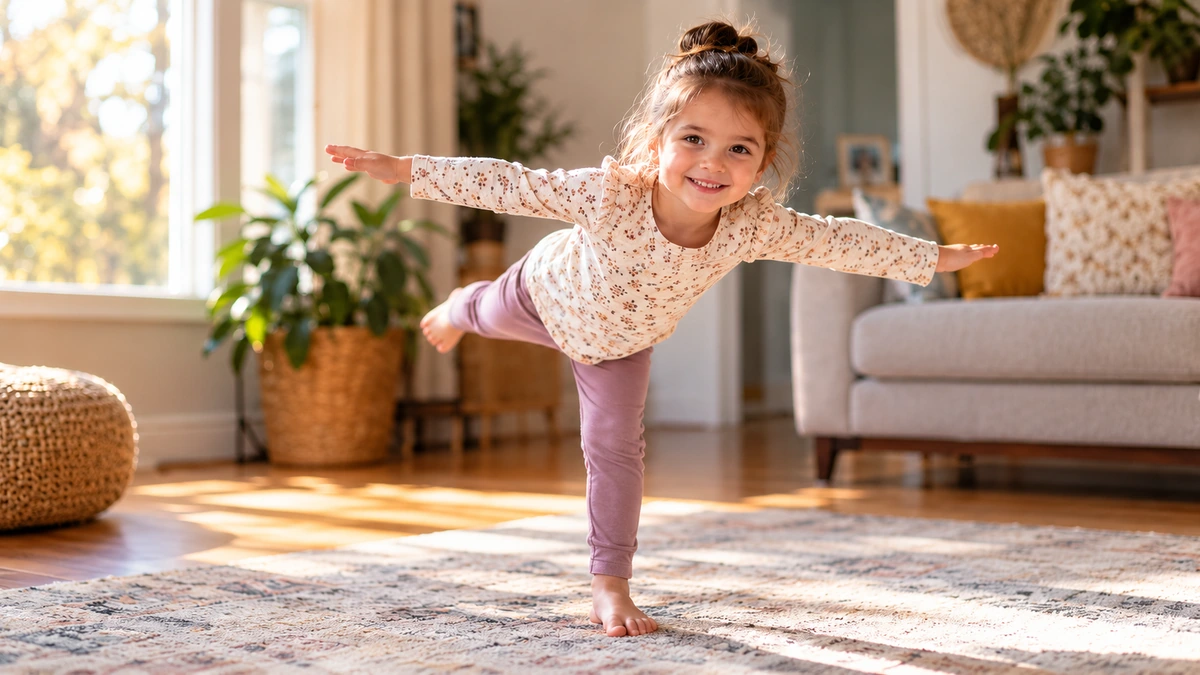
Use the arms like airplane wings to steady single-leg landings — the wobble-and-catch is how balance is built.
Key Takeaways
- Arms out wide are the whole cue: “airplane wings” turn a wobble into a catch.
- Land soft with a bent knee — a quiet landing is a controlled one.
- Wobbling isn’t failing; it’s the exact moment balance gets stronger.
Balancing on one foot looks like a party trick, but it’s one of the most useful things a young child can learn. It’s the base for hopping, skipping, and — down the road — planting a foot to kick or stopping under control. If you’ve come from our movement age-tier hub, this is one of the skills on the daily-movement menu you can teach in a few minutes on the living-room floor.
For the wider age-based progression, see How to Build Movement Skills in Young Kids, by Age.
This lesson comes from Rainbow Riders, LudoLogic’s movement series. LudoLogic is our company; Rainbow Riders builds 9 foundational movement skills across 10 adventures — the 10th ties them together in a reaction-time obstacle course. Your child rides along with Coach Kenzie, whom the kids know as “Stable Master Kenzie.” Today’s skill is straight from her Episode 7 adventure, “The Garden Pixie,” where the Rider helps a tiny pixie hop across the lily pads.
Quick Facts
- Age: 4–6
- Skill: Single-leg balance and hopping (same-foot takeoff and landing)
- Time: 5–10 minutes
- Equipment: None — just a clear floor; a chair or wall nearby for support
- One cue: “Airplane wings out.”
- Safety note: Clear a safe space and check the floor for slippery socks or toys. Use soft household props, supervise young kids, stop for pain, dizziness, or distress, and consult a professional for medical concerns. A wall or chair to hold is always allowed.
What Is Single-Leg Balance and Hopping?
In plain terms, single-leg balance is holding your body steady on one foot, and hopping is pushing off that foot and landing softly on the same foot. The two go together: you can’t hop with control until you can balance, and each landing is really a moment of balance caught in motion. Arms held out wide act like a tightrope walker’s pole.
What the research says: Hopping is a recognized fundamental movement skill — it’s one of the tasks in the PLAYfun physical-literacy observation tool, which assesses balance and stability alongside running and locomotor skills, per Sport for Life. In other words, this isn’t a random trick; it’s a building block trained programs actually measure.
Why Do Arms Matter So Much for Balancing on One Foot?
Arms matter because they’re your child’s balance tool. Held out wide like airplane wings, they let her make tiny corrections that keep her centered; glued to her sides, she has nothing to adjust with and tips right over. It’s the single fastest fix for a wobbly one-foot stand, and it’s a cue a 4-year-old can remember on her own.
What worked in our house: My five-year-old could not hold a one-foot stand to save her life — until we stopped saying “balance!” and started saying “airplane wings!” The instant her arms went out, she went from a two-second wobble to a proud, giggling freeze. The cue did the coaching. We also made the wobble the fun part: “wobble and catch it!” turned near-falls into wins, and she stopped being afraid to try.
What Age Can a Child Balance and Hop on One Foot?
Most children begin balancing briefly on one foot around age 3 and can hop on one foot by about 4, with steadier, repeated hops arriving between 5 and 6. Every child is on her own clock, so treat these as rough signposts, not deadlines. Short, playful practice — with a wall or chair to hold — moves it along faster than any push.
What the research says: Balancing and hopping on one foot are standard gross-motor milestones that emerge across the preschool years, according to Cleveland Clinic’s overview of gross-motor development. The CDC’s 5-year milestones also include hopping on one foot. If it’s not there yet at 4, keep it light and keep it fun; if you have a developmental concern, consult your child’s healthcare professional.
How Does This Help Her in Soccer?
It helps because nearly every kick, pass, and stop in soccer happens while balancing on one leg. The foot that stays on the ground — the “plant foot” — has to hold her whole weight steady while the other foot swings. A child who can balance and land on one foot has a head start on a stable plant foot, which is why we cross-link this skill with our soccer program.
See Teaching Soccer to 4–6 Year Olds.
How Do You Teach a Child to Balance and Hop on One Foot?
Build it in order: get steady first, then add a soft hop, then a little forward hop. Keep the arms out the whole time and land quietly with a bent knee. Let her hold a wall or chair whenever she needs it — that’s not cheating, it’s smart.
- Space bubble and floor check. Arms out, slow spin; clear socks and toys off the floor.
- Stork stand. Airplane wings out, lift one foot behind her, bend the standing knee a little, and freeze for a count of five. Switch feet.
- Load the spring. Same one-foot stand, but now dip the standing knee down and push back up tall — no hop yet, just feeling the “spring.”
- Soft hop in place. Dip, hop straight up, and land on the same foot with a quiet, bent-knee landing. “Load, hop, soft landing.” A few on each foot.
- Hop to a spot. Pick a target just in front of her; hop forward onto it and stick the landing softly. If one-foot landing is tricky, land softly on two feet — that counts too.
- Wobble and catch. When she wobbles, cheer it — “you caught it!” The catch is the skill getting stronger.
Common Mistakes (and One-Line Fixes)
- Arms pinned to the sides. Cue “airplane wings out” — it fixes most wobbles instantly.
- Landing with a loud thump. Ask for a “quiet landing” and a soft, bent knee; the same controlled landing habits start here.
- Standing leg locked straight. Have her keep a soft bend in the knee — a stiff leg tips over.
- Getting frustrated. Offer the wall or chair and the two-foot landing; success first, difficulty later.
Make It an Adventure
In Episode 7, the Garden Pixie is too tiny to cross the pond on two feet, so the Rider teaches her the Lily Pad Hop. Coach Kenzie’s Captain’s Challenge is to hop across a path of lily pads — three rounds, counting every hop where you land softly and keep your balance, aiming for 15. Lay out couch cushions or paper plates as “lily pads” and let your child hop the path at home. When she finishes, log her score in the Rider Log and add the Garden Pixie trading card to her collection. Next stop in the Stables is the Shadow Cat, who moves backward to hide her tracks.
Frequently Asked Questions
My child can’t land on one foot yet — is that a problem?
No. Landing softly on two feet after a one-foot push-off is a perfectly good starting point, and it’s the version we build in first. Keep the arms out and the landing quiet, and the same-foot landing will come with practice.
How long should we practice balancing?
A few minutes is plenty. Balance improves with frequent short bursts, not long sessions — a stork stand while brushing teeth or waiting for dinner adds up fast and keeps it feeling like play.
Is it okay to let her hold onto a chair the whole time?
Absolutely. Holding a wall or chair lets her practice the movement while she builds the strength to balance on her own. Let her decide when to let go — most kids drop the support as soon as they feel steady.
Ready for the Next Skill?
If your child can wobble, catch, and hop, she’s building real balance. Watch the free first episode of Rainbow Riders (Stop & Brake) with her, then grab the Rainbow Riders bundle — 10 adventures, the Rider Log workbook, and the collectible cards — to keep moving through the full set of foundational skills.
About the Author
Lincoln Gunn is the Founder & CEO of LudoLogic and the author of the Rainbow Riders and Sunfield Basketball curricula. He and his wife are both former Division I basketball players raising two young daughters, and his guiding motto is to “build the ultimate athlete, not the elite basketball player.” LudoLogic’s programs are grounded in recognized physical-literacy frameworks and pediatric developmental guidance.
Sources
- Hopping and balance as fundamental movement skills (PLAYfun observation tool) — Sport for Life: https://play.physicalliteracy.ca/play-tools/playfun/
- Gross-motor milestones, including balancing and hopping on one foot — Cleveland Clinic: https://my.clevelandclinic.org/health/articles/gross-motor-skills
- Hopping on one foot as a 5-year movement milestone — U.S. CDC: https://www.cdc.gov/act-early/milestones/5-years.html
- Soft, bent-knee landings and moving safely — Nemours KidsHealth: https://kidshealth.org/en/parents/knee-injuries.html