
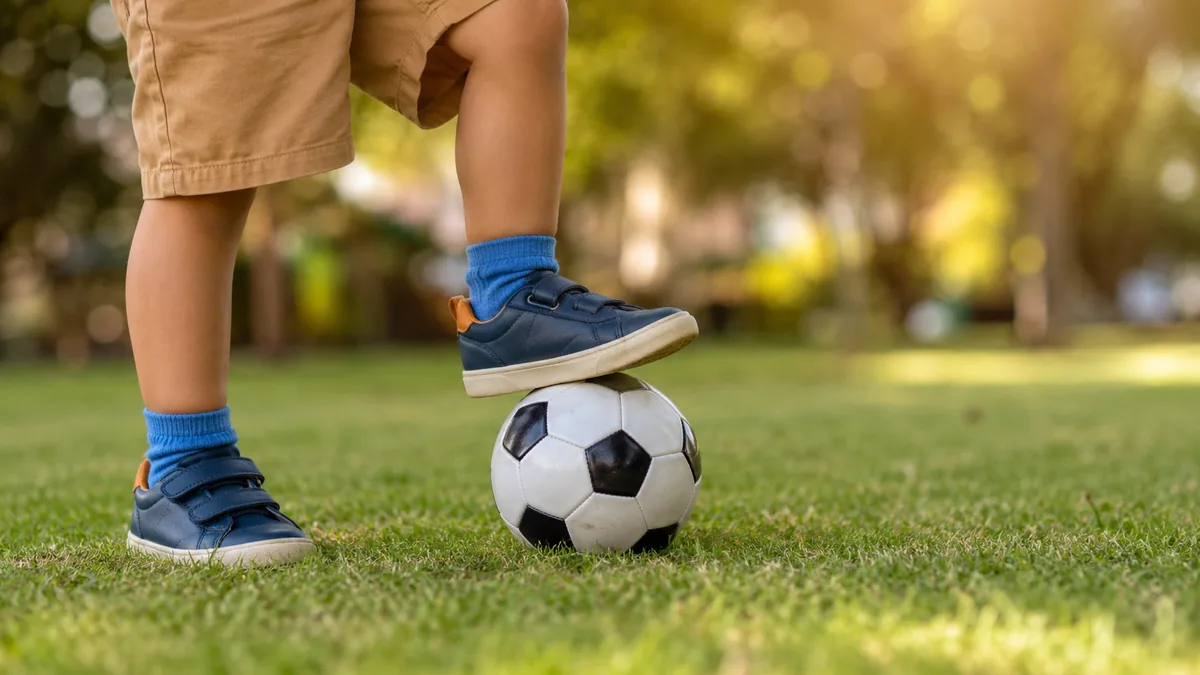
Before kicking hard, young kids master ball control with the inside and sole of the foot — so we start with the fundamentals, wrapped in imagination and storytelling.
Key takeaways
- The order matters: control before power. At 4-6, soccer is about touching the ball with the inside and sole of the foot — not shooting or passing on goal.
- Movement comes before the sport. Running, stopping, and changing direction are the base soccer sits on.
- Match the skill to the age: 4-6 is touch and ball familiarity; passing, shooting, and real games come later.
If you've ever watched a herd of five-year-olds chase one ball in a giant clump, you already know the truth about little-kid soccer: the game isn't the point yet. The touch is. A child who's comfortable with the ball at her feet will enjoy soccer for years. A child who's rushed into kicking hard, passing, and "scoring" usually just learns that the ball is hard to control and a little frustrating.
In plain terms, teaching soccer to a 4-6 year old means building ball and body control at the same time — getting comfortable moving the body (stopping, steering, changing direction) while keeping the ball close. That dual demand is part of the value: pairing movement with a ball makes the body and brain work together, and play like this is a powerful driver of development at this age. All of it comes long before passing, shooting, or real games. This guide walks through what to teach at each age and why and what worked for me. If you want the big-picture map of how sports stack up across childhood, start with our full guide to teaching kids sports by age; here we're focused on soccer.
LudoLogic is our company, Rainbow Riders is our movement series, and The Global Trophy Trek is our soccer series — where the Discovery Crew travels the world collecting skills with Coach Lola, the "Big Sister" mentor, as their guide.
Why does movement come before soccer skills?
Movement comes first because soccer skills sit on top of general movement. Before a child can dribble a ball, she has to run, stop, and change direction under control — the fundamental movement skills built between roughly ages 2 and 8. A child who can't control her body will have a hard time at that first practice, which is why we teach gross-motor movement first.
What the research says:
Fundamental movement skills — running, stopping, jumping, changing direction — are built in the window from roughly ages 2 to 8, the foundation for any sport that follows. Soccer sits on top of that base.
What we believe:
This is why we built a movement series before we ever pushed soccer drills. The skills that make a soccer player at six aren't "soccer skills" — they're the ability to decelerate, cut, and balance. We teach those first in Rainbow Riders, then layer the ball on top in The Global Trophy Trek. If your daughter is brand new to moving with intent, the movement foundation that comes before any sport is a better place to start than a ball at her feet.
What soccer fundamentals should a 4-6 year old learn?
Two kinds of fundamentals. First, the basics of the sport itself — what the ball, shin guards, and jersey are, and what a coach does — so she feels confident stepping on the field. Then the movement fundamentals: stopping, rolling, and tapping the ball with the inside of the foot (the control surface) and the sole (the brake and steering wheel). Kicking hard, passing, and shooting come later.
It's worth saying the first part out loud, because it's easy to skip: familiarize her with the basic gear and vocabulary before her first practice. Knowing what a shin guard is, what the coach is there to do, and what the words mean isn't a "skill," but it's the difference between a child who feels lost on the field and one who feels ready.
What the research says:
For this age, the guidance is breadth, not specialization: reinforce a wide range of movement and ball skills through play rather than drilling one position or technique. In soccer terms, that means lots of touches in every direction, keeping her active and moving — not passing patterns or shooting drills.
How we weave it into the series:
On the skills front, almost all of it happens with two surfaces of the foot:
- The inside of the foot — the biggest, flattest surface, and the one to learn first. It's the control surface: settling the ball, gentle taps, keeping it close.
- The sole of the foot — the brake and the steering wheel. Rolling the ball with the sole teaches stopping and changing direction.
For the full age-by-age skill index and a daily routine, see everything a 4-6 year old can learn in soccer in our soccer hub.
What worked in our house:
We started in a rec league at four, mostly because her school friends were on the team. The volunteer coach had no soccer background, and most of the kids had never played — so the practice that actually worked started with no ball at all: balancing, hopping, jumping, then relay races, and only then some dribbling. The biggest lesson came when I asked my daughter what she liked best, and the answer was sharks-and-minnows and being with her friends. After that season we moved to a structured, curriculum-based program, which fit this age better than a volunteer-run rec league — though the rec league still won on playing with friends.
What's the right size ball, space, and setup?
Keep the gear and the space small so the touches stay frequent. A light, small ball in a tight area — a hallway, garage, or patch of yard — gives a young child far more touches than a full-size ball in a big yard, and more touches is how the skill comes.
Here's the simple setup we use:
- Ball: a small, light ball (a size 1 or 2 "skills" ball, or a soft playground ball) is easier for little feet than a full-size soccer ball.
- Shoes: bare feet or thin sneakers indoors. Feeling the ball helps her learn the surfaces — many coaches start kids shoes-off on purpose.
- Space: small. A hallway, a garage, or a small patch of yard. Smaller space = more touches = faster learning.
- One cue at a time: pick a single focus per session ("today we use the inside of the foot") and let everything else go.
Safety note: Use a clear, non-slick space and soft household props, supervise young kids, and stop if your child has pain, dizziness, or distress. For medical concerns, consult a qualified professional.
Why does control come before power?
Because power without control is just a ball flying away from a frustrated kid. At 4-6 there's no reason to chase distance or a hard shot — a confident touch is what keeps a child in the game. Build the ability to stop, roll, and steer the ball first; the power bolts on later, once the body is bigger and more coordinated.
What the research says:
The logic mirrors the case for delaying single-sport specialization: build broad competence first, because rushing technique and volume too early is tied to overuse and burnout — about half of youth sports injuries are overuse injuries.
What we believe:
Control before power isn't just a soccer rule — it's our whole philosophy: confidence follows competence. A child who can stop, roll, and steer a ball feels capable, and a capable kid keeps playing. A child who can only blast it and chase it learns that soccer is mostly chasing. The order we teach in is how we build the first kind of player.
How much should a young child play, and how often?
Little and often beats long and rare. Young kids are built for short bursts, not long sessions, so 10-15 minutes of ball time most days does far more than one long weekly "practice." The goal at this age is frequent, low-pressure touches — a ball by the back door, not a calendar of formal drills.
What the research says:
Global guidance for 3-4 year olds is at least 180 minutes of physical activity spread across the day, including an hour of more energetic play, with screen time kept low. Soccer fits inside that as short, frequent touches.
What worked in our house:
The version that stuck for us was an indoor soccer ball we could use in the living room. After she watched The Global Trophy Trek, we'd turn the skills into simple games of Simon Says and follow-the-leader, focusing on dribbling and mastering just one or two moves a week.
When is she ready for real games and teams?
Most 4-6 year olds aren't developmentally ready for true team play — positions, passing lanes, and "spread out" mean little when the ball is the only thing that exists. That's normal and expected. A small-sided, low-structure environment focused on individual ball skills fits this age far better than a "real" game with scores and positions.
That said, I'm not telling you never to play a real game. If your child wants it and the parents are keen, try it — you'll see quickly whether the kids are ready. Start with something like a 7-minute game and build from there.
Where we’re headed:
Our beginner soccer series, The Global Trophy Trek, focuses on the 4-6 touch-and-control skills today. As our players grow, we're building toward the passing, receiving, and small-sided-game skills that come next — but we'll add those when the age fits the skill, not before. We won't pass off a seven-year-old's curriculum as something a four-year-old should be doing.
How we structure our beginner series:
Here's the rough order we teach, each one its own episode and its own at-home challenge:
- Sole stops and rolls — stop the ball, then roll it with the sole. Control first.
- Toe taps — light, quick touches on top of the ball to build ball feel and rhythm.
- Inside-of-foot taps (tic-toks) — tap the ball between both feet, soft touches that keep it close.
- Windshield wipers — roll the ball foot to foot with the inside of each, building both-footed control.
- Simple turns (drag back, T-turn) — use the sole to stop and change direction, her first real "moves."
Each skill gets its own deep how-to. This pillar is the map; the soccer hub is where the daily routine and the full skill list live.
Common mistakes parents make (and the fix)
- Starting with "kick it hard." Fix: start with "stop it" and "roll it." Control first, always.
- Full-size ball, big space. Fix: smaller, lighter ball and a small area for more touches.
- One long weekly session. Fix: short, near-daily ball time — 10-15 minutes.
- Coaching five things at once. Fix: one cue per session.
- Pushing real games too early. Fix: let the game be touches and small challenges, not positions and scores.
Make it an adventure
In The Global Trophy Trek, the Discovery Crew travels the world collecting skills, with Coach Lola as the Big Sister guide. Each stop teaches one touch — and each one has a Captain's Challenge your daughter can do at home, log in her Guardian Field Book, and earn a Trophy card for. Framing the inside-of-the-foot tap as "the move they learned in Mexico" turns a drill into a story she wants to be part of.
FAQs
What age should my child start soccer?
She can start touching a ball as young as 3-4 — just keep it about control and play, not games or competition. The "right age" is less about a number and more about whether the setup matches her stage: lots of touches, low structure, no pressure.
What's the first soccer skill to teach?
Stopping and rolling the ball with the sole of the foot. Control comes before everything — before passing, before shooting, before "kick it hard."
Do I need to know soccer to teach her?
No. If you can give one simple cue at a time and roll a ball back to her, you can teach the 4-6 skills. That's the whole idea behind how we build our episodes — one cue, one skill, parent-friendly.
Get started with The Global Trophy Trek
If your daughter is ready to put a ball at her feet, follow along with the series. Start with the free first episode of The Global Trophy Trek (her first touch), then grab the Global Trophy Trek bundle — 5 episodes plus the Guardian Field Book and the Trophy cards — so she can collect a card for every skill she earns.
About the author
Lincoln Gunn is the Founder and CEO of LudoLogic Sports and a former Division I basketball player. He and his wife — also a former D1 athlete — are raising two daughters (ages 5 and 2) and building LudoLogic on a simple motto: build the ultimate athlete, not the elite basketball player. He writes about giving kids a confident, joyful start in movement and sport.
Sources
- National Strength and Conditioning Association — The ABCs of Long-Term Athletic Development (fundamental movement skills, the 2-8 window): https://www.nsca.com/education/articles/nsca-coach/abc-of-long-term-athletic-development/
- SHAPE America — Active Start: Physical Activity Guidelines for ages 3-5 (broad skills over specialization; individual play over competition): https://blog.shapeamerica.org/2020/10/give-kids-an-active-start-for-a-healthier-future/
- American Academy of Pediatrics / HealthyChildren — Preventing Overuse Injuries (about half of youth injuries are overuse; delay specialization): https://www.healthychildren.org/English/health-issues/injuries-emergencies/sports-injuries/Pages/Preventing-Overuse-Injuries.aspx
- American Academy of Pediatrics — Yogman M, et al., "The Power of Play: A Pediatric Role in Enhancing Development in Young Children" (play drives brain development): https://publications.aap.org/pediatrics/article/142/3/e20182058/38649/The-Power-of-Play-A-Pediatric-Role-in-Enhancing
- World Health Organization (2019) — To grow up healthy, children need to sit less and play more (activity guidance for young children): https://www.who.int/news/item/24-04-2019-to-grow-up-healthy-children-need-to-sit-less-and-play-more