
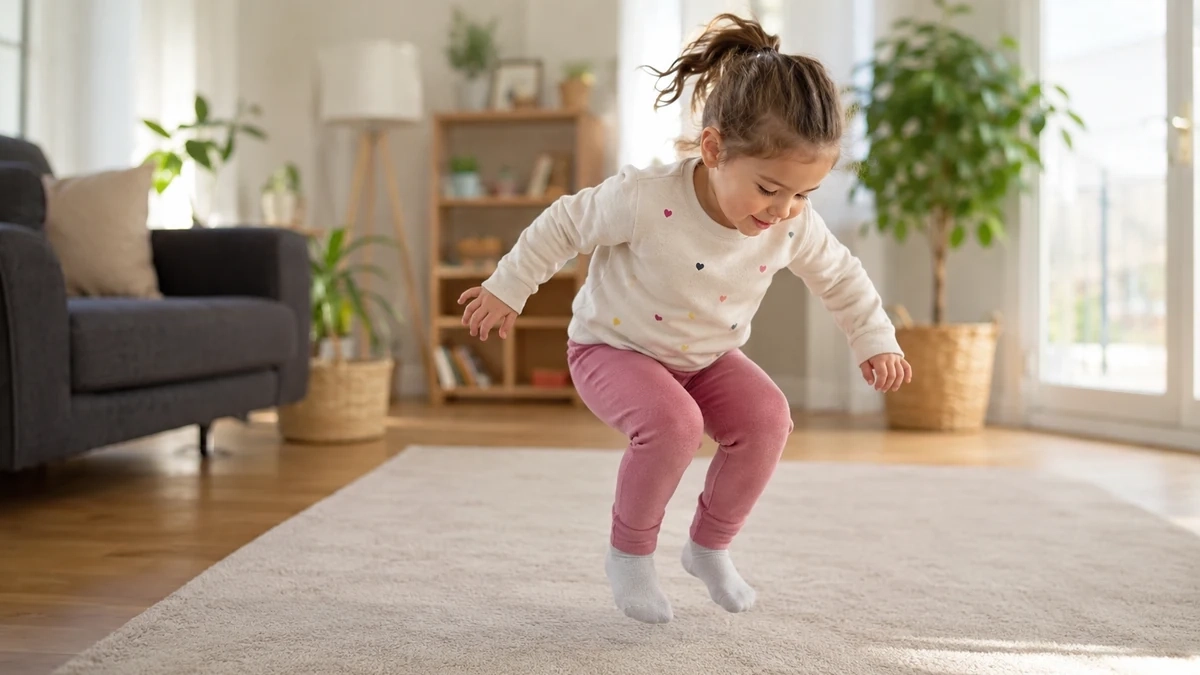
A safe landing is a quiet landing — bend the knees and absorb the bounce, and the power comes from a deep squat load and a forceful arm swing.
Key takeaways
- Jumping has two halves: the load, a deep squat with the arms swung back, and the soft landing, with bent knees and quiet feet.
- Teach the landing first. A "feather landing" that makes no thump helps kids practice the same mechanics that support safer movement habits later.
- Use one cue at a time: load, explode, land. Look up and clear the space before she jumps.
Most kids already love to jump. What they do not do naturally is land — they thud down on stiff, straight legs, and that is the part worth teaching. The good news is that a soft landing and a higher jump come from the same simple move, and you can teach it tonight in the living room.
This is the deep how-to for one skill. For the daily routine and the rest of the movement skills, head up to our hub, Teaching Movement to 4–6 Year Olds.
LudoLogic Sports is our company, Rainbow Riders is our movement series, and Coach Kenzie — the kids know her as "Stable Master Kenzie" — is the guide your child rides along with. This skill is the heart of her Episode 4 adventure, The Fire Phoenix, where a Rider teaches the Phoenix to use her "springs." Rainbow Riders builds 9 foundational movement skills across 10 adventures — the 10th adventure ties the skills together in a reaction-time obstacle course.
Quick facts
- Age: 4–6
- Skill: Vertical jump and soft landing, power and control
- Time: 8–10 minutes
- Equipment: A clear space; socks or bare feet; nothing overhead
- One cue: "Land soft and silent, like a feather."
- Safety note: Look up — no lights or ceiling fans overhead — and check her "space bubble" before jumping. Supervise young kids, stop for pain, dizziness, or distress, and consult a qualified professional for medical concerns.
What does a safe landing look like for a young child?
A safe landing is a quiet, springy one. She lands on both feet at the same time, lets her knees bend, and sinks into a little squat to absorb the bounce — no loud thump, no stiff, straight legs. In plain terms, a soft landing means catching yourself by bending, not by slamming down. Quiet feet are the goal you can actually hear.
What the research says
Bending the knees to land cushions the impact and is the safer way to come down, according to Nemours KidsHealth's guidance for parents. We teach the soft, bent-knee landing now because it builds the same mechanics that help support safer movement habits later — not because a preschooler is at risk on the carpet, but because the habit is far easier to learn early than to fix later.
How do you teach a child to jump higher and land softly, step by step?
Teach it in three cues, one at a time: load, explode, land. First practice a deep squat with the arms swung back, then the arm swing up onto tiptoes without leaving the floor, then add a jump that lands soft and silent back in the same spot. Power comes from the legs and the arm swing together.
Do it in this order:
- Safety check. Clear the space, look up for anything overhead, and check her space bubble by having her put her arms out and spin slowly.
- Draw a box. Picture an imaginary box around her feet. She will jump up and land back inside it, not fly forward.
- Load the spring. Bend the knees into a squat and swing both arms back, like getting ready to ski. "Squish the spring."
- Explode, engines only. From the load, swing the arms up fast and rise onto tiptoes — no jump yet. This teaches the arm swing that adds height.
- Jump off both feet. Put it together: load, then explode straight up off both feet at the same time.
- Feather landing. Land soft and silent, dropping right back into the squat to catch yourself. If you cannot hear it, she nailed it.
What worked in our house
My wife and I both played Division I basketball, so I will admit the lesson that finally stuck at home started as a noise complaint. My five-year-old's room sits directly above my office, and for a while my workday came with a soundtrack of thuds — her launching off the bed and crashing down on stiff legs. Something had to give, and it was not going to be her knees. So we made one rule: if you jump off the bed, you land like a marshmallow — stick it, no noise. We leaned on our own family catchphrase, "stick it," to turn it into a game, and it clicked fast once she understood that a loud landing is not a controlled one. Jumping off the bed turned out to be the most relatable way for her to practice, so we made it fun instead of forbidden.
What age can kids learn to jump and land?
Most kids can start learning a controlled two-foot jump and soft landing around ages 4–5. That is a genuine developmental window: research on children's landing control points to ages 4–5 as a turning point in how well kids absorb and control a landing. So this is a great age to teach the soft landing on purpose, while it is still forming.
The Frontiers in Psychology drop-landing study is the source for that age-related landing-control discussion.
Does this help with basketball or other sports?
Yes. The load-and-explode jump is the same move behind grabbing a rebound in basketball and blocking at the net in volleyball, and the soft, two-foot landing is how athletes come down under control in nearly every sport. Building it now means she is not learning to jump and land for the first time when a game is on the line.
To teach rebounding, a child first has to land balanced on two feet — catching the ball on the way down comes later.
Common mistakes and quick fixes
- Landing on stiff, straight legs. Fix: cue "soft and silent" — knees bend, no thump.
- Forgetting the arms. Fix: practice the arm swing on its own; it is where a lot of the height comes from.
- Drifting forward on the jump. Fix: use the imaginary box — land where she took off, on both feet.
- Skipping the look-up. Fix: always check for lights and fans overhead before jumping.
Make it an adventure
In Episode 4, The Fire Phoenix, the Captain's Challenge turns this into a game: jump up and catch the "Star Sparks" with both hands, then stick a Feather Landing inside your box on two feet. Each clean catch-and-soft-landing is 1 point, and the goal is 15 points to build the Phoenix's nest.
Watch for Stable Master Kenzie's "marshmallow!" fake-out — do not jump for the fake, only the real stars. That is a sneaky way to practice listening. Log her score in the Rider Log and she earns the Fire Phoenix trading card. Next ride: the Crystal Leviathan, who dodges and weaves through the clouds.
FAQ
Why does my child land so hard when she jumps?
Stiff, straight-legged landings are the default until kids are taught otherwise. The fix is to make softness the target: cue a quiet, "feather" landing where the knees bend to absorb the bounce. Kids pick it up fast when the goal is silence.
Is jumping on furniture okay for practice?
For structured practice, keep both feet starting and landing on the floor, in a clear space with nothing overhead. If she is going to bounce off the bed anyway, make the soft, two-foot "feather landing" the rule — but the cleanest place to build the skill is the floor.
Want this taught as a story she will ask to repeat?
The Rainbow Riders bundle includes all 10 adventures, the Rider Log workbook, and the trading cards. Try the free first episode of Rainbow Riders to see how the daily-vitamin format works, then ride along to The Fire Phoenix.
About the author
Lincoln Gunn is the Founder & CEO of LudoLogic Sports. He and his wife are both former Division I basketball players, and they are raising two young daughters. LudoLogic Sports' mission is to give every kid a better, more joyful start in sports — "build the ultimate athlete, not the elite basketball player" — using a play-based curriculum grounded in physical-literacy research. Read more on Lincoln's author page.
Sources
- Nemours KidsHealth — Knee Injuries: https://kidshealth.org/en/parents/knee-injuries.html
- Frontiers in Psychology — Children's strategies in drop-landing: https://www.frontiersin.org/journals/psychology/articles/10.3389/fpsyg.2022.982467/full