
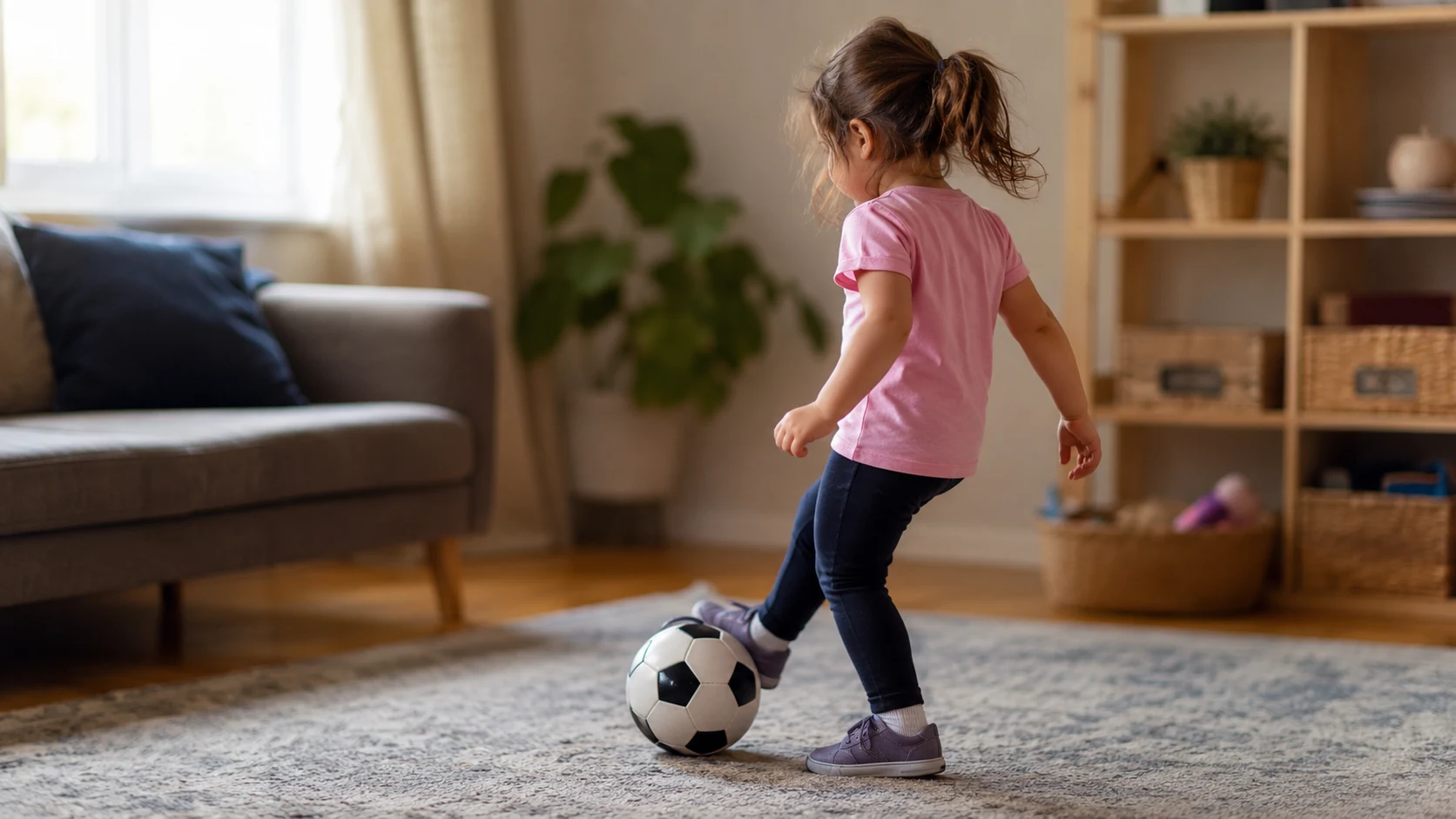
The inside of the foot is the biggest, flattest surface a child has — it's the control surface young kids should learn first, and in soccer there are no hands.
Key takeaways
- Teach the inside of the foot first: it's the largest, flattest part of the foot and gives the softest, most controlled touch.
- Soft touches keep the ball close, and a ball that stays close is a ball she controls.
- One cue is: "soft taps with the inside of your foot." Shoes off, so she can feel the ball.
The first time most kids meet a soccer ball, they wind up and boot it as hard as they can. It sails across the room, and the "skill" is over before it starts. Controlling the ball is the part that actually makes soccer fun — and it starts with one part of the foot.
This is the deep how-to for that very first touch. For where it fits in the bigger picture and the rest of the skills, head up to our hub, Teaching Soccer to 4-6 Year Olds.
LudoLogic Sports is our company, and Global Trophy Trek is our soccer partner series, where young players travel the world collecting soccer skills through playful adventures — and this touch is the heart of Episode 1, Mexico.
Quick facts
- Age: 4-6
- Skill: First touch / ball control with the inside of the foot
- Time: 8-10 minutes
- Equipment: A soccer ball or 3-4 pairs of socks rolled into a ball; a clear space; socks or bare feet
- One cue: "Soft taps with the inside of your foot."
- Safety note: Clear the space of furniture and toys, and check her "space bubble" — arms out, spin slowly, touching nothing. Supervise young kids, use soft household props when needed, stop for pain, dizziness, or distress, and consult a professional for medical concerns.
What part of the foot do you use to control the soccer ball?
You use the inside of the foot — the soft, flat edge that runs along the big toe. Press both feet together and that inner edge is the spot. In plain terms, a first touch is the gentle tap that cushions the ball and keeps it within a step of your feet, instead of sending it away. It's the most controlled surface a young child has, which is why it comes first.
What the research says
Controlling a ball is an object-control skill, and those develop later than running and jumping — reliable handling of a moving ball is more of a 6-and-up milestone, according to the Cleveland Clinic's overview of gross-motor development. That's exactly why we start with a still ball and the biggest, softest surface: we set the touch up to succeed.
How do you teach the inside-of-the-foot touch, step by step?
Teach it with a still ball, one cue, and lots of soft repetitions. Put the ball in front of her, show her the inside edge of her foot, and have her tap the ball gently from one inside foot to the other so it barely moves. Keep her hands on her hips or by her side, and count the taps together.
Do it in this order:
- Shoes off, ball still, clear space. Have her stand with the ball just in front of her toes.
- Show the surface. Press both feet together and point to the soft edge along the big toe — "this is your control spot."
- Hands on hips or by her side. This sets the no-hands rule and keeps her balanced.
- One soft tap. Tap the ball with the inside of one foot just enough to nudge it — the ball should barely move.
- Tic, tok. Tap it from the inside of one foot to the inside of the other, back and forth, soft and slow.
- Count ten together. Then challenge her to take one step while keeping the ball close.
What worked in our house
My wife and I both played Division I basketball, and the hardest habit to coach out of a little kid is "harder is better." With my five-year-old, the breakthrough was making "soft" the goal: we'd whisper "tic… tok…" and the quieter the touch, the better. Once she started to get a feel for the ball, we could start integrating more motion-based activities — the foundation was set.
What age can a kid start controlling a soccer ball?
Most kids can start learning a basic inside-of-the-foot touch around age 4, as long as the ball starts still and the touches stay small. Don't expect clean control of a rolling ball yet — that sharpens closer to 6. At 4-5, the win is simply that she can tap the ball softly and keep it near her feet.
What the research says
Early wins matter more than they look. Motor competence and a child's confidence feed each other — kids who feel capable move more, and kids who move more get more capable, as described in Stodden and colleagues' developmental model. A soft touch she can actually pull off is a small competence win that keeps her in the game.
Common mistakes and quick fixes
- Kicking with the toe. Fix: cue the inside of the foot; the toe sends the ball flying.
- Touching too hard. Fix: make "quiet and soft" the goal — the ball should barely move.
- Using hands to settle the ball. Fix: hands on hips or by her side, every rep.
- Shoes on. Fix: socks or bare feet so she can feel the ball under her foot.
Make it an adventure
In Global Trophy Trek Episode 1, Mexico, this exact touch becomes a Trophy Hunt: dribble the ball close with soft inside-foot taps and keep it at your feet so you don't "wake the Aztec Jaguar." If the ball gets away, the Jaguar stirs — a playful way to reward control over power. When she's done, you're the official referee: ask her to show you a few soft tic-toks, then log the win and unlock her Mexico Trophy card. Next stop on the Trek: Brazil.
FAQ
What's the difference between the inside of the foot and the laces?
The inside of the foot is for control and short, accurate touches; the laces, the top of the foot, are for power and longer kicks. Young kids learn control first, so the inside comes well before the laces.
My child keeps kicking the ball too hard. Is that normal?
Completely normal — little kids equate harder with better. Make softness the game: whisper the cue, celebrate the quietest touch, and keep the ball close. Control will come.
Try the first adventure
Want every touch taught for you, with a story she'll ask to repeat? Start with the free first episode of Global Trophy Trek, Mexico, to teach this touch tonight.
About the author
Lincoln Gunn is the Founder & CEO of LudoLogic Sports. He and his wife are both former Division I basketball players, and they're raising two young daughters, ages 5 and 2. LudoLogic Sports' mission is to give every kid a better, more joyful start in sports — "build the ultimate athlete, not the elite basketball player" — using a play-based curriculum grounded in physical-literacy research. Read more on Lincoln's author page.
Sources
- Cleveland Clinic — Gross Motor Skills: https://my.clevelandclinic.org/health/articles/gross-motor-skills
- Stodden et al., 2008, Quest 60(2): https://doi.org/10.1080/00336297.2008.10483582