
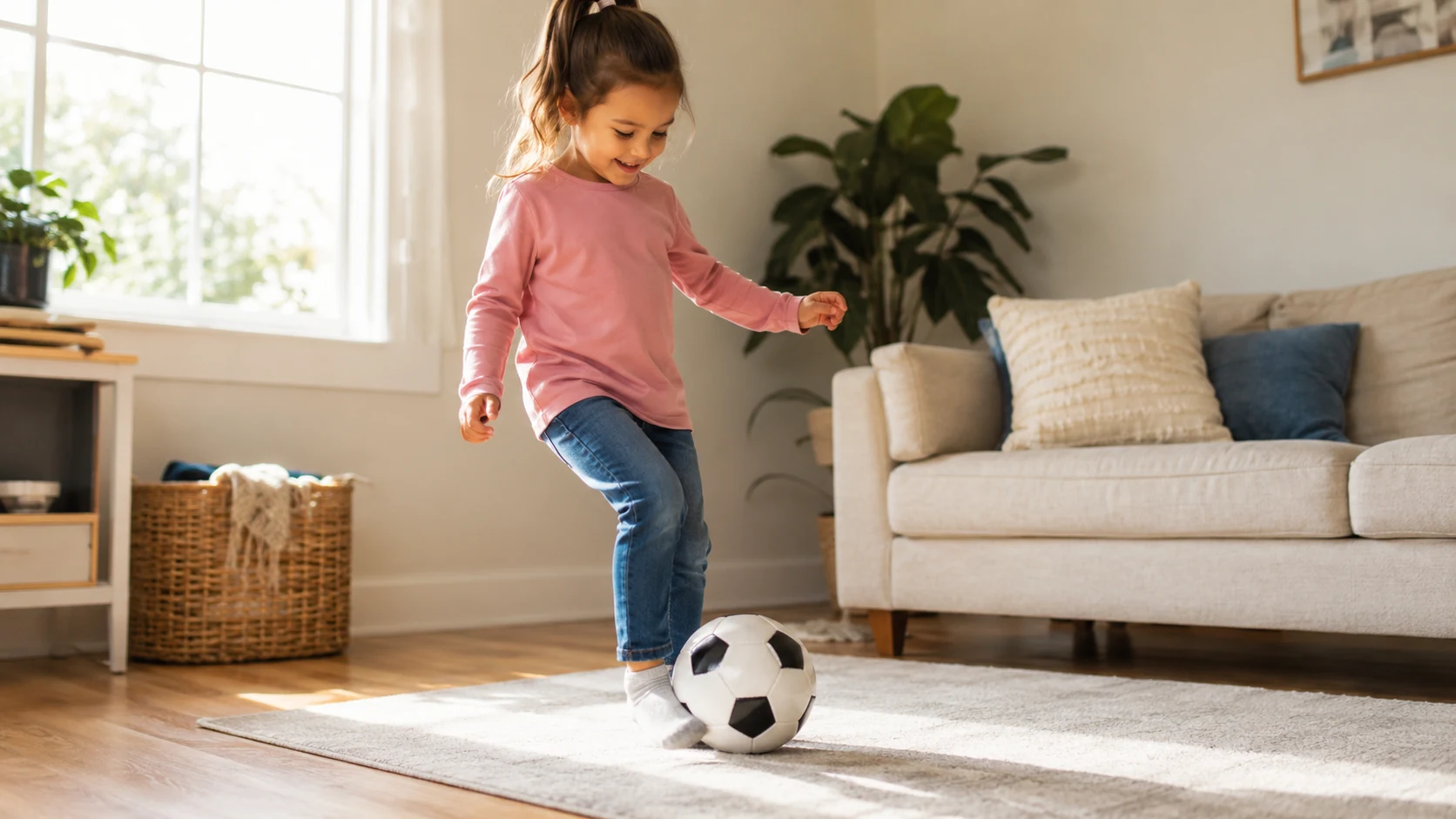
At 4-6, soccer is about touch and control in every direction — forward, backward, and sideways — not passing or shooting on goal. It asks the body and the brain to work together, which is hard at this age and exactly why it's so good for them.
Key Takeaways
- A 4-6 year old can learn real ball control: dragging the ball back, tapping it side to side, and keeping it close while moving. Passing and shooting come later.
- A short daily routine beats one long weekly session — about 10 minutes of touches at home builds more skill than a once-a-week scramble.
- Teach the skills in an order: feel the ball first with the sole and inside of the foot, then move it, then move with it.
If you've ever stood at the edge of a field watching a swarm of five-year-olds chase one ball, you already know the truth: this age isn't about plays or positions. It's about whether your child can touch the ball and keep it close and under control. Control is the word that matters at this age — that's the whole game right now, and it's very teachable at home.
This hub is the map for soccer at 4-6: what she can learn, what a good 10 minutes looks like, and the order to teach the skills. For the bigger "why start with movement, and how soccer fits the whole athletic journey" picture, start with our soccer pillar, How to Teach Soccer to Kids, by Age — this page picks up where that one leaves off. For movement-focused adventures running alongside soccer at this age, see Rainbow Riders.
LudoLogic Sports is our company, and Global Trophy Trek is our soccer series, where the Guardians travel the world collecting skills with Coach Lola, the "Big Sister" mentor, as their guide — starting in Episode 1, Mexico.
What soccer skills can a 4-6 year old actually learn?
A 4-6 year old can learn to control a still or slow-rolling ball with the sole and the inside of the foot, drag it backward, tap it gently side to side, and keep it within a step or two while walking. What they're not ready for is reliable passing to a moving target, shooting with power, or anything that depends on judging a ball in the air. In plain terms, soccer at this age is ball control in every direction — not a small game of the adult sport.
What the research says
National guidance for ages 3-5 is to reinforce a wide range of basic movement and ball skills through play rather than specialize early, according to SHAPE America's Active Start guidelines. And the object-control skills that soccer leans on develop gradually — predictable control of a moving ball is more of a 6-and-up milestone, per the Cleveland Clinic's overview of gross-motor development. So at 4-6, "control it in every direction" is exactly the right target.
What worked in our house
My wife and I both played Division I basketball, so the early instinct was to make it look like the real sport — pass, shoot, score. None of that stuck with my oldest. What did stick was simpler: we put a ball at her feet early and just let her kick it around, as young as 2. At 4 we signed her up for organized soccer with kids from her class. She was intimidated at first, but having her friends out there made all the difference — she was on the field, happy, and picking up the basics, and each season she's gotten a little better. If I could redo those first couple of years, I'd spend far less time on passing and shooting and far more on ball skills: simple dribbling and close control. That's the foundation everything else is built on.
What does a good soccer practice look like for a 5 year old at home?
A good at-home soccer practice for a 5 year old is short, daily, and barefoot: about 10 minutes of touches in a clear space, one skill at a time. Start with 60 seconds of silly warm-up, spend most of the time on a single touch, like dragging the ball back, and end with a tiny game. Shoes off, so she can feel the ball.
A simple rhythm we use, and the one Global Trophy Trek follows:
- Warm up (1-2 min): something playful to get moving — star jumps, marching knees.
- One skill (5-6 min): pick a single touch and repeat it. One cue only.
- A tiny game (2-3 min): turn the skill into a hunt or a challenge so the reps feel like playing.
- A check (1 min): have her show you the skill and tell you which part of the foot she used.
What the research says
Young kids need a lot of movement, often: the World Health Organization recommends at least 180 minutes of physical activity spread across a 3-4 year old's day, with screens kept under an hour, according to the WHO's 2019 guidance. A daily "vitamin" of touches fits that far better than one long weekly session.
What are the soccer skills to teach in order?
Teach soccer skills in the order a child's control develops: feel the ball first, then move it, then move with it. Begin with the sole of the foot, like drag backs and rolls, add the inside of the foot, like soft taps and tic-toks, then combine them to dribble in a clear space. Passing and shooting wait until the touch is reliable.
Here's the index this hub routes to:
- Inside-of-foot control — the control surface to learn first.
- Toe taps for ball familiarity and a light touch.
- Sole rolls — forward and side control with the bottom of the foot.
- Tic-toks — inside-foot taps between the feet.
- Windshield wipers — rolling the ball side to side, both feet.
How we weave it into the series
Global Trophy Trek teaches one touch per episode and gives it a story. In Episode 1, Mexico, the Guardians learn the drag back, using the sole of the foot, and the tic-tok, using the inside of the foot, then go on a Trophy Hunt to dribble the ball close without "waking the Aztec Stone Jaguar" — a kid-friendly way to practice keeping the ball under control. Every skill she earns gets logged in her Guardian Field Book and unlocks a Trophy card, so the practice feels like collecting, not drilling.
What age should kids start soccer?
Kids can start soccer skills as early as 3-4, as long as "soccer" means touches and games, not teams and scrimmages. At 4-6, the goal is comfort with the ball at her own feet. Organized small-sided play and passing usually make more sense around 6-7, once she can control a moving ball — so there's no rush, and no reason to wait to start at home.
What we believe
Our motto is "build the ultimate athlete, not the elite basketball player," and soccer at this age is one of the best foundations there is. The footwork, balance, and both-sided control she builds with a ball at her feet pays off in every sport she tries later. Start broad, keep it fun, and let competence do the confidence-building.
Common mistake and quick fixes
- Going straight to shooting on a goal. Fix: spend the first weeks on control; power is the easy part to add later.
- Letting her kick with the toe. Fix: cue the inside of the foot for soft touches; the toe sends the ball away.
- One long weekly session. Fix: trade it for 10 daily minutes — habit beats intensity at this age.
- Coaching with shoes on. Fix: socks or bare feet, so she can actually feel the ball.
Safety note
Use a clear safe space, soft household props, and close supervision for young kids. Stop for pain, dizziness, or distress. Consult a professional for medical concerns.
FAQ
How long should a 4-6 year old practice soccer?
About 10 minutes a day is plenty. Short, frequent touches build skill and keep it fun; long sessions lose a preschooler's attention and rarely add more learning.
Does my child need a real soccer ball?
No. A size-3 ball is nice once she's into it, but three or four pairs of socks rolled into a ball works perfectly for indoor touches — and it won't break a lamp.
Is it bad to start soccer at 4?
Not at all, as long as it's play-based. At 4, "soccer" is feeling the ball and keeping it close. Teams, positions, and passing can wait until she's ready for them.
Start with the first adventure
Want the whole thing mapped out for you? The Global Trophy Trek bundle includes all 5 episodes, the Guardian Field Book workbook, and the Trophy cards — a done-for-you way to teach these touches at home, one adventure at a time. Start with the free first episode of Global Trophy Trek, Mexico.
About the author
Lincoln Gunn is the Founder & CEO of LudoLogic Sports. He and his wife are both former Division I basketball players, and they're raising two young daughters, ages 5 and 2. LudoLogic Sports' mission is to give every kid a better, more joyful start in sports — "build the ultimate athlete, not the elite basketball player" — using a play-based curriculum grounded in physical-literacy research. Read more on Lincoln's author page.
Sources
- SHAPE America — Active Start guidelines, ages 3-5: https://blog.shapeamerica.org/2020/10/give-kids-an-active-start-for-a-healthier-future/
- Cleveland Clinic — Gross Motor Skills, developmental milestones: https://my.clevelandclinic.org/health/articles/gross-motor-skills
- World Health Organization — To grow up healthy, children need to sit less and play more, 2019: https://www.who.int/news/item/24-04-2019-to-grow-up-healthy-children-need-to-sit-less-and-play-more