
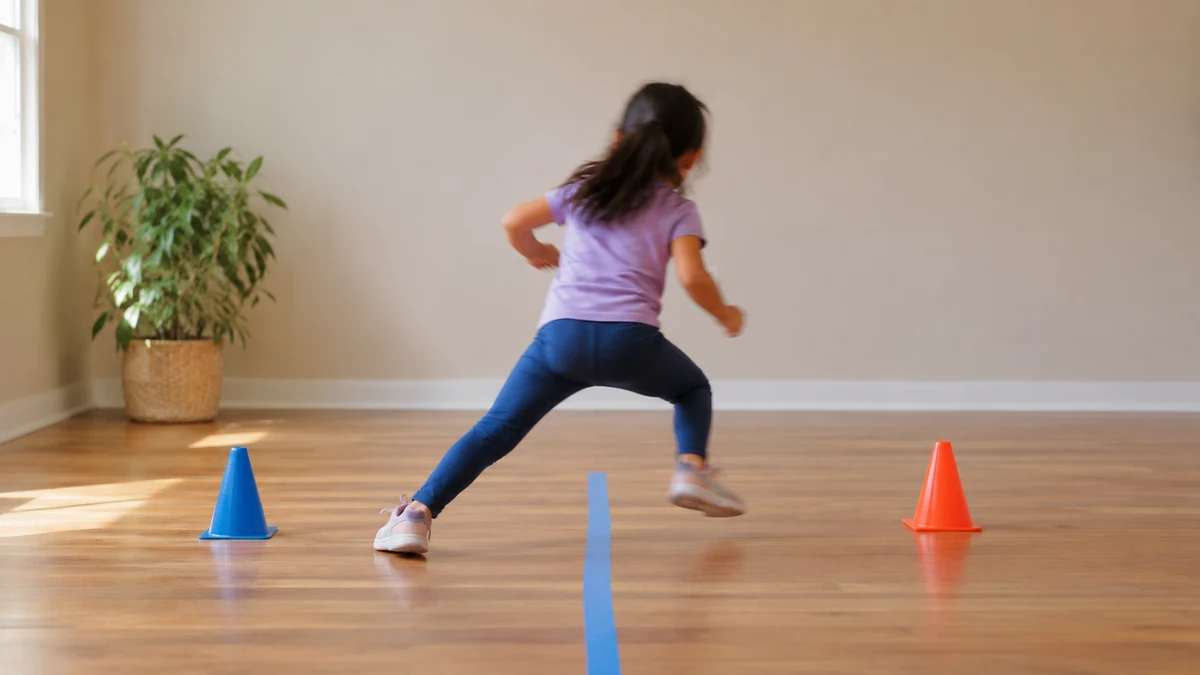
Dodging isn't a curve — it's a quick lateral push off the outside foot. Kids plant hard, then push the other way.
Key takeaways
- The whole skill is “plant and push”: stomp the outside foot out to the side, then push off it to jump back to the middle on two feet.
- Don't curve to change direction — plant and cut. Curving is slow; a hard plant is sharp and fast.
- It is a foundational agility pattern that supports cutting and evasion in games such as soccer, flag football, and tag.
Little kids often change direction by drifting. They lean, curve, and slowly arc around like a boat turning. Then they trip over their own feet or sail right past the thing they were trying to avoid. The fix isn't running faster. It is learning to stop and redirect on purpose.
That's dodging, and it comes down to one move: plant the outside foot hard, then push off it to move the other way. In plain terms, a dodge is a quick lateral plant-and-push — a child brakes with one foot stepped out wide and uses that same foot to launch back in the other direction.
For how this fits the rest of the movement week, see our daily movement guide for 4-6 year olds. This article focuses on the dodge.
LudoLogic Sports is our company, Rainbow Riders is our movement series, and Coach Kenzie — the kids know her as “Stable Master Kenzie” — is the guide your child rides along with. This skill comes from Episode 5, The Crystal Leviathan. Here is how the episode teaches it so you can run the same play at home.
Quick facts
- Age: 4-6
- Skill: Agility and evasion — dodging, plant-and-push, and cutting
- Time: 10 minutes
- Equipment: A clear floor area on both sides; two or three soft markers, such as pillows or stuffed animals; and an optional strip of tape for a centerline
- One cue: “Plant and push — jump back to the middle.”
- Safety: Clear a safe space and use only soft household props. Supervise young children. Use grippy shoes or bare feet on a clean, non-slick floor. Stop if a child has pain, dizziness, or distress, and consult a qualified professional for medical concerns.
What is dodging, and why teach the “plant and push”?
Dodging is changing direction sharply by planting the outside foot out to the side and pushing off it to move the other way — not curving around. The plant-and-push gives a child a deliberate brake and launch in one move. It is a base pattern for cutting, evading, and changing direction with control.
A gradual turn is a different skill. For that pattern, see running corners and changing direction.
What the research says: Agility, balance, and coordination are commonly treated as important parts of long-term athletic development. The NSCA article cited below also discusses a “motor skill proficiency barrier” around age eight when fundamental motor skills have not been established. That does not mean children cannot learn after eight; it supports offering frequent, playful movement practice early.
What worked in our house: For my daughter, the hard part at first wasn't the footwork. It was that she couldn't tell dodging apart from turning. She thought she was dodging when she was slowly turning her whole body.
The unlock was teaching her to plant on one foot and jump straight back to a line. We took it to the backyard with a piece of chalk. I drew a straight line about ten yards long, then chalked a square off to the side every yard or two. She had to plant her closest foot in the square and hop back to the line: “Stomp the square, and stick the landing on the line.”
That made the difference click: this is a sharp plant-and-hop, not a lazy turn. I emphasized the stomp early. As her coordination improved, she became more comfortable pushing off and moving down the line faster.
What age can kids start learning to dodge and cut?
Around ages 4 to 5 is a practical time to introduce a slow, controlled dodge. At this age, the goal is the plant — learning to brake and redirect — rather than game speed or beating a defender. Start at a walk, build to a jog, and add sharper cuts only after the movement looks balanced.
What the research says: A 2022 study of drop-landing strategies in children ages 3 to 9 suggested that a developmental change in landing performance may occur around ages 4 to 5 and that targeted practice could begin around this age. The study supports practicing balance and control; it should not be read as proof that a dodging drill prevents injury.
What worked in our house: Start at 4 or 5, but do not expect the movement to look sharp right away. We started at a walk, gradually built to a jog, and then tried a run. Going slowly also helped me see which leg she preferred, so we could practice planting on both sides.
At this age, she does not need to juke anyone. She needs a controlled plant, brake, and redirect. The faster cuts come later.
How do I teach it step by step?
Teach the dodge in short stages and use one cue throughout: “Plant and push — jump back to the middle.” Start slowly. Add speed only after the child can place the outside foot cleanly and return to a balanced two-foot landing.
- Set Home Base. Mark a center spot with a tape line or pillow. The child stands on it with two feet. This is the middle she returns to.
- Teach the plant. Keep one foot home. Step the other foot wide to the side and “stomp” it flat. That wide, firm foot is the brake.
- Add the push. Push off the planted foot to jump back to Home Base and land on two feet. Say, “Stomp and push back.” Practice both sides.
- Dodge from a jog. Jog in place at Home Base. When you point or call a side, the child plants out, pushes back to the middle on two feet, and keeps jogging. Try a few repetitions in each direction.
If she leans instead of planting, slow down and return to “stomp and stick.” A deliberate, flat plant helps separate a sharp dodge from a gradual turn.
How do you teach cutting for soccer or flag football?
Use the same plant-and-push with a game purpose: plant the outside foot and push away from an imaginary defender. Start without a ball or opponent, keep the movement slow, and return to a balanced stance between cuts. Add a ball, flag, or tag game only after the footwork is controlled.
In soccer, this is the cutting she'll use in soccer to change direction, keep the ball, or move into space. In flag football or tag, it helps her move away from someone reaching for a flag.
What we believe: We do not teach dodging so a five-year-old can “beat defenders.” At this age, it is about owning the controlled stop and redirect. That pattern appears later in soccer, flag football, tag, and everyday play.
Confidence can grow as a child becomes more competent and familiar with a movement. Repetition gives her a chance to feel steady rather than rushed.
Common mistakes and the one-line fix
- She leans or falls into the turn. Say: “Stomp and stick” — a flat foot out to the side.
- She curves around in a big arc. Say: “Sharp corner, not a circle — plant and go.”
- She forgets to come back to the middle. Say: “Two feet at Home Base before the next one.”
- Her steps are tiny or on tiptoe. Say: “Big step out; push off the whole foot.”
Make it an adventure
This skill is Episode 5 of Rainbow Riders: The Crystal Leviathan. The sky-dragon flies fast but cannot change direction, so she drifts into the crystals. Your child, the Rider, teaches her the “Lightning Dodge.”
Stable Master Kenzie warms up the steering movements first with Leviathan Lunges, fast-feet Tidal Taps, and the balancing Sea-Star. Then she builds the same plant-and-push: keep one foot at Home Base, step the other foot out and stomp, then push back to the middle.
The Captain's Challenge is Crystal Canyon. The child runs down a centerline and weaves around soft “crystals.” She scores a point when both feet return to the centerline after each dodge. There are three rounds, counting up to 15 to clear the canyon.
When Kenzie calls “fluffy cloud,” the Rider should not dodge. That surprise cue adds a simple reaction-time choice. She can log her score in the Rider Log and earn the Crystal Leviathan trading card.
Rainbow Riders builds 9 foundational movement skills across 10 adventures. The 10th adventure ties the skills together in a reaction-time obstacle course. The Leviathan's dodge is one of the nine. The next ride, the Winged Pegasus, practices leaping forward across gaps.
FAQs
My child just leans instead of planting her foot. How do I fix it?
Use “stomp and stick.” Have her place the outside foot flat and deliberately, like stamping in a puddle, before she pushes off. Leaning often means she is skipping the plant. Slow the movement down until she can hold the planted position, then add the push.
Is dodging safe for a 4-year-old's knees?
A slow, low-speed plant-and-push can be an appropriate play activity for many children, but no movement drill is risk-free. Clear the space, use soft props, supervise, and stop for pain, dizziness, or distress. Keep the goal on balance and control rather than speed. Consult a pediatric or medical professional for individual concerns.
Do I need cones or special markers?
No. Pillows, stuffed animals, or couch cushions make useful soft “crystals,” and a strip of tape can mark the centerline. Keep the area clear and make sure the floor is not slippery.
Try it with the series
If Crystal Canyon is a hit, start with the free first episode of Rainbow Riders, Stop & Brake. Then visit the Rainbow Riders series for the full set of adventures and current bundle information.
About the author
Lincoln Gunn is the Founder and CEO of LudoLogic Sports and a former Division I basketball player. He and his wife, also a former Division I athlete, are raising two daughters and building LudoLogic around a simple idea: give children a confident, joyful start in movement and sport.
Sources
- NSCA Coach — The ABCs of Long-Term Athletic Development: https://www.nsca.com/education/articles/nsca-coach/abc-of-long-term-athletic-development/
- Frontiers in Psychology (2022) — Children's strategies in drop-landing: https://www.frontiersin.org/journals/psychology/articles/10.3389/fpsyg.2022.982467/full
- Stodden, D. F., et al. (2008) — A Developmental Perspective on the Role of Motor Skill Competence in Physical Activity: An Emergent Relationship. Quest, 60(2), 290-306: https://doi.org/10.1080/00336297.2008.10483582