
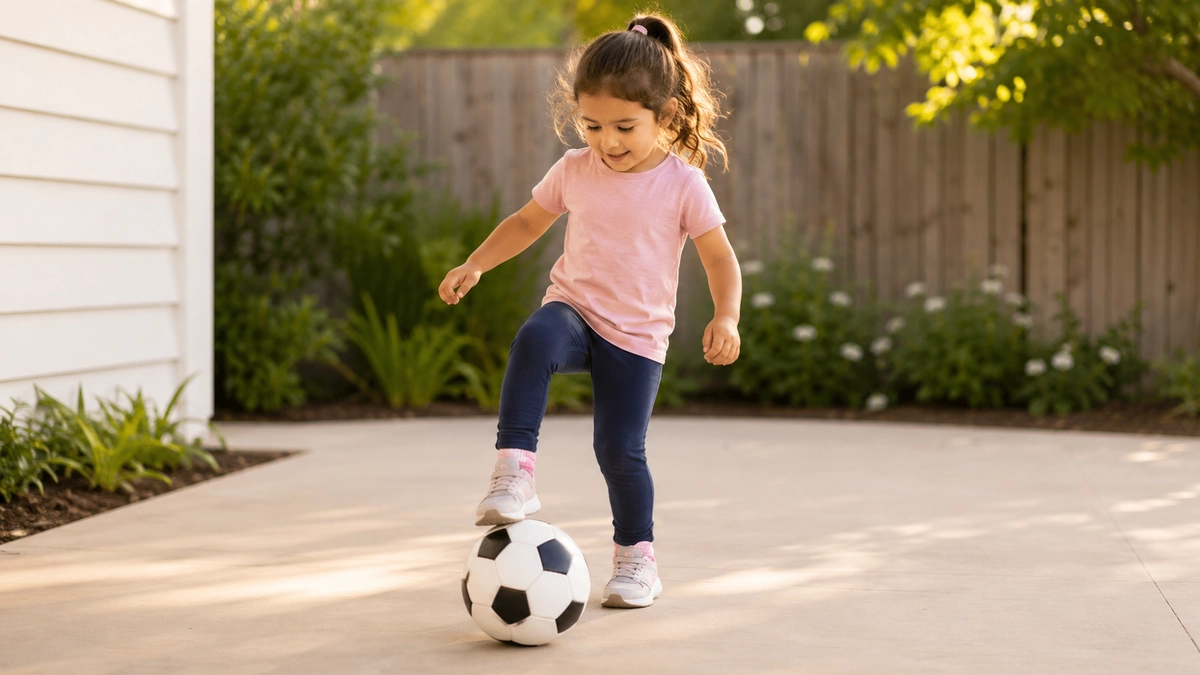
Toe taps are the best first soccer skill for a young child: light, repeated touches on top of the ball that build "ball feel" before any real dribbling starts.
Key Takeaways
- Toe taps come before dribbling. They teach a light, quick touch and a sense of where the ball is under the foot.
- The cue is "light taps on top, ball stays still." If the ball is rolling away, the touch is too hard.
- Shoes off, ball still, alternate feet. Start with ten and make a game of keeping the ball quiet.
Most kids want to wind up and blast the ball the first time it's in front of them. Toe taps flip that instinct on its head. They're slow, soft, and almost boring on purpose — and that's exactly what builds the touch every later skill is built on.
This is the deep how-to for that very first skill. For where toe taps sit in the full soccer journey and the other skills your child will learn, head up to our hub, Teaching Soccer to 4-6 Year Olds.
LudoLogic Sports is our company, and The Global Trophy Trek is our soccer series, where the Guardians travel the world collecting skills with a LudoLogic coach as their guide — and toe taps are how the Guardians cross the Amazon River in Episode 2, Brazil.
Quick Facts
- Age: 4-6
- Skill: Toe taps / ball familiarity
- Time: 2-3 minutes
- Equipment: A size 3 soccer ball, or 3-4 pairs of socks rolled into a ball; a clear space; socks or bare feet
- One cue: "Light taps on top with your toes."
- Safety note: Clear the space of furniture and toys, check her "space bubble" — arms out, spin slowly, touching nothing — supervise young kids, and stop for pain, dizziness, or distress. Consult a professional for medical concerns.
What are toe taps in soccer?
Toe taps are quick, light touches on the very top of the ball with the tips of the toes, alternating right foot and left foot while the ball stays still. In plain terms, a toe tap isn't a kick — it's a tap, like tapping a fingertip on a table. The point isn't to move the ball. It's to get comfortable touching it again and again.
What the research says
Ball skills are part of gross-motor development because they ask kids to coordinate their eyes, feet, balance, and body position all at once. Toe taps give a young child lots of small, low-pressure touches in a couple of minutes, helping the ball feel less like something to chase and more like something she can control.
Why start with ball familiarity before dribbling?
You start with ball familiarity because a child who's comfortable touching the ball will dribble sooner and with more control than one who only knows how to kick it away. Toe taps build a rhythm and a feel for where the ball is under the foot, so when dribbling comes, the ball already feels like a friend instead of something to chase.
What we believe
Kicking hard is easy and it's a dead end at this age. The kids who fall in love with soccer are the ones who feel like the ball belongs to them — and that feeling starts with hundreds of tiny, low-pressure touches, not one big boot across the yard.
What's a good first drill for a four year old?
Toe taps are the ideal first skill for a 4-year-old because the ball never moves, so there's nothing to chase and almost no way to fail. She stands over a still ball and taps the top with alternating toes. It builds touch and rhythm in a tiny space, and you can run it for two minutes in the living room.
What worked in our house
My wife and I both played Division I basketball, and ball-handling drills were the least glamorous, most important part of every practice — the stuff that built the touch you never think about in a game. With my five-year-old, the honest miss came first: I handed her a ball and she immediately punted it into the couch, thrilled. The fix was making "quiet" the whole game. We'd tap and count, and she started whispering "tippy-taps" to herself. The day she got to twenty without the ball sneaking away, you'd have thought she won a trophy.
What age can kids start soccer footwork drills?
Most kids can start simple footwork like toe taps around age 4, as long as the ball stays still and the touches stay small. Don't expect speed or a steady rhythm yet — at 4-5, the win is just tapping the top of the ball and keeping it in place. Smoother, faster taps come closer to 6.
What the research says
For 3-to-5-year-olds, the goal is daily movement play that helps build broad movement skillfulness and confidence. Toe taps fit that well: they are one small, playful soccer touch inside a bigger movement diet of running, jumping, balancing, throwing, catching, and exploring.
How do you teach toe taps step by step?
Teach it with a still ball, one cue, and a count. Stand the ball in front of her, show her the tips of her toes, and have her tap the top of the ball lightly — right toe, left toe — without letting it roll. Keep her hands on her hips and count the taps out loud together.
Do it in this order
- Shoes off, ball still, clear space. Have her stand with the ball just in front of her toes.
- Show the surface. Wiggle her toes and point to the tips — "these are your tappers."
- Hands on hips. This keeps her balanced and sets the no-hands rule.
- One light tap. Tap the top of the ball with the toes of one foot — just a touch, the ball shouldn't move.
- Switch feet. Right toe, left toe, back and forth, slow and soft.
- Count ten together. Then challenge her to beat her own number while keeping the ball quiet.
Common mistakes and quick fixes
- Stomping or kicking. Fix: cue "light," not "hard" — the ball should barely feel it.
- The ball rolls away. Fix: smaller, slower taps; reset the ball and start the count over.
- Looking down the whole time. Fix: once she's got a rhythm, ask her to sneak a peek up at you between taps.
- Shoes on. Fix: socks or bare feet so she can feel the ball under her toes.
Make it an adventure
In Episode 2, Brazil, the Guardians use toe taps to cross the Amazon River — every lily pad has to be "tested" with a few light toe taps to make sure it's safe before moving on, and the ball has to stay still so it doesn't splash and wake the sleeping river dolphin. At home, lay out a few couch cushions as lily pads: she toe-taps on each one before stepping to the next. When she makes it across, you're the official referee — ask her to show you ten toe taps, then log the win in her Guardian Field Book and unlock her Brazil Trophy card. Next stop on the Trek: France.
FAQ
How are toe taps different from dribbling?
Toe taps keep the ball still and build touch and rhythm in place; dribbling moves the ball along the ground. Toe taps come first because the feel they build is what makes dribbling controllable later.
My child gets bored of toe taps fast. Is that okay?
Totally normal — they're repetitive on purpose. Keep sessions to two or three minutes, turn it into a counting game or a lily-pad story, and stop while she still wants more. Short and fun beats long and forced.
CTA
Want every skill taught for you, with a story she'll ask to repeat? The Global Trophy Trek bundle includes all 5 episodes, the Guardian Field Book workbook, and the Trophy cards. Try the free first episode of The Global Trophy Trek (Mexico) to start building her touch tonight.
About the author
Lincoln Gunn is the Founder & CEO of LudoLogic Sports. He and his wife are both former Division I basketball players, and they're raising two young daughters (ages 5 and 2). LudoLogic Sports' mission is to give every kid a better, more joyful start in sports — "build the ultimate athlete, not the elite basketball player" — using a play-based curriculum grounded in physical-literacy research. Read more on Lincoln's author page.
Sources
- Cleveland Clinic — Gross Motor Skills (developmental milestones, object control): https://my.clevelandclinic.org/health/articles/gross-motor-skills
- SHAPE America — Active Start guidelines (ages 3-5, reinforce a wide range of skills): https://blog.shapeamerica.org/2020/10/give-kids-an-active-start-for-a-healthier-future/