
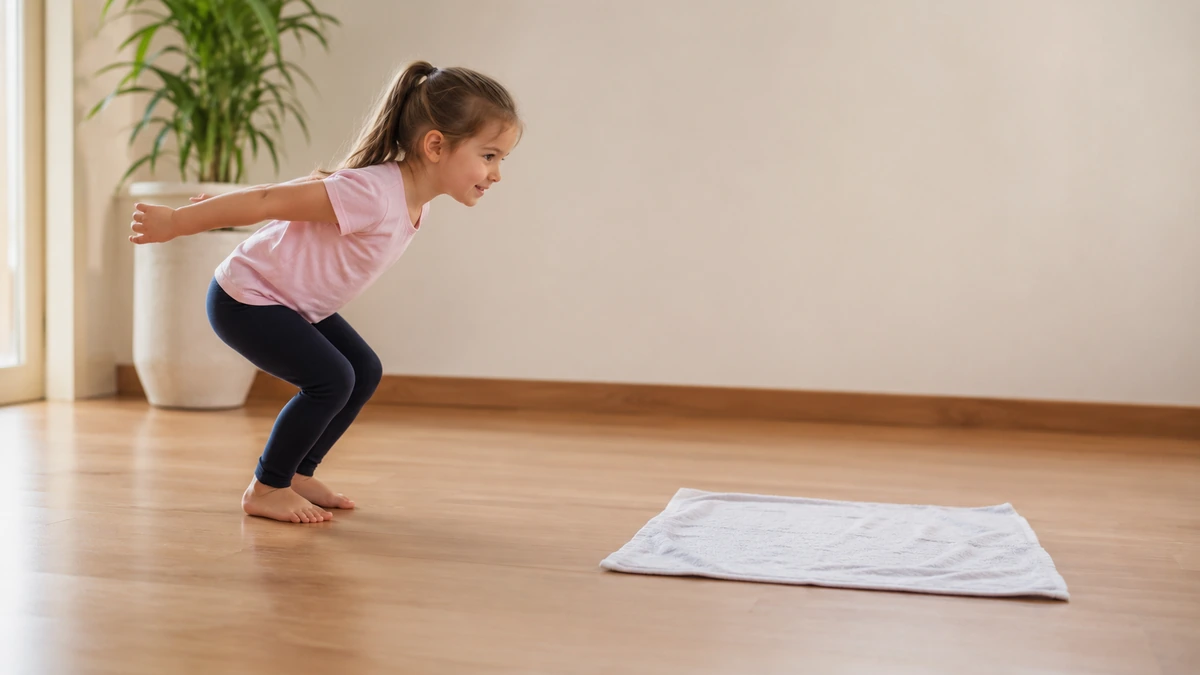
A broad jump swings the arms forward and pushes off both feet at once — arms lead, legs launch, two-foot landing.
Key takeaways
- A broad jump is a two-foot jump for distance — forward instead of up. The arms lead and the legs launch.
- The three beats are load (bend and swing the arms back), explode (both feet at once), and a soft two-foot landing.
- Landing softly, with bent knees, is the most important part — it is how she absorbs the jump and stays in control.
- It builds explosive leg power and arm-leg timing that carry into running, leaping, and many sports.
- A target can make the activity more engaging; give her a “river” to clear.
Jumping forward looks simple, but a good broad jump is a full-body skill — arms, legs, and balance all firing together in the right order. It is one of the fundamental ways a young child learns to produce and then absorb power. This is the deep how-to for that one skill. For where jumping fits in the bigger movement picture, head up to our hub, Teaching Movement to 4–6 Year Olds. For a broader look at physical literacy and readiness, read The ABCs of Movement.
LudoLogic Sports is our company, Rainbow Riders is our movement series, and Coach Kenzie — the kids know her as “Stable Master Kenzie” — is the guide your child rides along with. Rainbow Riders builds 9 foundational movement skills across 10 adventures — the 10th ties them together in a reaction-time obstacle course — and the broad jump is the hero skill of Episode 6, The Winged Pegasus, where your child teaches a horse to leap across the cloud rivers.
Quick facts
- Age: 4–6
- Skill: Broad jump / standing long jump (two-foot forward jump)
- Time: 3–4 minutes
- Equipment: A soft, flat surface with room ahead; a towel or jump rope for a “river”; a cushion for a landing “box”
- One cue: “Load, explode, and stick it soft.”
- Safety note: Clear a safe space, make sure household props are soft and stable, supervise young kids, and stop for pain, dizziness, or distress. Consult a qualified professional for medical concerns.
What is a broad jump?
A broad jump — also called a standing long jump — is a two-foot jump for distance, forward instead of up. In plain terms, your child bends her knees and swings her arms back, then swings the arms forward and pushes off both feet at the same time to launch out over the ground, landing on two feet.
The arms are not along for the ride; that forward swing is what pulls her body out and over.
What the research says
The broad jump is not a random party trick — it is one of the fundamental movement skills experts watch for. It appears as one of the tasks in PLAYfun, the physical-literacy observation tool from Sport for Life, which assesses 18 basic movement tasks across five domains. Teaching it at home means you are practicing a recognized movement building block, not just burning off a rainy afternoon.
How do I teach my child to jump forward with two feet?
Start on a soft, flat surface with plenty of room ahead. Walk her through three beats: load (feet hip-width, bend the knees, swing the arms back), explode (swing the arms forward and up as both feet leave the ground at once), and a soft, two-foot landing with bent knees. A few good jumps with a clean landing beat a dozen wild ones.
Do it in this order:
- Load the spring. Feet about hip-width apart, bend the knees into a little squat, arms swung back behind her. Cue: “Load like a spring.”
- Arms lead. Swing both arms forward and up as she jumps — the arms go first and the body follows.
- Push off both feet. Both feet leave the ground at the same time, not one and then the other.
- Stick the landing. Land on two feet with soft, bent knees. Cue: “Quiet, squishy landing.”
- Reset and repeat. Step back to the start and go again, chasing a clean landing more than a far one.
For the related stopping skill, see How to Teach Kids to Stop and Brake.
Why is the broad jump a foundational movement skill?
The broad jump trains explosive leg power, arm-leg coordination, and a balanced landing all at once. The two-foot takeoff teaches her to produce power from her legs, and the soft landing helps her practice absorbing the movement with control. That combination carries into running, leaping, and many sports that ask a body to launch and land under control.
What the research says
The landing is where the real learning is. Coming down softly on two bent knees helps a child practice absorbing the landing with control, which is why we cue “quiet, squishy landing” rather than distance, echoing the bend-your-knees guidance from Nemours KidsHealth.
Research on young children’s drop-landing control reports developmental changes around ages 4–5. A laboratory drop-landing task is not identical to an at-home broad jump, so the study should be treated as supporting context rather than a direct broad-jump benchmark.
What worked in our house
Where this really shows up in our house is every night at bedtime. As my kid gets ready, her energy spikes and she ends up jumping off her bed. So we actually taught this skill backward — the soft-landing half first — because at some point she was going to hurt herself coming down. Once she understood that the price of jumping off the bed at all was landing softly, we added the jumping part back in. From there it turned into an easy game: could she “jump off the object” and land soft, then move her takeoff a little farther back each night? When she hit a spot she could not clear, that stuck point became the opening to teach her how to “get momentum” by swinging her arms. Sometimes it is easier to build a skill backward, and this is a good example — she owned the landing before she ever chased the distance.
Safety note: This is a family anecdote, not a recommended practice setup. For teaching the skill, use a clear floor-level area rather than a bed or elevated furniture, and supervise young kids.
What sports does the broad jump help with?
Many of them. Similar “load, explode, land” coordination shows up when a track athlete clears a hurdle, when a gymnast launches off a vault, when a basketball player gathers for a layup, and any time a kid jumps for a ball. Because it trains two-footed power and controlled landing together, the broad jump is a transferable movement a young child can practice — a foundation under many later skills.
What age can a child do a broad jump?
Many 4–6-year-olds can begin learning a two-foot broad jump once they can jump and land with some control. Focus first on the two-foot takeoff and the soft landing; distance may develop as the arm swing and leg drive start syncing up. Do not worry about how far she goes yet — a clean launch off both feet and a quiet, balanced landing is the right target.
Common mistakes and quick fixes
- Stepping off one foot instead of two. Fix: cue “both feet at the exact same time” and start with tiny leaps.
- Forgetting the arms. Fix: practice just the arm swing first — “arms back, then throw them forward.”
- Landing stiff or with a big thump. Fix: cue “quiet, squishy landing” and bend the knees to catch her weight.
- Falling forward on landing. Fix: aim for a smaller jump she can actually stick, then build distance.
- Chasing distance over control. Fix: reward the clean landing, not the far one; far follows soft.
Make it an adventure
In Episode 6, The Winged Pegasus, a brave horse keeps trying to cross the “cloud rivers” by stepping over the gaps — and keeps falling in with a splash. Your child, the Rider, teaches him the “River Leap”: load, explode off two feet, and stick a soft landing in an imaginary “box” on the far side.
Coach Kenzie runs it as the Captain’s Challenge — three rounds of leaping over rivers into the box, counting every clean two-foot landing toward a goal of 15, with a sneaky “tiny puddle” fake-out round where the smart move is not to jump.
At home, you are the referee: lay a towel down as the river and a cushion as the landing box, make sure the props are stable, and count each quiet, two-footed stick. When she hits her points, log it in her Rider Log and unlock her Winged Pegasus card. Next stop: the Garden Pixie, who hops lily pad to lily pad on one foot.
FAQ
What can we use as a target at home?
Anything that gives her something to clear and land in. A rolled towel or a jump rope makes a good “river,” and a couch cushion makes a soft landing “box.” Keep the props stable and the surrounding space clear. A target can make the activity more engaging and give her something concrete to aim for.
What if she lands with a big thump every time?
Make the landing the whole game for a bit. Ask for the quietest landing she can manage and have her bend her knees to “catch” herself. A softer landing means she is practicing absorbing the jump with her legs — that is the skill that matters most.
How is a broad jump different from a regular jump?
A regular jump usually goes straight up; a broad jump goes forward for distance. That forward direction is why the arm swing matters so much — the arms pull her body out and over, not just up.
Try Rainbow Riders
Want every skill taught for you, with a story she will ask to repeat? The Rainbow Riders bundle includes all 10 episodes, the Rider Log workbook, and the collectible cards. Try the free first episode, Rainbow Riders: Stop & Brake, to start the adventure.
About the author
Lincoln Gunn is the Founder & CEO of LudoLogic Sports. He and his wife are both former Division I basketball players, and they are raising two young daughters, ages 5 and 2. LudoLogic Sports’ mission is to give every girl a better, more joyful start in sports using a play-based curriculum grounded in physical-literacy research. Read more on Lincoln’s author page.
Sources
- Sport for Life — PLAYfun observation tool: https://play.physicalliteracy.ca/play-tools/playfun/
- Nemours KidsHealth — Knee Injuries: https://kidshealth.org/en/parents/knee-injuries.html
- Frontiers in Psychology — Children’s drop-landing strategies: https://www.frontiersin.org/journals/psychology/articles/10.3389/fpsyg.2022.982467/full