
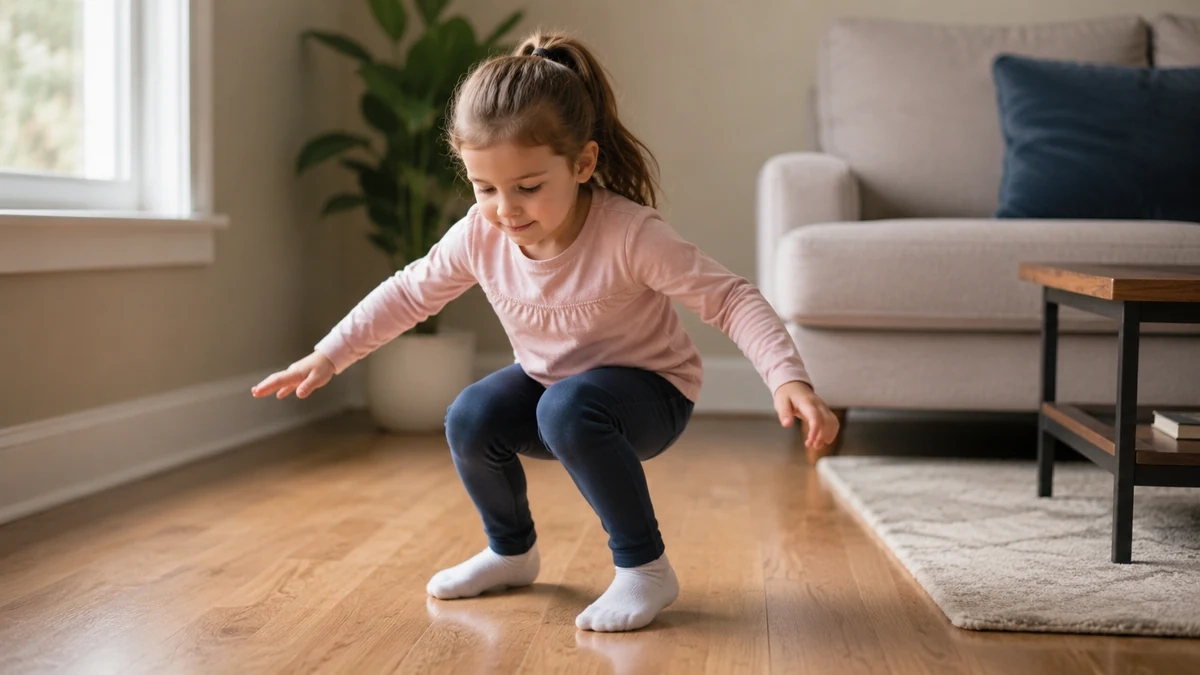
Teach stopping before anything else. Give your child one job — drop into a low, bent-knee "brake" and freeze — and one playful cue, and practice it for a few minutes a day. A child who can stop under control can more safely try every other movement skill.
Key takeaways
- Teach stopping first — a child who can stop under control can more safely try every other movement skill.
- Cue one thing at a time: "bend your knees" and a soft "brake" beat a five-step lecture.
- Reliable stopping develops in the 4–6 window — expect wobbly, all-or-nothing stops early on.
Of all the movement skills a 4–6 year old can build, this is the one to start with. Not because it's flashy — it's the opposite of flashy — but because stopping is the safety valve underneath everything else. A child who can run and then stop on command can change direction, dodge, and play without crashing into the coffee table or another kid. It's also the very first skill in our Discovery Crew sequence and the star of Rainbow Riders Episode 1, where a unicorn learns to skid to a graceful stop.
This guide is the deep dive on that one skill. For where stopping fits in the bigger movement routine, see the Movement 4–6 hub; for why movement comes before sport at all, see the Movement pillar. Here, we get specific: how to teach your child to brake.
Why teach stopping first?
What the research says
Stopping under control — deceleration — is one of the "ABCs" of athletic movement and the foundation of agility. Long-term athlete-development frameworks group it with agility, balance, and coordination as the fundamental movement skills built in early childhood. You can't change direction, cut, or dodge without first being able to slow down and stop — every quick movement in every sport begins with a brake. And the way a child stops matters: a soft, bent-knee stop absorbs force gently, while a stiff, straight-legged stop sends far more force jolting up through the body. The same soft-landing mechanics a child learns now are the ones often coached for safer movement habits during quick stops and direction changes later.
There's a confidence payoff too. A child who feels in control of her own body — who can stop herself instead of careening — plays bolder, not more timid. Control comes first; courage follows.
What we believe
Stopping is the skill everyone overlooks. Our whole approach is to teach the unglamorous basics first and build the foundation brick by brick, so a child can stack each new skill on top of a solid one — and that's what turns into real enjoyment and lasting confidence down the road. Stopping in particular translates to every sport she'll ever play: pulling up before the ball rolls out of bounds in soccer, stopping without traveling in basketball, holding up at second base in softball. Master the brake, and the whole field opens up.
I ran a version of this my whole basketball career: dribble the length of the court, jump-stop on each free-throw line and at half court. It's a standard warm-up at every level — and my AAU team used to fold the same stops into relay races to build chemistry and teamwork. The same simple skill shows up in a dozen forms, from a preschool living room all the way through a college career.
When can my child stop under control?
What the research says
The 4–6 window is the right time to start. Research on how children learn to land and decelerate points to a developmental turning point in landing control around ages 4 to 5 — meaning this is exactly when deliberate practice starts to pay off. Before that, expect wild, all-or-nothing stops or face-plants; that's normal. The goal at 4–6 isn't a crisp athletic stop on day one — it's a child who's learning to gather herself, bend her knees, and come to a balanced halt more often than not.
How to teach stop & brake at home, step by step
How we coach it
Teach the "brake" position first, standing still, then add speed one notch at a time. The whole skill lives in one shape: feet about shoulder-width apart, knees bent, weight low and slightly back, arms out for balance, eyes up. That's the brake. Here's the progression we use:
- Build the shape, no movement. Stand together and "drop into your brake" — knees bent, low, arms out, frozen. Make it a statue game. One cue: "Bend your knees."
- Walk, then freeze. Walk across the room and call "freeze!" She drops into the brake and holds it for a beat. Celebrate the hold, not the speed.
- Add a jog. Same game at a slow jog. Now she has to gather herself a step or two before she stops — that gathering is deceleration.
- Stop on a line. Put a line of tape on the floor and have her stop right at it without crossing. A target turns "stop" into a fun challenge.
- Surprise stops. Run and freeze on a random "freeze!" or when the music cuts. This is the real-world version — stopping when she didn't plan to.
One idea per session. Don't stack "bend your knees" and "arms out" and "eyes up" in the same breath — a four-year-old can hold exactly one cue at a time. Nail the bent knees first; the rest layers in over days.
Safety note: Clear a safe space before you start, use soft household props, supervise young kids, stop for pain, dizziness, or distress, and consult a professional for medical concerns.
The cues that actually land
Little kids don't run on instructions; they run on images. The cue does the teaching:
- "Freeze like a statue" — the stop itself.
- "Brake like a unicorn skidding to a stop" — gather and slow under control, and a nod to Episode 1.
- "Marshmallow knees" or "land soft" — the bent-knee absorb, not a stiff stick.
- "Show me your strong, ready position" — the athletic base, eyes up.
Pick one image per session and lean on it. The word becomes the skill.
What worked in our house
Our most reliable stopping drill is a bedtime race: "Race from my bed to yours — but you have to freeze before you touch it, or you start over." The "or you start over" is the whole trick; it forces her to plan her stop instead of crashing into the mattress, and she'll run it ten times laughing. We also practice it without ever calling it practice — on the BART train coming back from the airport, when it starts to slow, I'll say "ready position!" and she drops into a low, knees-bent stance to ride the stop without grabbing a pole. Same skill: absorb the momentum, stay balanced. Stopping is everywhere once you start looking for it.
Common mistakes and the easy fix
- Stiff, straight-legged stops. The most common one — and the one worth correcting, because bent knees make a stop more controlled and support safer movement habits. Fix: "marshmallow knees."
- Stopping on tiptoes. Tippy, not balanced. Fix: "whole foot, heavy feet."
- Eyes down. Looking at her feet tips her forward. Fix: "eyes up, look at me."
- Too much speed, too soon. A full sprint-stop before she can walk-stop just ends in a tumble. Fix: drop back a level until the shape holds.
- Coaching five things at once. Overwhelms her and kills the fun. Fix: one cue, one session.
How do I know she's got it?
She's got the foundation when she can jog and come to a balanced stop within a step or two, knees bent, without toppling forward — and when she can do it on a surprise cue, not just when she's expecting it. That's the marker that stopping has become automatic enough to build on. Once it's there, she's ready for the next skill: changing direction.
Make it an adventure
In Rainbow Riders Episode 1, your child meets the Unicorn of the Discovery Crew and learns to stop and brake through the story. After the lesson comes the "Captain's Challenge" — a gamified version that puts the skill to work — and then she logs what she learned in her Rider Log and earns the episode's trading card to keep. It's the same one-skill-at-a-time approach above, turned into a quest she'll want to repeat. For clarity: LudoLogic Sports is our company, Rainbow Riders is the video series, and the Discovery Crew are the characters your child follows through it.
Start with the free first episode of Rainbow Riders: Stop & Brake.
Frequently asked questions
What is deceleration for kids?
It's the ability to slow down and stop the body under control — bending the knees and gathering balance instead of crashing or stumbling. It's the foundation of agility and more controlled movement.
My child can't stop without falling — is that normal?
At 4–6, yes, especially early on. Controlled stopping is still developing in this window. Drop back to walking stops and build the bent-knee "brake" shape before adding speed.
How long should we practice?
A few minutes, a few times a week, mixed into play. Short and frequent beats long and forced — stop while she still wants another go.
Why does the bent-knee part matter so much?
A soft, bent-knee stop absorbs force gently; a stiff, straight-legged one jolts the body. It's the same basic mechanic kids practice for more controlled stops and turns as they get older.
Start tonight
Clear a little floor, pick one cue — "bend your knees" — and play three rounds of run-and-freeze. That's the whole lesson. When you want a guided version, begin with the free first episode of Rainbow Riders: Stop & Brake, and the full Rainbow Riders bundle adds all 10 episodes, the Rider Log workbook, and the trading cards.
About the author
Lincoln Gunn is the founder and CEO of LudoLogic Sports, a girls-first sports-learning platform that helps parents build movement and sport skills at home. A former Division I athlete and the dad of two girls — ages five and two — he field-tests most of this on the living-room floor, at the playground, and more than once on a moving BART train. LudoLogic Sports' guidance is grounded in established physical-literacy research and made practical through the Rainbow Riders series. Learn more about Lincoln.
Sources
- NSCA — The "ABCs" of Long-Term Athletic Development
- Frontiers in Psychology — Children's strategies in drop-landing
- Nemours KidsHealth — Knee Injuries
For the fuller research base behind the movement ABCs, the motor-skill proficiency barrier, and physical literacy, see the Sources list on the Movement pillar.