
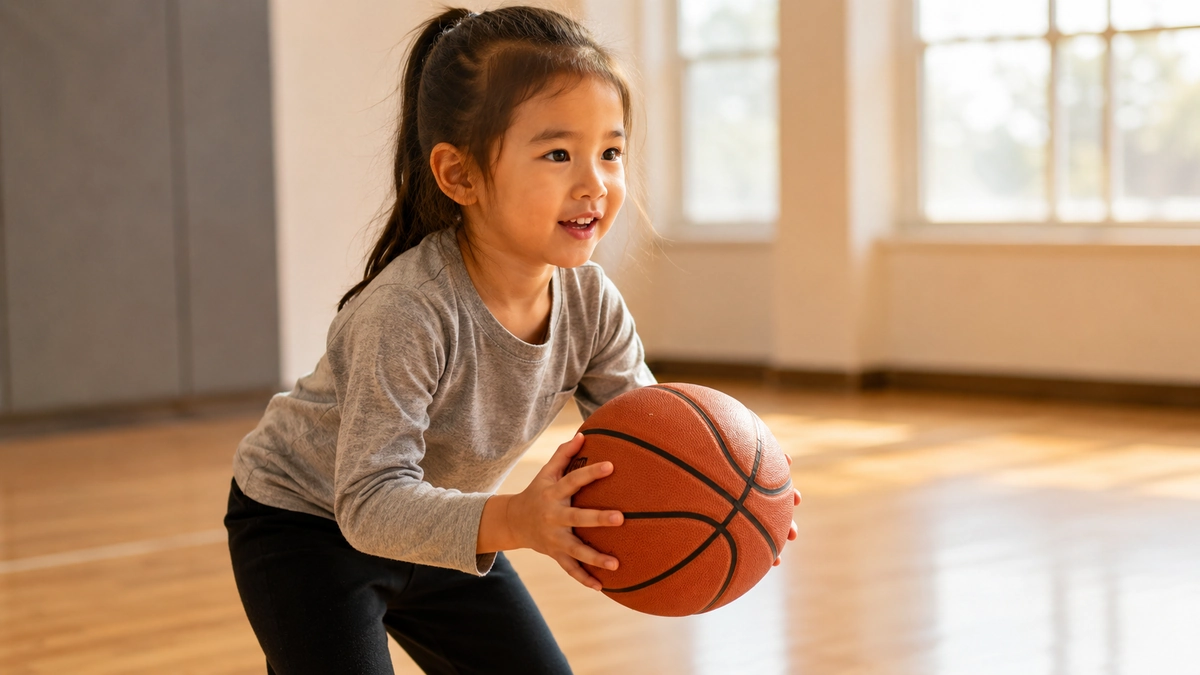
Control the ball with the fingertips, never the palms — the fingertips give little hands the touch and control a flat palm simply can't.
Key takeaways
- Teach touch before anything else: the ball rides on the finger pads, not the flat of the hand.
- A real basketball is optional — a tennis ball, sock ball, foam ball, or stuffed animal works for a 4-year-old's first reps.
- Size the ball to the hands. A full-size men's or women's ball is too much for a 4–6 year old, and that's a fun-killer.
- One cue is enough at this age: "fingertips, not palms." Master that and dribbling comes easier next.
Before your child ever dribbles, shoots, or passes, she needs one quiet skill underneath all of it: a feel for the ball in her hands. If you've landed here from our basketball age-tier hub or you're just getting started, this is the first rung on the ladder — and it's a great one to teach at home in ten minutes.
This piece belongs to Sunfield Basketball, LudoLogic's basketball series. LudoLogic is our company; in Sunfield, kids become "Guardians" and learn alongside Coach Tina and her sleepy sidekick, Scout. The fingertip-control work below is the foundation for Episode 1, "Scout's Hide-and-Seek," where kids take the next step into dribbling.
Quick facts
- Age: 4–6 (works from about 3 with a soft ball)
- Skill: Fingertip ball control (feel and grip)
- Time: 5–10 minutes
- Equipment: A junior basketball if you have one; a tennis ball, sock ball, foam ball, or stuffed animal works just as well
- One cue: "Fingertips, not palms."
- Safety note: Clear a "space bubble" — arms out, turn a slow circle, no lamps or little brothers in reach.
What does it mean to control a basketball with your fingertips?
In plain terms, fingertip control means holding and steering the ball with the soft pads of the fingers rather than the flat palm. The finger pads are covered in nerve endings, so they read the ball and adjust in tiny ways a stiff palm can't. Think of the palm as a shelf and the fingertips as ten little steering wheels.
What the research says
Ball skills are built, not born, and they arrive gradually as a child's hand-eye coordination matures through the preschool years, according to the Cleveland Clinic's overview of gross-motor development. At 4, the goal isn't a clean handle — it's exposure and touch. You're laying track, not racing on it.
Why fingertips and not palms?
Fingertips give control; palms give slaps. When the ball sits on the finger pads, your child can feel where it is and guide it. When it lands flat in the palm, it squirts away on the next bounce. This is also the exact hand position she'll use later to dribble and shoot, so teaching it now means nothing to un-teach at six or seven.
What worked in our house
My wife and I both played Division I basketball, and the fastest tell of a beginner is a palm dribble — the ball smacks the hand instead of riding the fingers. With our own daughter, we started with a tennis ball, wrapping it around her body to get her used to moving a ball around. Then it was simply squeezing the ball with her fingertips. The goal at that point was nothing more than being comfortable handling a ball and controlling it in one hand.
Find balls or objects that aren't too big. There's no way a 4–6 year old can control a men's or women's basketball, and age-appropriate gear is critical at this age to make sure it's fun and she can succeed. Building confidence in her hands is what made dribbling possible — and dribbling is where all of this leads.
What age can a child start handling a basketball?
A child can start handling a basketball as soon as she can hold one — often around age 3 with a soft ball, and comfortably by 4–6 with a junior-size ball (youth size 5 or even smaller). Reliable dribbling and catching come later; early on, aim for familiarity and fun, not performance. Match the ball to the hands: little hands need a little ball.
What the research says
National guidelines for ages 3–5 emphasize reinforcing a wide range of movement skills through active play rather than specializing or drilling for mastery, per SHAPE America's Active Start guidance. In practice: keep it short, keep it playful, and celebrate the try.
How do you teach a 4-year-old to control a basketball at home?
Start seated so your child has nothing to balance and can give the ball her full attention, then build feel with a few playful reps. Use one cue the whole time — "fingertips, not palms" — and stop while she still wants more.
- Make a space bubble. Arms out wide, turn a slow circle. No tables, lamps, or little siblings in reach.
- Pick your ball. A junior basketball is perfect; a tennis ball, sock ball, or stuffed animal is a great softer starter. Whatever she's holding is her ball for today.
- Wake up the hands. Do a few gentle two-hand "ball slaps" on top of the ball — flat hands, just to warm up her feel and get the giggles out.
- Switch to fingertips. Now spread the fingers and rest just the pads on the ball. Have her wiggle her fingertips so she can feel them touch.
- Squeeze and greet. Squeeze the ball between two sets of fingertips and "say hello," then tip it side to side, pad to pad, without letting the palms flatten onto it.
- Name it back. Ask, "Do we use our palms or our fingertips?" Let her answer out loud — saying it locks it in.
Common mistakes (and one-line fixes)
- Palms flatten onto the ball. Cue "spider hands" — fingers spread, only the pads touch.
- The ball is too big. Drop to a junior ball, a tennis ball, or a sock ball so it fits her hands.
- Too many instructions. Give the one cue and let her explore; save dribbling for the next lesson.
- Turning it into a test. If she misses, use a quick "goldfish brain" — shake it off in two seconds and try again.
Make it an adventure
Turn the fingertip practice into a quick Scout game at home: alternate a few ball slaps with fingertip squeezes on call. You call "slaps!" then "fingertips!" and your child does the reps to wake her own imaginary Scout. When she does, open her Sunfield Field Book together and check the box — that check means "I did it." A Sunfield trading card is her keepsake for the skill.
Frequently asked questions
Do we need a real basketball to start?
No. A 4-year-old's first job is feel, and a tennis ball, sock ball, foam ball, or stuffed animal is often easier because it's small, soft, or slow. Move to a junior basketball when she's ready — it should sit comfortably in her two hands.
What size basketball should a 4-year-old use?
A junior ball — youth size 5 (27.5") or smaller. Skip the full-size men's (size 7) and women's (size 6) balls entirely at this age; they're simply too big for her hands to control, and a ball she can't control turns practice into frustration fast.
How long should a practice session last?
Five to ten minutes is plenty. Short and happy beats long and frustrating at this age. Two quick sessions in a week will do more than one long one, and it keeps her asking to play again.
My child keeps slapping the ball. Is that bad?
Not at all — it's the normal starting point. Slapping just means the palm is doing the work. Cue "fingertips, not palms," drop to a softer ball, and the touch will come with reps.
Ready for the next step?
If your child can feel the ball on her fingertips, she's ready to bounce it. Watch the free first episode of Sunfield Basketball, "Scout's Hide-and-Seek", where the next step is dribbling. Then explore the Sunfield Basketball series to keep the adventure going.
About the author
Lincoln Gunn is the Founder & CEO of LudoLogic and the author of the Sunfield Basketball and Rainbow Riders curricula. He and his wife are both former Division I basketball players raising two young daughters, and his guiding motto is to "build the ultimate athlete, not the elite basketball player." LudoLogic's programs are grounded in recognized physical-literacy frameworks and pediatric developmental guidance.
Sources
- Gross-motor development and how ball skills emerge with age — Cleveland Clinic
- Active Start guidance for ages 3–5 (reinforce a wide range of skills; don't specialize) — SHAPE America
- Motor competence is linked to perceived competence and confidence — Stodden et al., 2008, Quest 60(2)