
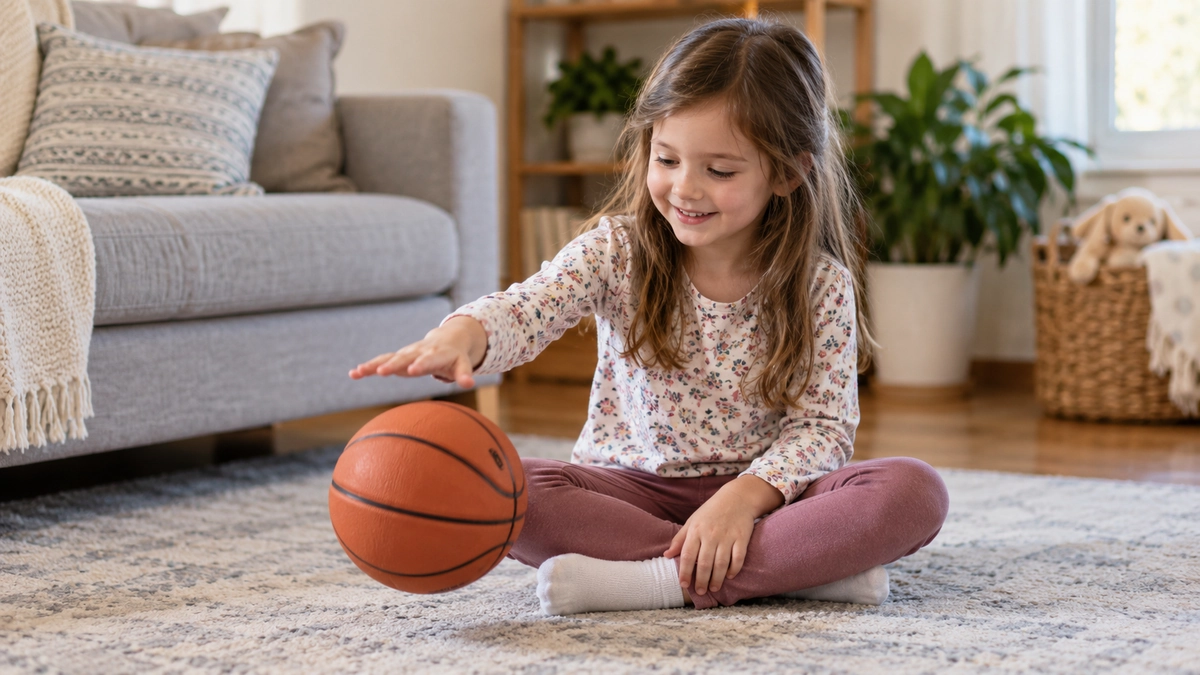
Teach dribbling stationary first — seated, then standing — using the fingertips and picking one spot on the floor to hit.
Key Takeaways
- Start on the floor. Sitting removes balance from the equation so your child succeeds on day one.
- Push, don't slap: fingertips send the ball down to one chosen spot, low and controlled.
- Expect bounce-and-catch first. Continuous dribbling takes months, not one session — a few controlled bounces is the win.
- Stay in one place. Traveling while dribbling is a big-kid skill for later — one spot is the whole job now.
Once your child can feel the ball on her fingertips, the natural next step is putting it on the floor. Dribbling looks simple, but for a preschooler it stacks three hard things at once — balance, timing, and touch. The fix is to take balance off the table first. If you're coming from our basketball age-tier hub, this is the second rung on the skill ladder.
This lesson comes straight from Sunfield Basketball, LudoLogic's basketball series. LudoLogic is our company; in Sunfield, kids become “Guardians” who learn with Coach Tina and her playful sidekick, Scout. It mirrors Episode 2, “Scout's Hide-and-Seek,” where the child learns to dribble from the ground up.
Quick Facts
- Age: 4–6
- Skill: Stationary dribble (seated → knees → standing)
- Time: 5–10 minutes
- Equipment: A junior basketball; a softer sock or foam ball is even easier to start because it bounces low and gentle
- One cue: “Push it to your spot.”
- Safety note: Clear a safe space bubble; dribble in one place, no walking yet. Supervise young kids, use soft household props where helpful, stop for pain, dizziness, or distress, and consult a professional for medical concerns.
What Is a Stationary Dribble?
In plain terms, a stationary dribble is bouncing the ball in one place with the fingertips — pushing it down to a spot on the floor and catching it as it comes back up, without walking. “Push, catch. Push, catch,” low and controlled. It's the foundation every other dribble is built on, and it's the version a preschooler can actually master.
What the research says
Coordinated ball skills like dribbling develop gradually across the preschool years as hand-eye timing matures, per the Cleveland Clinic's overview of gross-motor milestones. Translation for a 4-year-old: a few controlled bounces in a row is a real win, not a warm-up.
Why Start Seated Instead of Standing?
Start seated because it removes balance from the equation so your child can put all of her attention on her hand and the ball. Standing asks a preschooler to balance, aim, and time the bounce all at once. Sitting cross-legged deletes the hardest of those, hand-and-ball control comes first, and standing is added once it's easy.
What Worked in Our House
Dribbling took us a long time, and I want to be honest about that, because none of the progression below happened in a week. We built to it. We started with bouncing and catching on the floor, then came up to our knees, and only later stood up at waist height. For a good while it was all bounce-and-catch, one at a time — not continuous dribbles at all. If you're expecting a real handle after a few sessions, you'll think something has gone wrong. Nothing has.
The one thing that changed our pace was an indoor basketball. It's easy for small hands to control, it's forgiving indoors, and she had a blast with it — which meant she practiced on ordinary days, inside, without any of it becoming a project. Her coordination came along with the fun. If you're serious about getting your child dribbling and enjoying it, that's the one piece of gear I'd actually go buy.
How Do You Teach a Preschooler to Dribble Step by Step?
Teach it from the ground up in one continuous progression: seated, then up on the knees, then standing — same fingertips, same gentle push, same chosen spot the whole way. Keep the bounce low (about waist height when standing) and stay in one place.
- Make a space bubble and sit down. Cross-legged on the floor, ball in her lap.
- Fingertips, not palms. Spread the fingers; only the pads touch the ball.
- Pick a spot. A fuzzy patch on the rug, a tile, or an imagined X right in front of her. Every bounce goes there.
- Push, don't slap. Push the ball down to the spot and catch it softly as it comes up. “Push, catch. Push, catch.” Low and gentle.
- Come up to your knees. Same push, same spot, just a little taller. A few controlled bounces here.
- Stand up over your spot. Now the ball bounces to about her waist. Push down, catch, stay right there — no walking yet.
- Shake off misses. If the ball runs away, “goldfish brain” — forget it in two seconds and try again.
Common Mistakes (and One-Line Fixes)
- Slapping the ball hard. Cue “push it down, don't hit it” so it stays low and controlled.
- No target. Have her pick a spot on the floor; aiming steadies the whole motion.
- Standing too soon. Drop back to knees or seated — success first, height later.
- Walking while bouncing. Remind her it's a “stay in one place” day; traveling comes when she's older.
- Rushing to continuous dribbles. Bounce-and-catch is the stage, not a failure to reach the real thing.
Make It an Adventure
In Episode 2, Scout is hiding in the Sunfield bushes, and the only way to find him is to “knock” by dribbling. Coach Tina's Captain's Challenge is three knocks: each good dribble streak to your spot — sitting or standing, the child's choice — rustles a bush a little more, until Scout pops out laughing. Set it up at home with a pillow or laundry basket as the “bush,” and let your child knock Scout out of hiding. Then open the Sunfield Field Book together and check the box: “Did you find Scout by dribbling to your spot?” A checked box means “I did it,” and a Sunfield trading card marks the skill.
Frequently Asked Questions
What age can a child start dribbling a basketball?
Most children can start a seated, stationary dribble around 4, and a standing one in place by 5–6. Reliable dribbling while walking or running comes years later. Early on, a few controlled bounces to a spot is the goal — not a real handle.
How long does it take a preschooler to learn to dribble?
Longer than most parents expect — usually months of short, occasional practice rather than a handful of sessions. Early on it's bounce-and-catch, one bounce at a time, and that is the right stage to be in. Continuous dribbling shows up on its own once the fingertip touch and the aim are steady.
Should we use a real basketball or something softer?
A softer ball — a sock ball or foam ball — is a great starter because it bounces low and gentle, which makes the seated dribble easier. A junior basketball works too; just make sure it fits comfortably in her two hands.
How is this different from just bouncing the ball?
Bouncing is random; dribbling has a target and a touch. The two cues — fingertips and “push to your spot” — turn a wild bounce into a controlled one she can repeat, which is what makes it a skill she can build on.
Ready for the Next Step?
If your child can string a few seated bounces together, she's dribbling. Watch the free first episode of Sunfield Basketball (“Wake Up Scout”) to lock in her fingertip touch, then grab the Basketball bundle — five episodes, the Field Book workbook, and the collectible cards — to keep the skill ladder going.
About the Author
Lincoln Gunn is the Founder & CEO of LudoLogic and the author of the Sunfield Basketball and Rainbow Riders curricula. He and his wife are both former Division I basketball players raising two young daughters, and his guiding motto is to “build the ultimate athlete, not the elite basketball player.” LudoLogic's programs are grounded in recognized physical-literacy frameworks and pediatric developmental guidance.
Sources
- Gross-motor milestones and how coordinated ball skills emerge with age — Cleveland Clinic
- Motor competence is linked to perceived competence and confidence — Stodden et al., 2008, Quest 60(2)
- Active Start guidance for ages 3–5 (reinforce a wide range of skills through play; don't specialize) — SHAPE America