
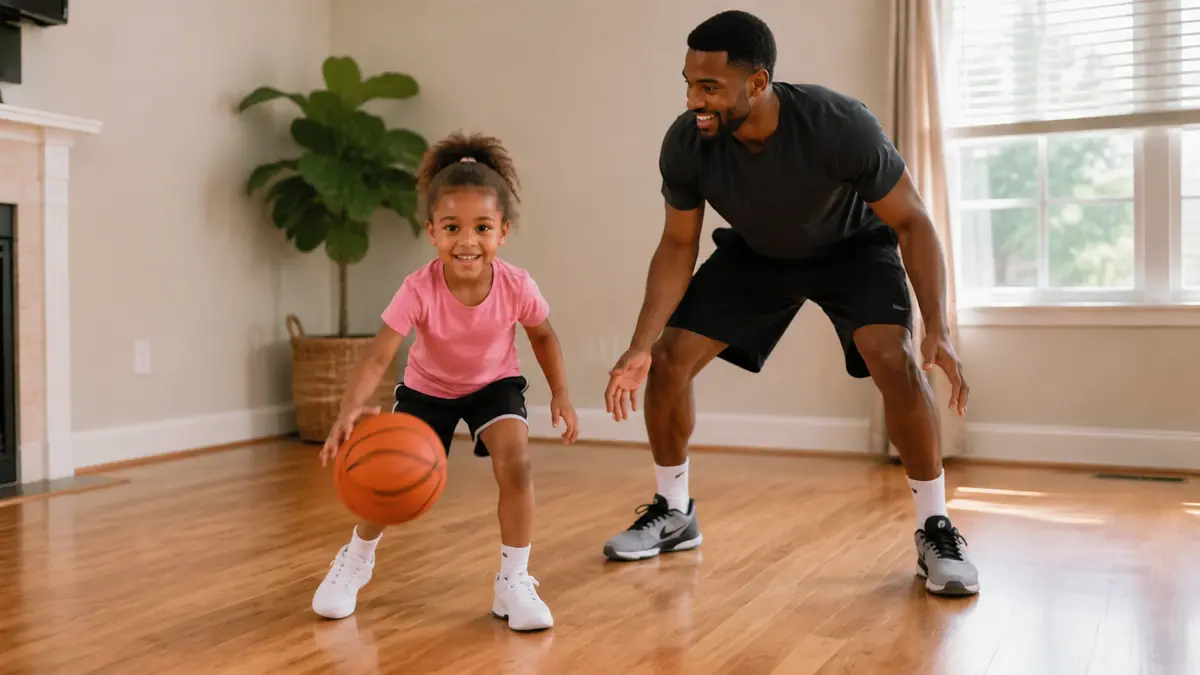
At 4–6, basketball is a handful of handling and body-control skills built in short daily doses—a 10–15 minute “vitamin” of play beats one long weekly practice.
Key takeaways
- Five skills fit this age: fingertip control, stationary dribbling, the jump-stop, passing as a “send,” and shooting with the legs.
- A “daily vitamin” of 10–15 minutes beats one long weekly session for building skills at this age.
- Don’t drill catching yet—send the ball to a target instead, and let real catching come around 7–8.
- Work in agility moves—jumping, hopping, running, stopping, and sliding—since those transfer directly to basketball.
So your child loves the ball and you’re ready to help—this is your map. Below is the short list of basketball skills a 4–6 year old can actually learn, a simple daily routine to build them, and the one rule that saves everyone a lot of frustration: at this age, we don’t catch, we “send.”
For the bigger by-age picture—how basketball skills evolve from 4 to 11 and why we teach movement first—see How to Teach Basketball to Kids, by Age. This hub is the launch pad to each individual skill.
This is the home for the 4–6 tier of Sunfield Basketball, LudoLogic Sports’ basketball series. In Sunfield, kids become “Guardians” and learn with Coach Tina and her sidekick, Scout, across five episodes.
What basketball skills can a 4–6 year old learn?
A 4–6 year old can learn five foundational basketball skills: controlling the ball on the fingertips, dribbling in one place, stopping under control with the jump-stop, passing the ball as a “send” to a target, and a basic shot powered by the legs. These are handling and body-control skills—the base every later basketball skill is built on.
Here’s the skill index, in the order we teach them. Each links to its own step-by-step guide:
- Fingertip control. The ball rides on the finger pads, not the palm—the very first skill. See Teaching a 4-Year-Old to Control a Basketball.
- Stationary dribble. Seated first, then standing, pushing the ball to one spot. See How to Teach a Preschooler to Dribble.
- Jump-stop and triple threat. Stopping balanced on two feet and holding a ready position. See Jump-Stop & Triple Threat for Little Kids.
- Passing as a “send.” Rolling or bouncing the ball to a target instead of a live chest pass. See Why Your Young Child Can’t Catch Yet—Teach Passing as a SEND.
- Shooting with the legs. Power comes from bending and lifting the legs, not the arms. See Teaching Kids to Shoot: The BLESH Method.
What the research says
These early ball skills track with normal gross-motor development, which unfolds gradually across the preschool years. A few controlled reps of any one of them is a genuine win at this age—you’re planting track, not racing. See Cleveland Clinic’s gross-motor overview.
What’s a good daily basketball routine for a young child?
A good routine is short, daily, and playful: about 10–15 minutes built from a quick warm-up, one skill focus, and a mini “challenge” to end on a win. Frequent short sessions build skill and habit far better than one long weekly practice, and they keep a preschooler eager instead of worn out.
A simple at-home structure:
- Warm up—2 minutes. Silly, no-ball movement—bouncy hops, big arm circles, a few “airplane wings” balances, and squats to warm up our “load and explode.”
- One skill—5–8 minutes. Pick a single skill from the index above and use its one cue. Don’t stack skills in one session.
- A mini challenge—2–3 minutes. Turn it into a game—a “dribble streak” or “hit the target three times.”
What the research says
Young children need lots of active play spread across the day—global guidance calls for around 180 minutes of activity daily for this age group. A daily basketball “vitamin” is a fun, easy way to bank a slice of that. See World Health Organization guidance.
Safety note
Use a clear safe space and soft household props. Supervise young kids, stop for pain, dizziness, or distress, and consult a professional for medical concerns.
Why do we teach passing as a “send” instead of catching?
We teach passing as a “send” because reliable catching typically doesn’t arrive until about 7–8—the “Catch Gate”—so a 4–6 year old’s hands aren’t ready to track and grab a ball flying at her. Instead of a live chest pass, she rolls or bounces the ball to a target. She gets all the aim and touch, and none of the fumbling that makes kids feel like they’re bad at it.
What worked in our house
We started with basic ball control—and we started with a tennis ball, wrapping it around our body (head, waist, legs) like a mummy. That got us familiar with handling the ball. We then graduated to small up-and-down tosses, catching with two hands or passing back and forth between hands. It wasn’t until she was comfortable handling the ball that she started to actually dribble.
Dribbling started on the floor, picking a spot; then we graduated to our knees, and finally to standing. The best investment we made was a “silent” quiet, low-bounce basketball—by age 5 she could do 100+ dribbles in a row! It needs to be a gradual progression.
Common mistakes and one-line fixes
- Stacking skills in one session. Pick one skill and one cue; save the rest for tomorrow.
- Live chest passes too early. Send the ball to a target until catching is reliable around 7–8.
- Making it a long practice. Cap it near 10–15 minutes and end on a win.
- Full-size ball. Use a junior ball, or a soft ball for the earliest reps.
Frequently asked questions
How many days a week should we practice?
A little most days beats a lot once a week. Even three or four 10-minute sessions a week will build real skill at this age, and the short format keeps it feeling like play rather than practice.
Do we need a hoop for these skills?
Not for the first four. Fingertip control, dribbling, the jump-stop, and sending passes all happen without a hoop. Bring a lowered hoop in for the shooting skill, and even then the focus is leg-driven form, not making baskets.
What if my child can’t do a skill yet?
That’s normal and fine—these emerge on each child’s own timeline. Drop to an easier version (seated instead of standing, a softer ball, a wall or chair for balance), keep it playful, and the skill will come with reps.
Ready to start the skills?
Watch the free first episode of Sunfield Basketball, “Wake Up Scout,” with your child, then pick a skill above and try it today. The Sunfield Basketball series—five episodes, the Field Book workbook, and the collectible cards—walks you through the whole set in order.
About the author
Lincoln Gunn is the Founder & CEO of LudoLogic Sports and the author of the Sunfield Basketball and Rainbow Riders curricula. He and his wife are both former Division I basketball players raising two young daughters, and his guiding motto is to “build the ultimate athlete, not the elite basketball player.” LudoLogic Sports’ programs are grounded in recognized physical-literacy frameworks and pediatric developmental guidance.
Sources
- Gross-motor development and how ball skills emerge with age—Cleveland Clinic: https://my.clevelandclinic.org/health/articles/gross-motor-skills
- Physical activity guidance for young children—World Health Organization, 2019: https://www.who.int/news/item/24-04-2019-to-grow-up-healthy-children-need-to-sit-less-and-play-more
- Motor competence, perceived competence, and confidence—Stodden et al., 2008, Quest 60(2): https://doi.org/10.1080/00336297.2008.10483582