
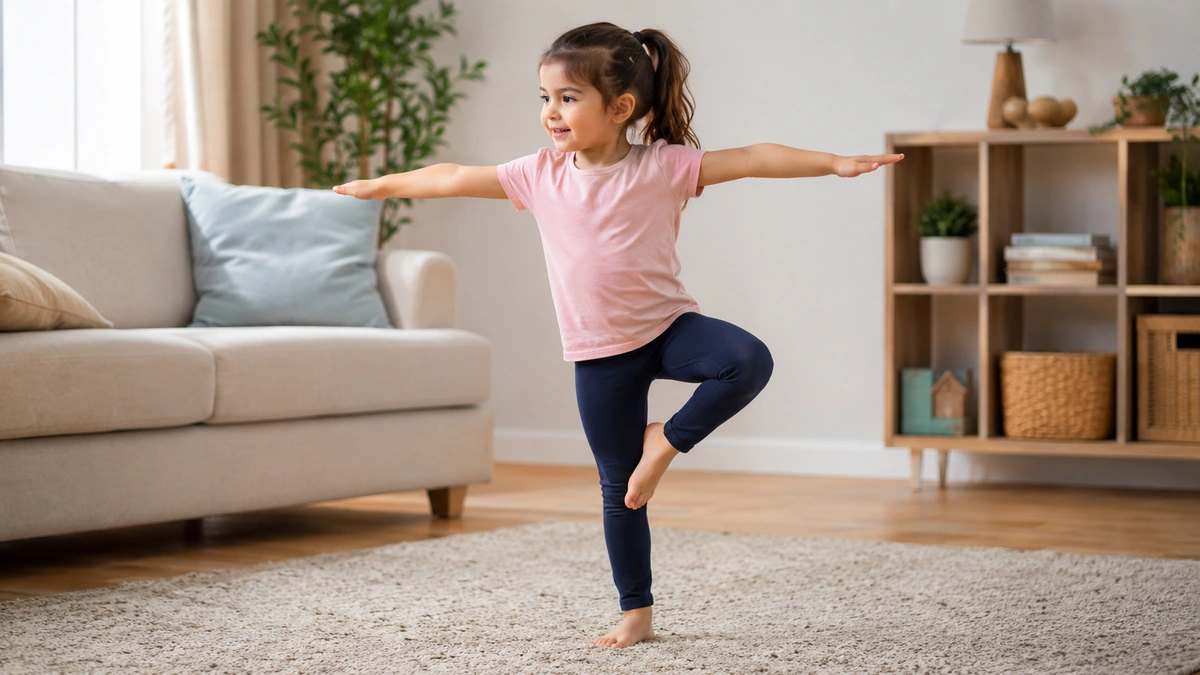
A "daily vitamin" of 10–15 minutes of structured movement beats one long weekly session for building habits at this age. Frequency, not duration, is what builds skills — and a love of moving — in a 4–6 year old.
Key takeaways
- A 10–15 minute daily "vitamin" of structured movement beats one long weekly session at this age.
- Start with stopping & braking, then work through the rest of the foundational skills one at a time.
- Rainbow Riders builds 9 foundational movement skills across 10 adventures — the 10th ties them together in a reaction-time obstacle course.
You don't need a gym, a coach, or a free Saturday to raise a confident little mover. You need about ten minutes, a clear patch of floor, and a plan for what to practice. The trouble most parents hit isn't motivation — it's the blank page: once your preschooler is bouncing off the walls, what exactly do you do with her?
This hub is your answer. It lays out the foundational movement skills a 4–6 year old should build, a simple daily routine to build them, and the Discovery Crew adventures that turn each one into a game.
(Quick note on names: LudoLogic Sports is our company, Rainbow Riders is the video series, and the Discovery Crew are the characters your child follows through it.)
How do I know what to work on? Start with PLAYfun.
What the research says
You don't have to guess at what "good movement" looks like — there's an established framework for it. PLAYfun, developed by Sport for Life, is a recognized tool for observing a child's physical literacy rather than guessing at it: a trained assessor watches a child perform 18 fundamental tasks and rates each from Initial to Proficient. PLAYfun sorts those tasks into five domains — running, locomotor, object control (upper body), object control (lower body), and balance, stability & body control.
For 4–6 year olds, three of those domains do most of the heavy lifting: running, locomotor, and balance/stability. Object control — catching, dribbling, kicking with intent — leans on skills that mostly arrive later, which is exactly why our soccer and basketball series pick those up down the road. At the movement stage, the job is to build a deep base in the three domains a preschooler is actually ready for.
How we weave it into the series
We chose PLAYfun deliberately: its tasks span the full range of a young child's physical abilities, so mapping our episodes to it means nothing important slips through. Each PLAYfun task lives in one of our episodes — deceleration, cornering, jumping, hopping — and we weave in a few skills the framework leaves out but we think matter, like moving backward with control and getting up safely after a fall.
Every episode teaches one task in plain, age-appropriate language aimed at the child, not the parent. Once she's got it, we hand her the "Captain's Challenge" — a gamified version that puts the skill to work. After the episode, she logs what she learned in her "Rider Log," which connects the physical skill to the cognitive layer and helps it stick. Then she earns the episode's trading card to keep, a reminder of the skill and the animal she "taught" it to.
What movement skills should a 4–6 year old work on?
At this age the goal is a broad base, not a specialty. Rainbow Riders builds 9 foundational movement skills across 10 adventures — the 10th ties them together in a reaction-time obstacle course. Each foundational skill is a building block that later transfers straight onto the field:
- Stop & brake (deceleration) — stopping under control without falling. Episode 1 — The Unicorn →
- Change direction / run corners (agility) — turning quickly while running. Episode 2 — The Storm Dragon →
- Side shuffle (lateral movement) — moving side to side, the base of defense in every sport. Episode 3 — The Golden Griffin →
- Jump & land softly (vertical power) — a soft, bent-knee landing. Episode 4 — The Fire Phoenix →
- Dodge & weave (evasion) — a quick lateral push off the outside foot. Episode 5 — The Crystal Leviathan →
- Broad jump (forward power) — a two-foot jump for distance. Episode 6 — The Winged Pegasus →
- Single-leg balance & hop — steadying on one foot. Episode 7 — The Garden Pixie →
- Move backward safely (spatial awareness) — stepping back while looking. Episode 8 — The Shadow Cat →
- Drop & pop back up (recovery) — a controlled drop and quick recovery. Episode 9 — The Cosmic Owl →
The 10th adventure — Episode 10 — The Rainbow Master, the reaction-time obstacle course — ties the other nine together. Start anywhere, but most families begin with stopping and braking, because a child who can stop with control can practice safer movement habits in almost any play setting.
How much movement does a preschooler need a day?
- What the research says: the WHO recommends children ages 3–4 get at least 180 minutes of activity across the day, including 60 minutes of more energetic play, and under an hour of sedentary screen time — but almost all of that is everyday free play, not drills.
- What worked in our house: ten focused minutes most days, anchored to a moment that already happens. Consistency beats duration — the daily vitamin is about building the habit, not hitting a number.
How do I make daily movement fun?
Turn the skill into a story. "Practice stopping" gets one half-hearted try; "freeze like a statue the second the music stops" gets ten. A few reliable tricks:
- Use imagination. A child "braking like a unicorn skidding to a stop" is learning deceleration without knowing the word.
- Give one cue, not five. "Bend your knees" is something a four-year-old can hold.
- Celebrate the wobble. Falling and missing is how balance gets built. Never compare her to another kid.
- Keep props simple and safe. Rolled socks, a soft ball, a line of tape, a pillow to leap. Clear a "space bubble" first.
- Warm up with a coloring or workbook page. It gets her cognitive gears turning and builds excitement for the skill ahead.
- Stop while she still wants more.
Safety note: clear a safe space, use soft household props, supervise young kids, stop for pain, dizziness, or distress, and consult a professional for medical concerns.
Meet the Discovery Crew
Each Rainbow Riders adventure pairs a movement skill with a character and a mission, led by a relatable "Big Sister" mentor — Coach Kenzie — rather than a cartoon mascot. That's deliberate: at this age, a real role model a girl wants to become drives connection in a way a cartoon can't, and it's what keeps her coming back to the next skill. The Crew turns the 9 foundational skills into 10 short adventures your child can follow along with at home.
Start with the free first episode of Rainbow Riders (Stop & Brake).
Frequently asked questions
How long should each session be?
About 10–15 minutes of structured practice, a few times a week, on top of everyday free play. Short and frequent wins.
Where do I start?
With stopping and braking. A child who can stop under control can practice safer movement habits as she tries every other skill — and it's an easy, satisfying first win.
What if she loses interest halfway through?
That's your cue to stop. Ending on a high note protects her appetite for tomorrow.
Is this just for girls?
The brand is built girls-first and our launch focus is girls 4–6, but every skill here is foundational movement that benefits any young child.
Start tonight
Pick one skill, watch the matching adventure together, and spend ten minutes trying it on the living-room floor. Begin with the free first episode of Rainbow Riders (Stop & Brake) — and when you're ready, the full Rainbow Riders series adds all 10 episodes, the Rider Log workbook, and the trading cards.
About the author
Lincoln Gunn is the founder and CEO of LudoLogic Sports, a girls-first sports-learning platform that helps parents build movement and sport skills at home. A former Division I athlete and the dad of two girls — ages five and two — he field-tests most of this on the living-room floor, at the playground, and in the few minutes before bath time. LudoLogic Sports' guidance is grounded in established physical-literacy research and made practical through the Rainbow Riders series. Learn more about Lincoln.
Sources
- Sport for Life — PLAYfun (Physical Literacy Assessment for Youth): 18 tasks across five movement domains
- World Health Organization — physical activity guidelines for under-5s (180 minutes/day; less than 1 hour sedentary screen time)
For the fuller research base behind the movement ABCs, the motor-skill proficiency barrier, and physical literacy, see the Sources list on the Movement pillar.