
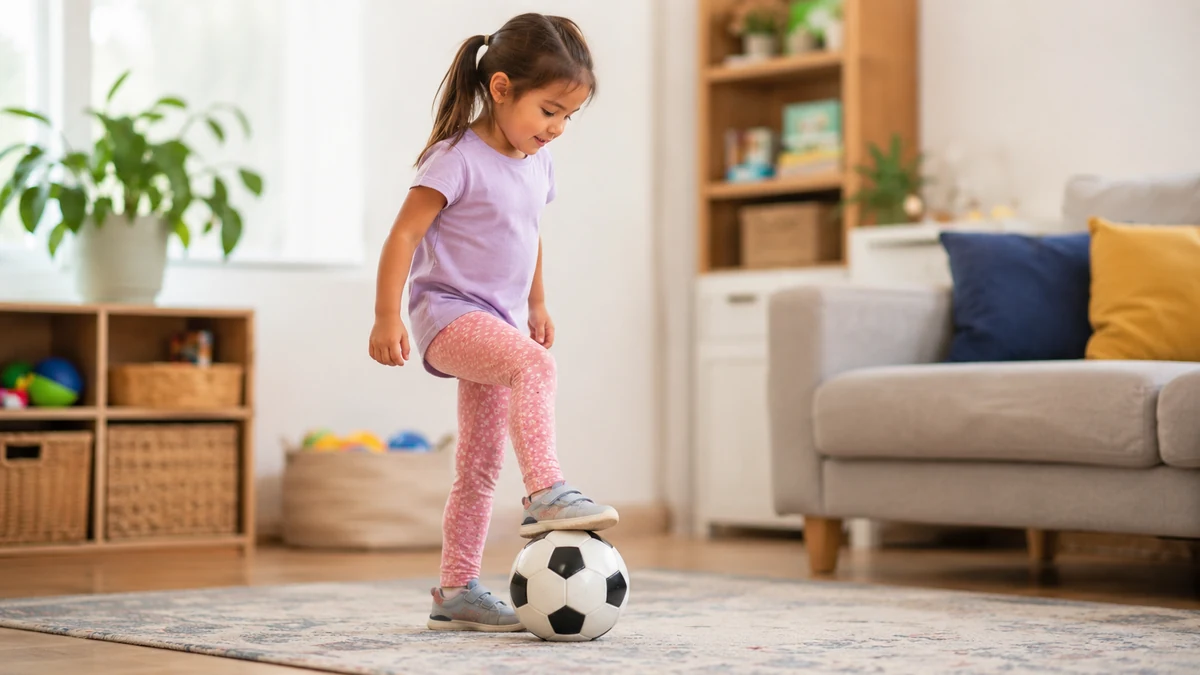
The sole of the foot is a child's brake and steering wheel — rolling the ball with the sole teaches control in every direction.
Key takeaways
- The sole (the flat bottom of the foot) is the most controlling surface a child has — it grips and guides the ball.
- Forward rolls come first; side rolls are the next step once she can roll slow and smooth.
- The cue is "sole on top, roll it slow." Push too hard and the ball gets away.
Once a child is comfortable touching the ball, the next question is how to move it without losing it. That's what the sole is for. It's the part of the foot that can roll the ball an inch at a time and stop it on a dime.
This is the deep how-to for the forward and side sole roll. For where these fit in the full soccer journey, head up to our hub, Teaching Soccer to 4-6 Year Olds.
LudoLogic Sports is our company, and Global Trophy Trek is our soccer series, where the Guardians travel the world collecting skills with Coach Lola, the "Big Sister" mentor, as their guide — and the forward sole roll is how the Guardians glide across the Amazon River in Episode 2, Brazil.
Quick facts
- Age: 4-6
- Skill: Sole rolls (forward and side) / bottom-of-foot control
- Time: 2-3 minutes
- Equipment: A size 3 soccer ball (or 3-4 pairs of socks rolled into a ball); a clear space; socks or bare feet
- One cue: "Sole on top, roll it slow."
- Safety note: Clear the space of furniture and toys, and check her "space bubble" — arms out, spin slowly, touching nothing. Supervise young kids, use soft household props, and stop for pain, dizziness, or distress. Consult a professional for medical concerns.
What is a sole roll in soccer?
A sole roll is when a child rests the sole — the flat bottom of the foot — on top of the ball and rolls it slowly in one direction, then stops it. In plain terms, the sole works like a hand on top of a ball: it can guide the ball forward, pull it back, or push it side to side, all while keeping it close and under control.
What the research says
The ABCs of young athletes — agility, balance, and coordination — are built through varied movement, and coordinated control of the body and an object keeps improving up to a "motor skill proficiency barrier" around age 8, as the NSCA long-term athletic development guidance describes. Sole rolls are a simple way to grow that coordination: one foot, one ball, one slow, controlled touch at a time.
What’s the difference between a forward and side sole roll?
A forward sole roll pushes the ball slightly ahead and stops it; a side sole roll pushes it left or right across the body. Both use the same surface — the sole — but in different directions. Forward rolls come first because they're the most natural. Side rolls come next and teach the ball to move sideways without the feet crossing.
How we coach it
We teach the forward roll until it's slow and quiet, then add the side roll as "now we can steer." In the series, the forward roll shows up in Brazil and the sideways version arrives in the next country, so your child meets them in the same order: control first, then direction.
What worked in our house
The sole roll clicked for us as the natural next step after she'd learned to stop the ball — foot on top, ball quiet. Once she could trap it under her foot, the real question changed: now what? When the ball is under control, you finally get to choose a direction, and forward is almost always the natural first pick. As a former Division I player, the thing I trust most is the unglamorous stuff, and this is about as unglamorous as it gets. Our honest hurdle, though, was balance. The first few days she'd reach for the ball with a stiff, straight leg, tip off to one side, and the ball would squirt away. The fix was getting her into an athletic stance — knees soft, a little bend, weight ready — before she ever put a foot on the ball. Once she was balanced first and rolling second, "slow" finally clicked, and she could roll it forward, stop it, and look up at me grinning like she'd done magic.
How do you teach the forward sole roll, step by step?
Teach it with the ball still, a balanced stance, and one slow push. Get her into an athletic position first — knees soft, weight ready — then have her rest the sole of one foot lightly on top of the ball, roll it forward just a few inches, and trap it again with the same foot. Keep the rolls small and the pace slow, and count them together.
Do it in this order:
- Shoes off, ball still, clear space. Have her stand with the ball just in front of one foot.
- Get balanced first. Set an athletic stance — feet about shoulder-width, knees soft with a slight bend, weight ready. Straight, locked legs make balancing (and rolling) much harder.
- Sole on top. Rest the flat bottom of her foot gently on top of the ball — "feel it under your foot."
- Roll it slow. Push the ball forward just a few inches, smooth and steady.
- Trap it. Stop the ball with the same sole so it doesn't get away.
- Reset and repeat. Roll, trap, roll, trap — five times on one foot, then switch.
- Add the side roll. Once forward is smooth, push the ball gently left, trap it, then right — the feet never cross.
Common mistakes and quick fixes
- Stabbing or kicking the ball. Fix: cue "roll, don't kick" — the sole stays in contact.
- The ball squirts away. Fix: slow everything down and make the rolls smaller.
- Standing flat with straight legs and losing balance. Fix: reset the athletic stance — soft bend in the knees, arms out, weight ready before she touches the ball.
- Shoes on. Fix: socks or bare feet so she can feel the ball under her sole.
What age can kids learn ball-control moves?
Most kids can start rolling the ball with the sole around age 4-5, as long as it's slow and the rolls are small. Don't expect quick, two-footed control yet — that sharpens closer to 6 and beyond. At this age, a single smooth forward roll and a clean stop is a real, celebration-worthy win.
What the research says
These early wins do more than they look like they do. Motor competence and confidence feed each other — kids who feel capable move more, and kids who move more get more capable, as described in Stodden and colleagues' developmental model. A sole roll she can actually pull off is a small competence win that keeps her coming back to the ball.
Make it an adventure
In Episode 2, Brazil, the Guardians use the forward sole roll to glide across the Amazon River — the ball has to roll smoothly from one lily pad to the next, slow and quiet, so it doesn't splash and wake the sleeping river dolphin. At home, set two cushions a few feet apart: she rolls the ball from one to the other and traps it, with no splash. When she makes the crossing, you're the official referee — ask her to show you three smooth forward rolls, then log the win in her Guardian Field Book and unlock her Brazil Trophy card. Next stop on the Trek: France, where the side roll becomes "steering on snow."
FAQ
Is the sole roll the same as a drag back?
They're close cousins. Both use the sole, but a drag back pulls the ball backward toward her, while a sole roll moves it forward or sideways. Kids usually learn the forward roll first, then the drag back as a way to escape pressure.
My child keeps kicking the ball instead of rolling it. How do I fix that?
Make "slow" the goal. Cue "roll, don't kick," shrink the movement to a few inches, and celebrate the quietest, slowest roll. The kicking instinct fades once she feels how much more control the sole gives her.
CTA
Want every skill taught for you, with a story she'll ask to repeat? The Global Trophy Trek bundle includes all 5 episodes, the Guardian Field Book workbook, and the Trophy cards. Try the free first episode of Global Trophy Trek (Mexico) to start building her control tonight.
About the author
Lincoln Gunn is the Founder & CEO of LudoLogic Sports. He and his wife are both former Division I basketball players, and they're raising two young daughters (ages 5 and 2). LudoLogic Sports' mission is to give every kid a better, more joyful start in sports — "build the ultimate athlete, not the elite basketball player" — using a play-based curriculum grounded in physical-literacy research. Read more on Lincoln's author page.
Sources
- NSCA Coach — The ABCs of Long-Term Athletic Development (agility, balance, coordination; motor proficiency barrier by ~age 8): https://www.nsca.com/education/articles/nsca-coach/abc-of-long-term-athletic-development/
- Stodden et al., 2008, Quest 60(2) — motor competence, physical activity, and perceived competence: https://doi.org/10.1080/00336297.2008.10483582