
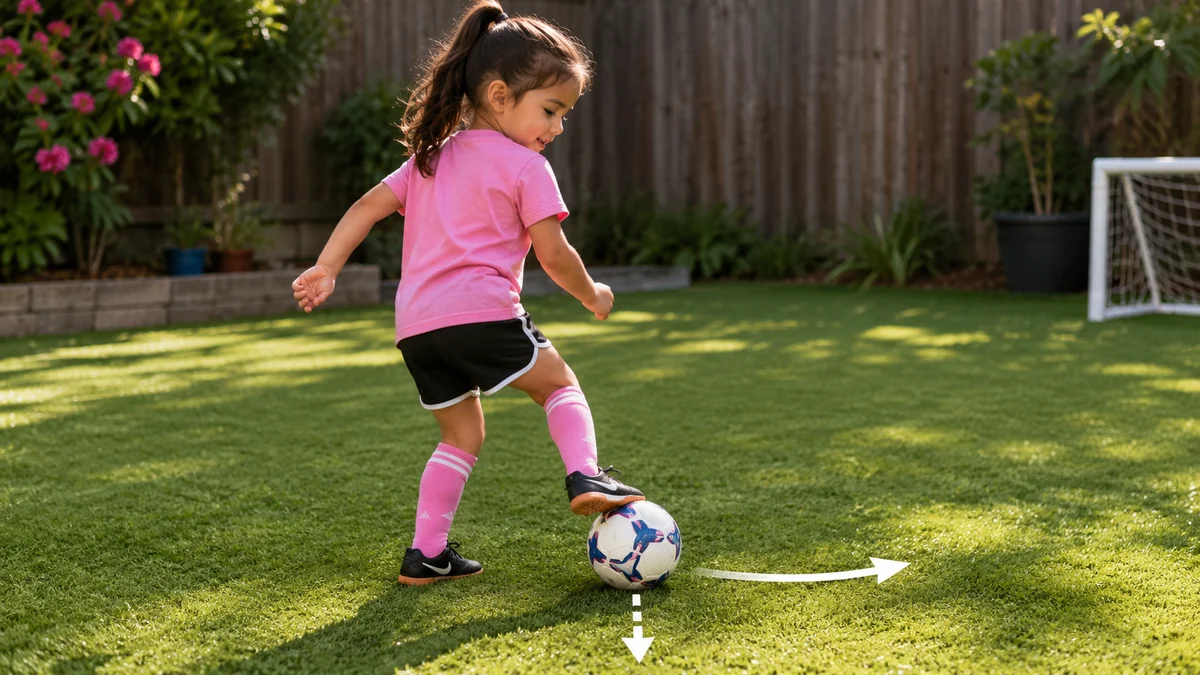
The T-Turn uses the sole for both steps — drag the ball back, then redirect it sideways. Two directions in one smooth move.
Key takeaways
- The T-Turn is two skills your child may already know, chained together: a drag back, then a sideways roll — the ball traces a little “T.”
- The sole, or flat bottom of the foot, does both parts and gives the child close control over where the ball goes.
- It teaches a child to change direction while keeping the ball — the heart of dribbling under pressure.
- Go slow and connected. Smooth beats fast; the “snap” develops with time.
- Practice turning both left and right, using each foot.
Once your child can drag the ball back, the T-Turn is the natural next step. This is the deep how-to for that one skill. For where turning fits in the wider soccer journey, head up to Teaching Soccer to 4-6 Year Olds or see How to Teach Soccer to Kids, by Age.
LudoLogic Sports is our company, and Global Trophy Trek is our soccer partner series, where the Discovery Crew travels the world collecting skills with Coach Lola, the “Big Sister” mentor, as their guide. The T-Turn appears in the Morocco adventure, where the child changes direction around desert obstacles without waking a sleeping fox.
Quick facts
- Age: 4-6
- Skill: T-Turn — drag back plus sideways redirect, all with the sole
- Time: 2-3 minutes
- Equipment: A size 3 soccer ball, a clear safe space, and socks or bare feet
- One cue: “Drag it back, then turn it out — sole the whole time.”
- Safety note: Clear the space around her and check her “space bubble” — arms out, spin slowly, touching nothing.
What is a T-Turn in soccer?
A T-Turn is a stop-and-redirect. A child pulls the ball straight back with the sole of one foot, then uses the same foot to roll it out to one side. The ball goes backward first and sideways second, helping the child change direction while keeping it close.
Using the sole for both parts helps the child feel where the ball is and guide it precisely.
Why is it called a T-Turn and not an L-turn?
From above, one turn can look more like an “L” than a “T.” The name describes the full pattern: the child moves forward, drags the ball back along the same line, then redirects left or right. Both possible side exits create the crossbar of the “T.”
You may also hear it called a drag-back turn or an L-turn. The name matters less than the sequence: back first, then out.
“It looks more like an L to me” is a common observation, and it means the child is watching the ball’s path. At home, call it the “drag-back turn” if that is easier to remember. The movement stays the same: stop the ball with the sole, then send it in a new direction with the sole.
How do I teach my child a soccer turn, the T-Turn?
Start with the ball still and the child standing just behind it. Have the child put the sole on top, pull the ball back a few inches, then roll it to one side with the same foot and follow it into the new direction. Keep both parts slow and connected.
Do it in this order:
- Sole on top, ball still. The child stands just behind the ball with the sole resting lightly on top.
- Drag it back. Pull the ball backward a few inches. Cue: “Drag it back.”
- Redirect with the sole. With the same foot, roll the ball to the left or right instead of forward. Cue: “Now turn it out.”
- Turn and go. The body follows the ball into the new direction, then the child pushes it forward to escape.
- Both feet, both ways. Practice turning left and right and leading with each foot. Slow first — smooth beats fast.
What skills should my child learn before the T-Turn?
The T-Turn is easiest after two simpler skills feel comfortable: the drag back, which pulls the ball straight toward the child with the sole, and the sideways sole roll, which moves the ball to the side with the bottom of the foot. The T-Turn links those two actions.
Start with the drag back and forward and side sole rolls. If either action is still shaky, practice it separately before combining the two.
Related beginner skills include dribbling backward, Tic-Toks, and toe taps.
What the research says
Changing direction with control is a foundational athletic skill, not a fancy extra. Coaching bodies group agility and coordination among the “ABCs” of long-term athletic development that are best built young, and note that kids who miss these fundamentals can hit a motor-skill proficiency barrier by around age 8, according to the NSCA. A simple turn like this is one small, age-right way to build that base early.
Source: https://www.nsca.com/education/articles/nsca-coach/abc-of-long-term-athletic-development/
Why does changing direction matter in soccer?
The T-Turn helps a child change direction without giving up the ball. It combines slowing the ball with sending it a new way, so the child practices control before accelerating again. On the field, that creates another option besides continuing straight ahead.
The drag-back half is a small act of braking: the child slows the ball and body before redirecting.
What the research says
The “drag back” half of this turn is really a small act of deceleration — stopping the ball and her momentum before redirecting. Research on young children’s landing and stopping control points to a developmental turning point around ages 4-5, when kids start managing deceleration far more capably, according to Frontiers in Psychology. That’s a big reason a controlled turn is realistic at this age — and why we teach the “stop” before the “go.”
Source: https://www.frontiersin.org/journals/psychology/articles/10.3389/fpsyg.2022.982467/full
What worked in our house
This was one of the last skills we worked on. The drag back and side sole roll needed to feel familiar before the combination made sense.
Our best drill was a simple version of Statue. I stood next to her like a defender planted in the grass, and she dragged the ball back and redirected away without touching me. I did not move; my position was enough to encourage her to find open space. No tactics and no speed — just “see the person, turn the other way.”
What age can kids learn the T-Turn?
Many 4-6-year-olds can begin learning a slow T-Turn once the drag back feels comfortable. Keep both steps connected and unhurried. At this age, the goal is a smooth, controlled turn in each direction — not speed.
The T-Turn is one of the more advanced skills in this progression because it combines two sole actions. If the drag back or side sole roll is not comfortable yet, return to those skills and try the combination again later.
Common mistakes and quick fixes
- Turning with the inside of the foot instead of the sole. Point to the flat bottom of the foot and cue, “Sole the whole time.”
- Rushing both steps into one blur. Separate the cues: “Drag it back … now turn it out.”
- Only turning one direction. Alternate left and right and switch the leading foot.
- Pulling the ball too far. Shrink the drag to a few inches; guide the ball instead of kicking it.
- Losing balance. Slow down, keep the weight centered, and use a clear safe space.
Make it an adventure
In the Morocco adventure of Global Trophy Trek, a trophy piece sits at the top of a sand dune near a sleeping fennec fox. Coach Lola has the child dribble backward and use the T-Turn when an obstacle appears: “Backward first, then turn.”
At home, place two soft cushions as exits and call “left” or “right.” The child reacts, drags the ball back, and redirects around the cushions. Celebrate each clean T-Turn that keeps the ball close.
FAQ
Why is it called a T-Turn if it looks more like an L?
The name describes the full pattern rather than one repetition. The ball comes straight back along the stem, then can exit left or right. Both exits together make the crossbar. “Drag-back turn” or “L-turn” is also fine if it helps the child remember “back first, then out.”
Which foot should my child use for the T-Turn?
The same foot completes both parts of one turn: it drags the ball back and rolls it sideways. Practice separate turns with each foot so the child can redirect in both directions.
How is a T-Turn different from turning the body around?
In a T-Turn, the child moves the ball with the sole while changing direction. The ball stays close instead of being left behind while the child runs around it.
How many T-Turns should we practice at a time?
Three or four clean, slow turns can be a strong short session at this age. Quality matters more than quantity, so stop before the movement becomes rushed or frustrating.
Try the free first episode
Want every skill taught through a story your child will ask to repeat? Try the free first episode of Global Trophy Trek — Mexico and start turning single touches into real moves.
About the author
Lincoln Gunn is the Founder & CEO of LudoLogic Sports. He and his wife are both former Division I basketball players, and they are raising two young daughters, ages 5 and 2. LudoLogic Sports’ mission is to give every child a better, more joyful start in sports through a play-based curriculum grounded in physical-literacy research. Read more on Lincoln’s author page.
Sources
- NSCA Coach — The ABCs of Long-Term Athletic Development: https://www.nsca.com/education/articles/nsca-coach/abc-of-long-term-athletic-development/
- Frontiers in Psychology — Children’s strategies in drop-landing: https://www.frontiersin.org/journals/psychology/articles/10.3389/fpsyg.2022.982467/full