
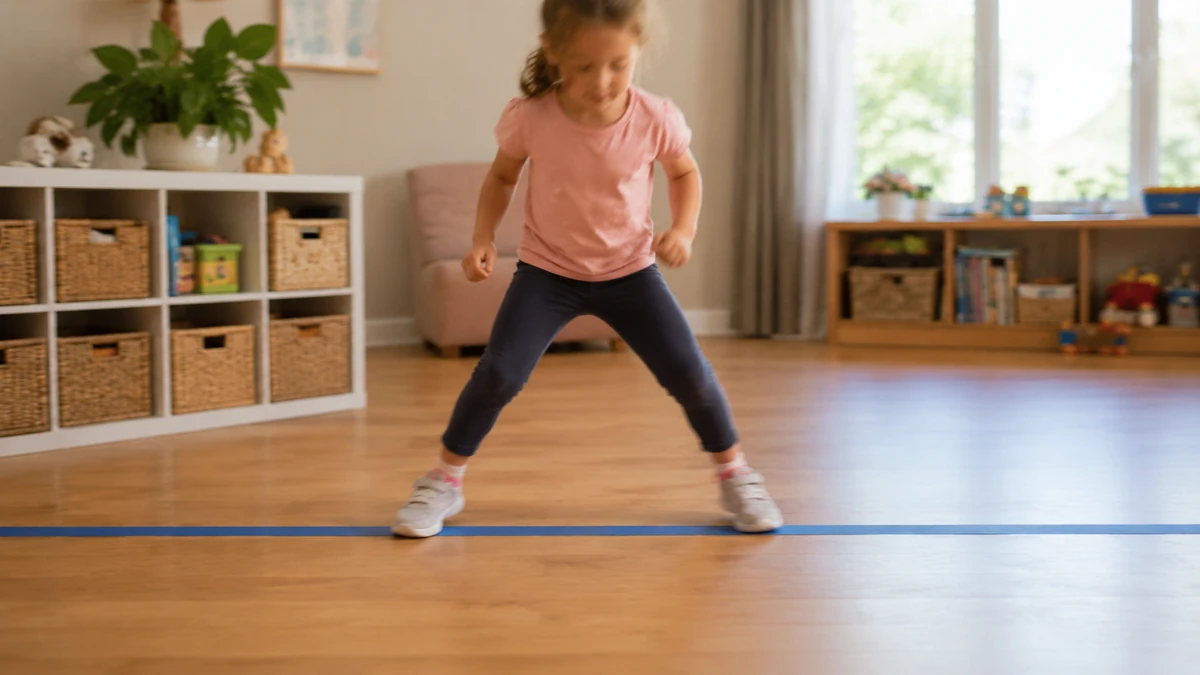
A side shuffle has one rule: the feet never cross. She takes a big step, then slides the trail foot to meet it — the base of defense in every sport.
Key takeaways
- The rule that matters most: the feet never cross. Move "big step, little step" — the lead foot steps, the trail foot slides to meet it.
- Stay low in a ready stance: back straight, knees bent, hips down, hands out. Coach one cue at a time.
- It's a foundational skill for the 2-8 window — the base of defense in basketball, the baseline in tennis, and the lateral drills she'll do as she grows.
Most kids move two directions on purpose: forward and, eventually, backward. Sideways is an afterthought — until she has to slide over to stop a rolling ball or stay in front of a friend in tag, and her feet tangle.
The fix is the side shuffle, and it's one of the easiest skills to teach at home: slow, low to the ground, and no equipment. It also pays off for years — it's the footwork under every quick sideways move she'll make in sports later.
One note on the names below: LudoLogic is our company and Rainbow Riders is our video series, guided by Coach Kenzie, or "Stable Master Kenzie." This skill is from her Episode 3 adventure, The Golden Griffin — and I'll show you how the episode teaches it so you can run the same play at home.
For the broader early-movement progression, see our daily movement guide for 4-6 year olds.
Quick facts
- Age: 4-6
- Skill: Lateral movement — the side shuffle, or defensive slide
- Time: 10 minutes
- Equipment: A clear hallway, and a tape line if helpful. For the full challenge, use two soft markers such as pillows or toys about six steps apart to make a gate.
- One cue: "Big step, little step — feet never cross." In the episode, Coach Kenzie calls it the Golden Slide.
- Safety check: Clear loose toys, and use grippy footwear on a non-slick floor so she doesn't slide out sideways.
What is a side shuffle, or defensive slide, and why teach it so young?
A side shuffle, also called a defensive slide, is moving sideways by stepping with the lead foot and sliding the trail foot to meet it, so the feet never cross. You teach it young because lateral movement is a foundational skill most kids never practice on purpose, and early childhood is when these movement patterns install most easily.
What the research says
The side shuffle is a locomotor skill — a fundamental movement skill that comes before sport-specific technique. For ages 3-5, the guidance is to reinforce a wide range of skills through active play rather than specialize early. Lateral movement is one of the under-practiced ones, which makes it high-value to teach at home.
What worked in our house
My five-year-old treated her first shuffle like a dance move — clicking her heels together, up on her toes and leaning forward, exactly what you don't want. It clicked when I swapped "shuffle" for two images: "big step, little step" and "keep a window between your feet." The crossing stopped almost immediately. The right words did more than ten reps.
What age should kids start learning the defensive slide?
Around ages 4 to 5 is a great time to start, within the 2-8 window for fundamental movement skills. At this age the goal is control, not speed — short, playful sessions where the feet stay apart and never cross. The lower, faster, game-speed slide comes naturally as she grows; first you're just building the pattern.
How do I teach it step by step? One cue at a time
Teach it in four short stages, adding one thing at a time — the same build Coach Kenzie uses in the Golden Griffin episode. Coach a single cue throughout: "big step, little step, feet never cross."
- Build the stance against a wall. Back flat on a wall, slide down into an "invisible chair." Feet wide, hands out front, back straight, hips down. The wall forces the tall, athletic spine every slide starts from.
- Drop into it on command. Off the wall, walk around; when you call "Stance!", she drops into that low, wide stance, fast. Toss in a silly fake word, like "spaghetti!", that she should not drop for.
- Add the slide: big step, little step. Staying low, a big step with the lead foot, then slide the trail foot over to meet it — feet never touch, never cross. A few steps one way, then back. Don't bounce up.
- Build the gate. Two soft markers about six steps apart. She stands in the middle and slides to touch one, then back to touch the other — a windshield wiper, never crossing her feet.
If she crosses her feet, don't pile on corrections — just say "big step, little step" and let her reset.
How do you teach a defensive slide for basketball?
It's the same side shuffle with a job: stay low, take a big step with the lead foot, slide the trail foot to meet it, and never cross. Keep her chest facing the player and her hands up, and reach with the hand closest to the ball — never across her body, or she's off balance and a step slow.
Make it a game of staying in front: play "mirror," where you lead with slow "big step, little step" moves and she matches you. Speed comes after the feet are clean. For the full age-band context, see basketball for 4-6 year olds.
How do I know she's doing it right?
Check two things and ignore the rest: do her feet stay apart and never cross, and does she stay low with her chest facing forward? If both are yes, it's a good slide — even slow and stiff is fine. Speed and smoothness come on their own. Coaching posture, arms, and tempo all at once just makes a four-year-old freeze; two checkpoints is the whole grade.
What the research says
At 4-6, the goal is broad, controlled movement, not polished form. Physical-literacy frameworks treat balance, stability, and body control as core early-childhood domains — the foundation that makes later skills possible.
Why does a defensive slide matter for a preschooler?
Because lateral control is a gap in how most kids move, and filling it early makes later sports feel natural. The side shuffle is the base of defense in basketball and tennis and shows up in everyday play like tag. And motor competence builds confidence — kids who move with control feel capable, so they keep playing and get even better.
What we believe
We don't teach this so a five-year-old can "play defense." And at this age we teach the step, not the push — "push off your outside foot" is a more advanced cue that comes later. Right now it's about owning the ready stance and keeping her feet from crossing. Plant that now, as a game, and the speed and power bolt on later.
The research backs up the bigger point: motor competence builds confidence and participation over time. Kids who feel capable moving are more likely to keep playing, and the reps build more skill.
Common mistakes and the one-line fix
- Feet cross or click together. Fix: "big step, little step — keep a window between your feet."
- She stands up tall or bounces. Fix: "stay low — hips down, back straight," like sitting in an invisible chair.
- Chest turns sideways, so she's running, not sliding. Fix: "belly button stays pointing at me."
- She reaches across her body to touch. Fix: "use your closest hand."
- You're giving three cues at once. Fix: pick one. Feet-never-cross is enough this week.
Make it an adventure
This skill is Episode 3 of Rainbow Riders: The Golden Griffin — half lion, half eagle, great at flying high but terrible at moving side to side. When she tries to guard her gate she crosses her paws and gets "tied in a knot," bonk, so your child, the Rider, has to teach her the Golden Slide.
Coach Kenzie builds it the same way you just did: a warm-up with Golden Jacks, the Griffin Guard plank, and the balancing Flying Flamingo, then the stance against a wall, the drop-into-stance reaction game, and the big-step-little-step slide. The Captain's Challenge is the Gate: two pillows about six steps apart, and your child stands in the middle and slides side to side like a windshield wiper — touching each pillow with the closest hand, never crossing her feet — counting one point per touch on the way to 15 to save the gate. She logs her score in her Rider Log and earns the Golden Griffin trading card.
Big picture: Rainbow Riders builds 9 foundational movement skills across 10 adventures — the 10th ties them together in a reaction-time obstacle course. The Griffin's slide is one of the nine. For the previous ride, see learning to cut and change direction. Tomorrow's ride, the Fire Phoenix, adds the vertical jump.
Frequently asked questions
My child keeps crossing her feet. How do I stop it?
Give her two images — "big step, little step" and a "window between your feet" she has to protect — and slow the whole drill down. Crossing usually means she's moving too fast for her control. Slower fixes it.
Is the side shuffle the same as a defensive slide?
Yes — it's the foundation of it. The slide she'll use in basketball or to stay in front of a soccer ball is this same feet-apart, chest-forward shuffle, just faster and lower as she grows.
Do I need tape or markers on the floor?
No, but they help. A tape line gives her a path to follow, and two markers turn it into the back-and-forth gate game that makes practice feel like a contest.
Try it with the series
If the Golden Griffin's gate challenge is a hit, follow the whole adventure. Start with the free first episode of Rainbow Riders, then explore the Rainbow Riders series — 10 episodes plus the Rider Log workbook and the trading cards — so she can add the Golden Griffin card to her collection and meet the Fire Phoenix next.
About the author
Lincoln Gunn is the Founder and CEO of LudoLogic Sports and a former Division I basketball player. He and his wife — also a former D1 athlete — are raising two daughters and building LudoLogic Sports on a simple motto: build the ultimate athlete, not the elite basketball player. He writes about giving kids a confident, joyful start in movement and sport. Learn more about Lincoln.