
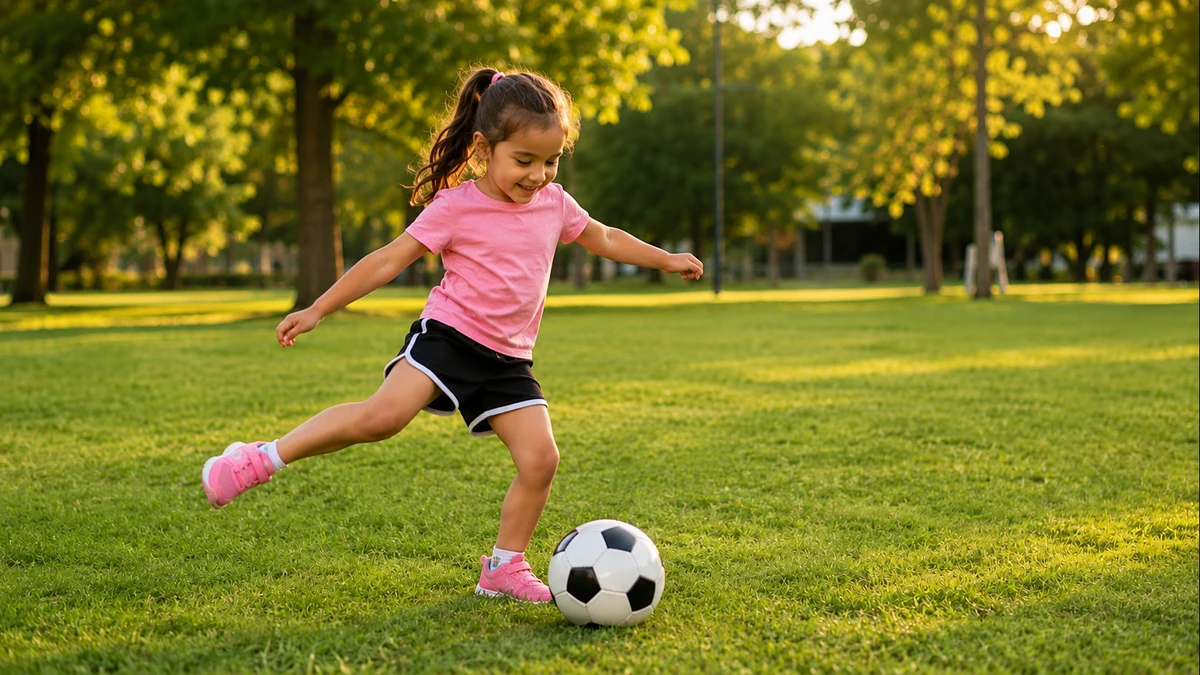
The windshield wiper has a surprising rule: the foot never touches the ball. The leg sweeps a wide arc around a still ball — and that's how young kids learn where the ball is before they ever try to dribble it.
Key Takeaways
- It's a no-kick drill. The ball stays still; the foot sweeps an arc around it, like a wiper on a windshield. The point is ball feel and coordination, not moving the ball.
- One cue does the work: "Sweep around the ball — don't touch it." Five slow arcs with each leg is a full rep.
- It builds spatial awareness under every dribble. Knowing where the ball is in the space comes before controlling it — and it's a perfect fit for the 4-6 ball-familiarity window.
If you've ever handed a four-year-old a ball and watched her wind up and boot it across the yard, you already know the first problem in little-kid soccer: kicking is easy, and control is hard. Kids want to hit the ball. What they actually need first is to feel where it is.
The windshield wiper flips the usual drill on its head. Nothing gets kicked. She stands over a still ball and sweeps one leg around it in a big arc, like a wiper clearing a windshield, without ever making contact. It looks almost too simple — and that's the point. For how soccer skills stack up before this one, see our age-by-age guide to teaching kids soccer; for the full daily picture, here's everything a 4-6 year old can learn in soccer. This piece is just the windshield wiper: what it is, why it works, and how to run it in your living room tonight.
LudoLogic is our company, and Soccer Stars — our Global Trophy Trek series — is where the Discovery Crew travels the world collecting skills, with Coach Lola, the "Big Sister" mentor, as their guide. The windshield wiper is one of the touches the Crew picks up on their stop in France, and below I'll show you how to run the same drill at home.
Quick Facts
- Age: 4-6
- Skill: Ball familiarity and coordination — the windshield wiper (no-contact foot arc)
- Time: 2-3 minutes
- Equipment: One ball (a size-3 or any soft ball); a stuffed animal works for the very first tries. No special shoes needed; bare feet are fine on carpet.
- One cue: "Sweep around the ball — don't touch it." Five slow arcs each leg is a rep.
- Safety check: Clear a little space so she isn't sweeping into furniture, and start on a non-slick surface so her planted foot stays put.
What is a windshield wiper in soccer, and why teach it with no kicking?
A windshield wiper is a coordination drill where a young player keeps the ball still and sweeps one leg in a wide arc around it — like a wiper crossing a windshield — without touching the ball. You teach it with no kicking because, at 4-6, the first job is ball feel: learning where the ball sits in the space and how the foot travels around it, which is the foundation every real dribble is built on.
What the research says
Physical literacy is often described as the ABCs of movement — agility, balance, and coordination — built through play before any sport-specific technique. Coordination drills like this one sit squarely in that foundation, and that foundation is exactly what frameworks like the international definition of physical literacy treat as the goal for young children. The windshield wiper is coordination training dressed up as a silly game.
What worked in our house
The first time I tried this with my five-year-old, she could not stop tapping the ball — every pass of her foot, she'd nudge it, then chase it. So we made "don't touch it" the entire game: I'd gasp like she'd set off an alarm every time the ball moved. Suddenly the challenge wasn't sweeping her leg, it was keeping the ball frozen. That reframe did it. She slowed down, the arcs got smooth, and she was concentrating harder on a still ball than she ever did kicking one.
What age should kids start soccer ball-control drills like this?
Around ages 4 to 5 is a great place to start, right inside the 2-8 window when fundamental movement skills install most easily. At this age the aim is comfort and control, not polish or speed — short, playful sessions where she gets used to a ball at her feet. Passing, dribbling at speed, and real games all come later; ball familiarity comes first.
What the research says
For ages 3-5, the guidance is to reinforce a wide range of basic skills through active play rather than push early specialization, which is exactly what a low-pressure, no-kick drill does. That early-childhood guidance from SHAPE America's Active Start standards is why we keep the first soccer touches broad and playful instead of drilling "technique."
How do I teach the windshield wiper step by step? (One cue at a time)
Teach it slowly, one leg at a time, coaching the single cue throughout: "sweep around the ball — don't touch it." Keep the ball still and let the arcs get bigger and smoother before you add any speed.
- Set the ball as a "no-touch zone." Put the ball right in front of her feet. Tell her it's frozen — the whole game is keeping it that way.
- Trace the arc with the sweeping leg. Standing on one foot, she swings the other leg around the outside of the ball in a wide half-circle — out, around the front, and back — never touching it. Arms out for balance.
- Five slow arcs, then switch legs. Five sweeps with one leg, then plant that foot and sweep with the other. Slow and smooth beats fast and wild.
- Make it bigger, then a little quicker. Once the ball stays frozen, widen the arc and pick up the pace just slightly — still no contact.
If the ball keeps moving, don't add corrections — just say "freeze the ball" and let her reset. Smooth and still is the whole grade.
How does this build real dribbling?
It trains the part of dribbling kids skip: knowing where the ball is without staring at it. By sweeping her foot around a still ball, she learns the ball's position in the space and gets comfortable with her foot traveling close to it. Later, when she's actually dribbling, that body awareness is what lets her keep the ball close instead of kicking it away and chasing it.
What we believe
Most early soccer coaching jumps straight to "dribble around the cones," and little kids end up booting and sprinting after the ball. We'd rather build the quiet skill first. When a child can sweep her foot around a ball she's not allowed to touch, she's proving she knows exactly where it is — and that control is what makes the ball feel like it belongs to her. Comfort comes before contact.
Common mistakes (and the one-line fix)
- She keeps nudging the ball. Fix: "Freeze the ball" — make keeping it still the whole challenge.
- She looks down the entire time. Fix: "Peek up at me between sweeps" so she's not glued to her feet.
- The arc is tiny and stiff. Fix: "Draw a big rainbow around the ball" with her foot.
- She rushes. Fix: "Slow motion" — smooth and controlled scores; fast and sloppy doesn't.
Make it an adventure
In The Global Trophy Trek, the windshield wiper is a touch the Discovery Crew collects on their stop in France. Coach Lola frames it just like you did: the ball stays still, the foot sweeps a wide arc around it, "and again — no contact." It's a chance for your child to show she knows where the ball is without touching it at all.
The Captain's Challenge is the count: five smooth arcs with each leg, the ball frozen the whole time, ten in a row to complete the challenge. Next stop on the trek, the Crew works on touches that actually move the ball — but only after the foot knows its way around it.
FAQs
Is the windshield wiper supposed to move the ball?
No. The ball stays still on purpose. The whole skill is sweeping the foot around it without contact, so she learns where the ball is. Moving it comes later, in drills like the drag back, her first real soccer move.
My child keeps kicking the ball during the drill. Is that bad?
It's normal, and it's the exact habit this drill gently retrains. Make "keep the ball frozen" the game itself — react big when it moves — and she'll start concentrating on control instead of contact.
Do we need a real soccer ball?
Not to start. A stuffed animal or any soft ball is fine for the first tries, since nothing gets kicked. A size-3 ball is a nice next step once she's got the arc down.
Try it with the series
If the France challenge is a hit, follow the whole trek. Start with the free first episode of Soccer Stars, then explore the Soccer Stars bundle to keep building her touch.
About the author
Lincoln Gunn is the Founder and CEO of LudoLogic Sports and a former Division I basketball player. He and his wife — also a former D1 athlete — are raising two daughters (ages 5 and 2) and building LudoLogic on a simple motto: build the ultimate athlete, not the elite basketball player. He writes about giving kids a confident, joyful start in movement and sport.
Sources
- Sport for Life / International Physical Literacy Association — What is physical literacy (the ABCs: agility, balance, coordination): https://physicalliteracy.ca/physical-literacy/
- SHAPE America — Active Start: Physical Activity Guidelines for ages 3-5 (reinforce a wide range of skills; don't specialize): https://blog.shapeamerica.org/2020/10/give-kids-an-active-start-for-a-healthier-future/
- Stodden, D. F., et al. (2008) — A Developmental Perspective on the Role of Motor Skill Competence in Physical Activity: An Emergent Relationship. Quest, 60(2), 290-306: https://doi.org/10.1080/00336297.2008.10483582