
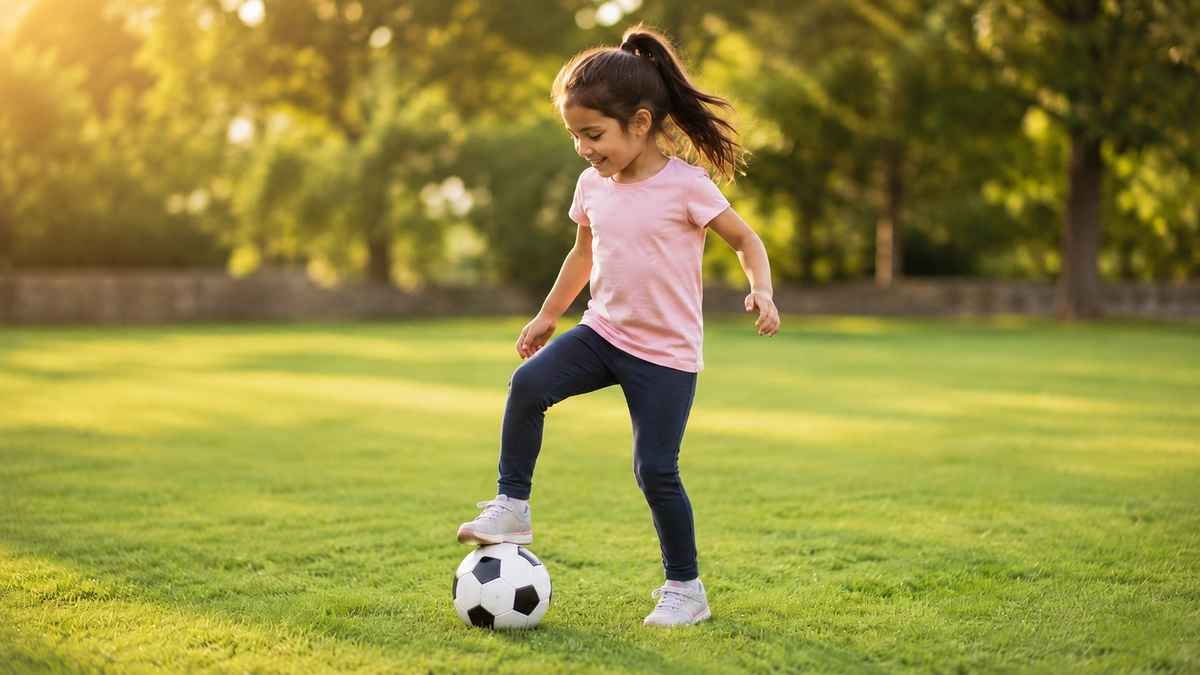
Watch the best players in the world and you'll see them use the bottom of the foot far more than they kick — and the drag back is the very first version of that your child can own.
Key Takeaways
- One simple move: put the sole on top of the ball, pull it back toward you. The flat bottom of the foot does all the work.
- It teaches control before power — the ball moves because she guides it, not because she boots it. That's how players protect the ball when they're surrounded.
- It's the first real soccer “move” a 4-6 year old can master, and most kids get it in under a minute.
The first time a kid does a drag back, something clicks. A second ago the ball was just a thing to kick; now she can stop it and pull it back wherever she wants. That little flash of “I control this” is the whole reason we teach it early — and it's why the drag back is the first skill the Discovery Crew picks up in Global Trophy Trek.
Here's the move in one breath: she puts the sole of her foot on top of the ball and drags it backward toward herself, smoothly, under control. No kicking, no power — just the flat bottom of the foot guiding the ball. For where this sits among the first soccer skills, see our age-by-age guide to teaching kids soccer, and for the daily picture, here's everything a 4-6 year old can learn in soccer. This piece is just the drag back.
LudoLogic is our company, and Global Trophy Trek is where the Discovery Crew travels the world collecting skills, with Coach Lola, the “Big Sister” mentor, as their guide. The drag back is the Crew's very first skill, learned on their opening stop in Mexico, and below I'll show you how to run it at home tonight.
Quick Facts
- Age: 4-6
- Skill: Ball control and turning — the drag back (sole pull-back)
- Time: 2-3 minutes
- Equipment: One ball (a size-3 or any soft ball). Shoes off are great so she can feel the ball through her foot.
- One cue: “Sole on top, pull it back.” Two clean reps to start; build from there.
- Safety check: Clear a little space behind her so she has room to pull the ball back, and start on a surface where her planted foot won't slip.
Safety note
Use a clear safe space and soft household props when practicing indoors. Supervise young kids. Stop for pain, dizziness, or distress, and consult a professional for medical concerns.
What is a drag back in soccer, and why is it the first move to teach?
A drag back is stopping and reversing the ball by placing the sole of the foot on top of it and pulling it backward toward yourself, under control. It's the first move to teach because it's simple, it works in under a minute, and it gives a young child her first taste of truly controlling the ball — the foundation for stopping, turning, and protecting it later.
What the research says
At 4-6, soccer should be about touch and control, not power, and the sole and inside of the foot are where that control lives. This fits how physical-literacy frameworks describe the early years: build the ABCs of movement — agility, balance, and coordination — through play before sport-specific technique. The international definition of physical literacy treats controlled, confident movement as the goal for young children, and the drag back is control in its simplest form.
What worked in our house
My five-year-old learned this one almost by accident. She kept kicking the ball away and getting frustrated chasing it, so I said, “Don't kick it — trap it and pull it back to you, like it's on a leash.”
She tried once, the ball came back to her foot, and she lit up. Within a minute she was dragging it back, looking up at me, and dragging it back again — narrating “mine!” every time. The non-kick was the unlock.
What age can a child learn a soccer move like this?
Around ages 4 to 5 is a great time, right inside the 2-8 window when fundamental movement skills install most easily. The drag back works this young because it's slow and controlled — there's no sprinting, no opponent, no timing a kick. She just needs to feel the ball under her sole and pull. Start there, and faster turns and combinations grow out of it as she does.
What the research says
For ages 3-5, the guidance is to reinforce a wide range of skills through active play rather than specialize early. SHAPE America's Active Start standards are why we keep first soccer sessions about exploring control — a drag back here, a sweep there — instead of drilling one “correct” technique. Broad and playful beats narrow and serious at this age.
How do I teach the drag back step by step? (One cue at a time)
Teach it slowly, coaching one cue the whole time: “sole on top, pull it back.” Keep it to a couple of clean reps before you add any speed, and let her feel the ball through her foot.
- Find the sole. Have her lift one foot and show you the flat bottom — that's the part that touches the ball. Tap the top of the ball with it a couple of times.
- Trap and freeze. Rest the sole gently on top of the ball so it stops. No weight, just contact — if she stomps, it pops out.
- Pull it back. Keeping the sole on top, she drags the ball backward toward herself a short distance, then puts her foot down. “Slow and smooth.”
- Two reps, then switch feet. Two clean drag backs with one foot, then try the other. Both feet matter, even if one feels clumsy at first.
If the ball squirts out, it usually means too much weight or too much speed — say “light foot, slow pull” and let her reset.
How does a drag back help in a real game?
It's how players stop and protect the ball when someone's closing in. The ball moves with control, not power, so a quick sole-pull lets her change direction and keep her body between the ball and a defender. That's exactly what you see the best players do — they use the bottom of the foot to keep the ball safe far more often than they blast it.
What we believe
Most little-kid soccer rewards the hardest kicker, and that teaches exactly the wrong lesson — that the ball is something you get rid of. We'd rather a child's first move be one that says the ball is hers to keep. The drag back is small, but it's the first time she protects and controls the ball instead of surrendering it, and that mindset — possession over power — is what real soccer is built on.
And because she can do it well almost immediately, it pays off in confidence: kids who feel competent keep playing, and that early sense of “I can do this” is its own reward, a pattern researchers describe in the link between motor competence and confidence.
Common mistakes (and the one-line fix)
- She kicks instead of dragging. Fix: “No kick — sole on top, pull it back like it's on a leash.”
- She stomps and the ball pops out. Fix: “Light foot — just rest it on top.”
- She only uses her strong foot. Fix: “Now the other foot gets a turn.”
- She pulls it too far and loses it. Fix: “Small pull — keep it close enough to touch.”
Make it an adventure
In Global Trophy Trek Episode 1, the drag back is the Discovery Crew's first collected skill, learned on their opening stop in Mexico. Coach Lola sets it up the way the pros do it: “sole on top of the ball, the flat bottom of your foot, and drag it back toward you. The ball moves with control, not with power.” It's the move that keeps the ball safe when defenders crowd in.
The Captain's Challenge is the streak: sole on top, one clean drag back, then reset — ten controlled pull-backs in a row without the ball squirting away, alternating feet. When she clears it, celebrate the streak and try the no-kick windshield wiper drill next.
FAQs
Why teach the sole of the foot before kicking?
Because control comes before power. The sole lets a young child stop and steer the ball at her own pace, with no timing or strength required. Once she can keep the ball close and under control, kicking and passing have something to build on.
My child keeps kicking the ball away instead of dragging it. How do I fix it?
Take the kick off the table. Tell her the ball can't leave her foot — it's “on a leash” — and make the whole game pulling it back to herself. When the goal is keeping the ball close, the dragging motion comes naturally.
Does she need both feet to do it?
Eventually, yes, and it's worth starting both early. One foot will feel clumsy — that's normal. A couple of reps with the weaker foot each session is plenty to keep it from falling behind.
About the author
Lincoln Gunn is the Founder and CEO of LudoLogic Sports and a former Division I basketball player. He and his wife — also a former D1 athlete — are raising two daughters (ages 5 and 2) and building LudoLogic on a simple motto: build the ultimate athlete, not the elite basketball player. He writes about giving kids a confident, joyful start in movement and sport.
Sources
- Sport for Life / International Physical Literacy Association — What is physical literacy (the ABCs: agility, balance, coordination): https://physicalliteracy.ca/physical-literacy/
- SHAPE America — Active Start: Physical Activity Guidelines for ages 3-5 (reinforce a wide range of skills; don't specialize): https://blog.shapeamerica.org/2020/10/give-kids-an-active-start-for-a-healthier-future/
- Stodden, D. F., et al. (2008) — A Developmental Perspective on the Role of Motor Skill Competence in Physical Activity: An Emergent Relationship. Quest, 60(2), 290-306: https://doi.org/10.1080/00336297.2008.10483582