
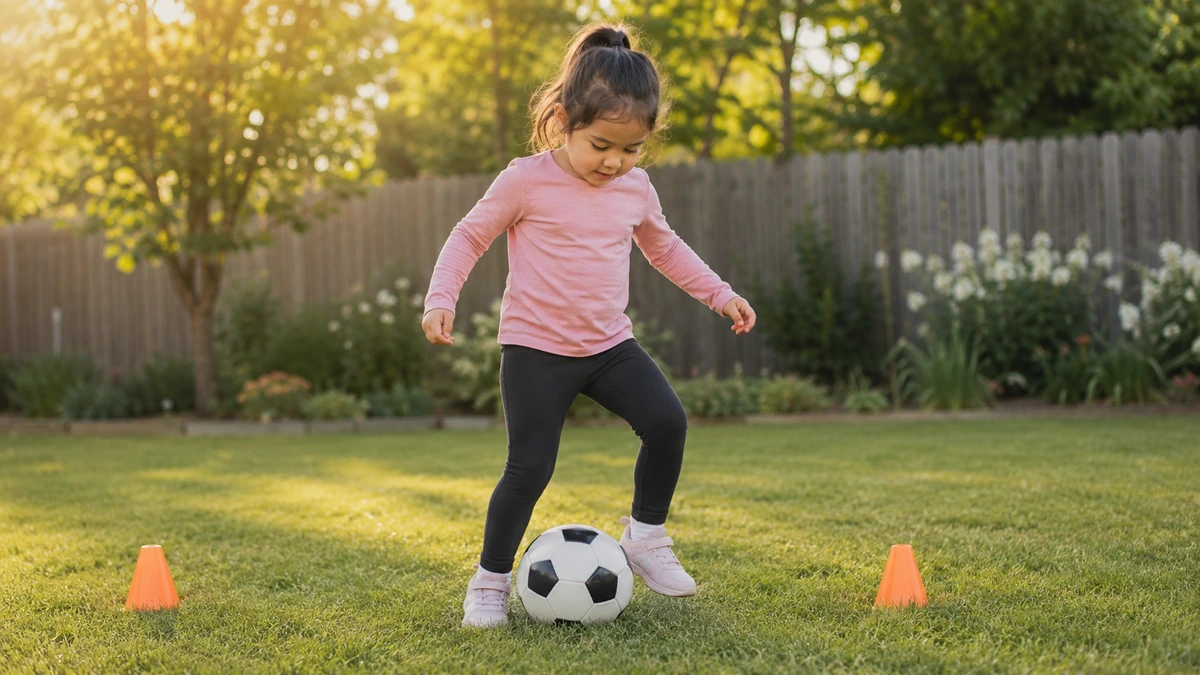
Tic-toks are a foundational dribbling drill: soft inside-foot taps that send the ball back and forth between both feet. They're small, controlled kicks that keep the ball close — building the ball control your child needs to dribble, and giving her weaker foot just as many reps as her strong one.
Key takeaways
- Tic-toks are a foundational dribbling drill — small, soft kicks that teach close ball control with both feet.
- The ball stays centered between the feet, tapped from the inside of one foot to the inside of the other.
- They're a strong early drill for the off-foot because the weaker foot gets as many reps as the strong one.
- Use a size 3 ball. A full-size ball is harder for little feet to control at this age.
- The cue is: "Soft taps, ball stays between your feet." Quiet and close beats fast.
Once your child can give the ball a soft first touch and tap it with her toes, tic-toks are the next step — the first real dribbling rhythm. It's a back-and-forth, tic, tok, that teaches her to control the ball with both feet at once and gives her off-foot useful reps.
This is the deep how-to for that skill. For where tic-toks sit in the full soccer journey, head up to our hub, Teaching Soccer to 4-6 Year Olds.
LudoLogic Sports is our company, and Global Trophy Trek is our soccer series, where the Guardians travel the world collecting skills with Coach Lola, the "Big Sister" mentor, as their guide — and tic-toks are the touch that stitches the trophy back together in the grand finale, Episode 5, New York City.
Quick facts
- Age: 4-6
- Skill: Tic-toks / inside-foot taps between the feet (foundational dribbling)
- Time: 2-3 minutes
- Equipment: A size 3 soccer ball; a clear space; socks or bare feet
- One cue: "Soft taps, ball stays between your feet."
- Safety note: Clear a safe space, move furniture and toys, use soft household props, supervise young kids, stop for pain, dizziness, or distress, and consult a professional for medical concerns.
What are tic-toks in soccer?
Tic-toks are a foundational dribbling drill: soft taps that send the ball from the inside of one foot to the inside of the other, back and forth, while it stays centered between the feet. In plain terms, it's a gentle ping-pong with the ball using the inside edges of both feet — tic, tok, tic, tok — with touches small enough that the ball barely travels. Those small, controlled kicks are exactly the kind of close ball control dribbling is built on.
What the research says
Coordinated foot-eye movement, kicking, balance, and body awareness are part of gross-motor development. Young kids build those skills gradually through repetition, not all at once. Tic-toks pack a lot of small, two-sided touches into a short window, which helps your child practice control on both feet — especially the weaker foot.
How are tic-toks different from a first touch or toe taps?
Tic-toks are the natural progression from toe taps. A first touch is one soft cushion of the ball with the inside of the foot; toe taps are light touches on top of a still ball that teach soft, controlled contact. Tic-toks take that same soft touch and add two things: rhythm and the second foot. Instead of tapping a still ball, your child sends it side to side between both inside edges — so it's the first drill where the ball actually moves under control. Master the still-ball skills first, then chain them into this back-and-forth.
How we coach it
We teach the single inside-of-the-foot touch first — that's its own skill; see How to Teach a Preschooler Their First Soccer Touch — then the toe tap, then turn that soft touch into a rhythm. The moment a child realizes her "bad foot" can do it too is a quiet confidence builder we see again and again.
What worked in our house
My wife and I both played Division I basketball, and if there's one thing that lens taught me, it's that your weak hand — or weak foot — only gets better when you stop avoiding it. With my five-year-old, the honest miss was predictable: she wanted to do everything with her right foot and treated her left like it was a stranger. Tic-toks are one of the best early drills I've found for that, because the rhythm forces both feet to take turns. She started saying "tic… tok…" under her breath, and her left foot stopped being an afterthought.
How do you teach tic-toks, step by step?
Teach it slow, soft, and centered. Put the ball between her feet, show her the inside edge of each foot, and have her tap the ball from one inside foot to the other so it barely moves. Keep her hands on her hips and count the taps together, starting slow.
Do it in this order:
- Shoes off, ball still, clear space. Have her stand with the ball centered between her feet.
- Show the surface. Press both feet together and point to the soft inside edge along each big toe.
- Hands on hips. This keeps her balanced and sets the no-hands rule.
- One soft tap across. Tap the ball with the inside of one foot just enough to send it to the other foot.
- Tap it back. Inside of the other foot taps it back — tic, tok — ball staying between her feet.
- Count ten together, slow. Speed comes later; right now the goal is soft and centered.
Common mistakes and quick fixes
- Using only the strong foot. Fix: cue "both feet take turns" and count out loud so each foot gets a tap.
- Tapping too hard, ball escapes. Fix: shrink the taps; the ball should barely cross.
- Using the toe instead of the inside. Fix: point to the inside edge and slow the rhythm down.
- Ball too big to move. Fix: use a size 3 ball; a full-size ball is harder for little feet to control.
- Shoes on. Fix: socks or bare feet so she can feel the inside edge on the ball.
What age can kids tap the ball between their feet?
Most kids can start tic-toks around age 4-5, as long as the taps are slow and small, the ball stays centered, and — this part matters a lot — the ball is the right size. Use a size 3 ball: a full-size size 4 or 5 ball is heavy and hard for little feet to move, which turns a fun drill into a frustrating one. Don't expect a fast, even rhythm yet; that comes closer to 6 and beyond. At this age, a few controlled taps that use both feet is a genuine win, even if the off-foot is wobbly at first.
What the research says about movement time
It helps to remember how much young kids are meant to move: for children ages 3-4, global guidance calls for at least 180 minutes of active play a day, with less sitting and very little screen time, per the World Health Organization. Tic-toks aren't a workout to schedule — they're a two-minute touch you can sprinkle into everyday play.
Make it an adventure
In the grand finale, Episode 5, tic-toks are the touch that stitches the global trophy back together. The Guardians play "Simon Says, Guardian style" — Coach Lola calls out skills, and your child only does the move if she hears "Simon Says" first. Tic-toks are the final move that locks all four trophy pieces into place. At home, you be the caller: mix in "Simon says, tic-toks!" with a few no-Simon fake-outs to train her listening, then let a long, soft tic-tok rhythm "assemble the trophy." When she does it, you're the official referee — log the win in her Guardian Field Book and unlock her final Trophy card. That completes her Trek — and we'll see her back next season for a brand-new adventure.
FAQ
Why do tic-toks matter if my child already kicks with her strong foot?
Because soccer is a two-footed game, and the off-foot only improves when it gets reps. Tic-toks force both feet to take turns, so her weaker foot builds touch without her even noticing.
What size ball should a 4-6 year old use for tic-toks?
A size 3. It's smaller and lighter, so little feet can actually move it with a soft tap. A full-size size 4 or 5 ball is harder at this age and makes controlled taps much harder.
How fast should the taps be?
Slow, at this age. A controlled, soft rhythm beats a fast, sloppy one every time. Speed builds on its own once the touch is reliable — chasing speed early just sends the ball flying.
CTA
Want every skill taught for you, with a story she'll ask to repeat? The Global Trophy Trek bundle includes all 5 episodes, the Guardian Field Book workbook, and the Trophy cards. Try the free first episode of Global Trophy Trek (Mexico) to start building both her feet tonight.
About the author
Lincoln Gunn is the Founder & CEO of LudoLogic Sports. He and his wife are both former Division I basketball players, and they're raising two young daughters. LudoLogic Sports' mission is to give every kid a better, more joyful start in sports using a play-based curriculum grounded in physical-literacy research. Read more on Lincoln's author page.
Sources
- Cleveland Clinic — Gross Motor Skills: https://my.clevelandclinic.org/health/articles/gross-motor-skills
- World Health Organization — To grow up healthy, children need to sit less and play more: https://www.who.int/news/item/24-04-2019-to-grow-up-healthy-children-need-to-sit-less-and-play-more