
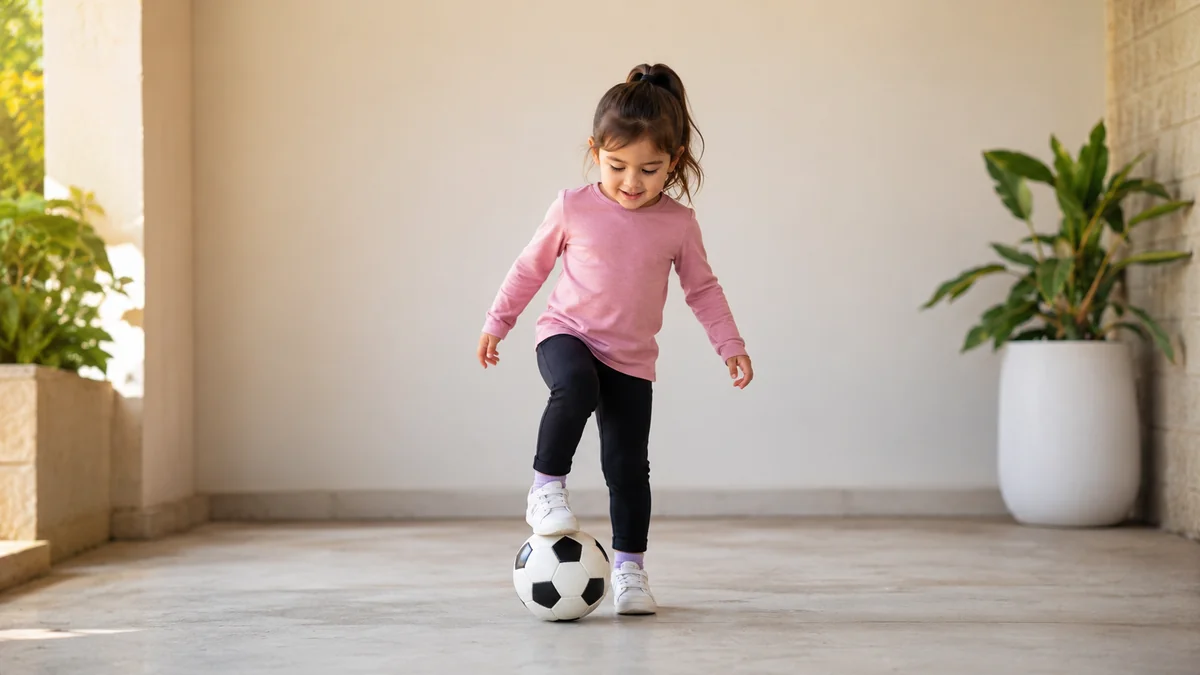
To dribble backward, the sole stays in contact with the top of the ball the whole time, guiding it back smoothly—one continuous roll, not a kick.
Key Takeaways
- A backward dribble is one smooth roll: the sole stays glued to the top of the ball and pulls it back in small steps.
- It gives a young player a third option under pressure—not just kick it or freeze, but keep it and retreat.
- Go at walking pace. The goal is constant contact with the ball, not speed; quickness comes later on its own.
- Use a size 3 ball and practice barefoot or in socks so she can feel the ball under her sole.
- The cue is “gentle foot-hug on top.” Slow and connected beats fast and runaway.
Most kids learn to push the ball forward long before anyone thinks to teach them how to bring it back. But backward control is one of the most useful early soccer skills there is—it’s how a young player keeps the ball, buys herself space, and stays calm when another kid comes charging at her. This is the deep how-to for that one skill. For where it sits in the whole soccer journey, head up to our hub, Teaching Soccer to 4-6 Year Olds, or see How to Teach Soccer to Kids, by Age.
LudoLogic Sports is our company, and Global Trophy Trek is our soccer series, where the Guardians travel the world collecting skills with Coach Lola, the “Big Sister” mentor, as their guide—and the backward dribble is one of two new skills your child unlocks in Episode 4, Morocco, sneaking across the Sahara without waking a sleeping fox.
Quick Facts
- Age: 4-6
- Skill: Backward dribble / retreat dribble (sole control)
- Time: 2-3 minutes
- Equipment: A size 3 soccer ball (smaller and lighter, so little feet can actually control it); a clear space; socks or bare feet
- One cue: “Gentle foot-hug on top—roll it back.”
- Safety note: Clear the space behind and around her, and check her “space bubble”—arms out, spin slowly, touching nothing. Supervise young kids, use soft household props, stop for pain, dizziness, or distress, and consult a professional for medical concerns.
What is a backward dribble in soccer?
A backward dribble is moving the ball behind you while keeping it under control. In plain terms, it’s a slow roll: you rest the sole—the flat bottom of the foot—lightly on top of the ball and pull it backward a few inches at a time, foot never leaving the ball. Unlike a forward dribble—quick pushes with the laces or the inside of the foot—the backward dribble is one continuous, controlled roll.
What the research says
Guiding a ball with the foot is an object-control skill, and object-control skills build gradually with repetition rather than arriving all at once, according to the Cleveland Clinic’s overview of gross-motor development. A backward dribble packs a lot of small, controlled touches into a short window, which is exactly the kind of repetition that turns “wobbly” into “reliable.”
How do I teach my kid to dribble the ball backward?
Start with the ball still and your child standing right behind it, then roll it back one small step at a time—sole on top, foot in contact the whole way. Keep it at walking pace and switch feet so both sides learn the same control. A few feet of smooth backward rolling is a great result at this age; stop while it’s still fun.
Do it in this order:
- Shoes off, ball still. Have her stand with the ball just in front of her.
- Sole on top. Rest the bottom of one foot lightly on top of the ball, toes up a touch—no stomping. Cue: “gentle foot-hug on top.”
- Roll, don’t kick. Pull the ball backward by rolling it under the sole, a few inches at a time. The foot stays in contact the whole way.
- Small steps back. Roll the ball back, take a little step back, roll again. Slow and connected beats fast and runaway.
- Switch feet. Practice with each foot so both sides learn the same control.
Why teach backward control so early?
Young kids panic when another child runs at the ball—the only instincts are to boot it away or freeze. A backward dribble hands her a third option: keep it and retreat. That one skill builds composure, protects possession, and sets up the turns and escapes that come later. Control in reverse is really control under pressure.
What the research says
There’s a reason we lead with skills a child can actually pull off. Motor competence and a child’s belief in her own ability are linked, and both help drive her to stay active, per the influential research of Stodden and colleagues in the journal Quest. In other words, giving her a move that works under pressure isn’t just tactics—it’s confidence she carries onto the field.
What worked in our house
My wife and I both played Division I basketball, and the backward dribble is one of those skills where that lens actually helps: in basketball, the retreat dribble is how you buy yourself a second when you’re trapped, and nobody’s born knowing it.
Translating that to soccer for my five-year-old, her very first instinct was just to kick the ball backward—which defeats the whole purpose, and she’d lose control every time. What I had to remind myself is that this move is really about teaching two hard things at once: walking backward and controlling a ball are each individually tough for a five-year-old, and the backward dribble asks her to do both together.
The reframe that made it click was that slow and steady on a line was the goal—not fast, and not “escaping a defender.” Again, at this age they aren’t juking anyone; the point was to teach the basic mechanics that build long-term confidence.
How does dribbling backward help in a real soccer game?
On the field, a player who can only go forward is easy to read and easy to stop. A player who can also move the ball backward can escape pressure, protect the ball, and reset to find a better angle. For a 4-6 year old, that shows up as staying calm when someone rushes her instead of blindly kicking it away—the first taste of playing with her head up.
To be honest, this isn’t a skill every 4-6 year old is going to reach for in weekly practice—but it’s a wonderful fundamental, because it trains a locomotor skill, moving her body backward under control, and a ball skill, keeping the sole glued to the ball, inside one exercise.
As she develops, a player who owns that combination is the one who can turn out of trouble, shield the ball, and buy herself the half-second she needs—all things that grow directly out of these first slow, backward rolls.
What age can a child dribble backward?
Most 4-6 year olds can learn a slow, sole-controlled backward roll once they can balance briefly on one foot. Keep it at walking pace, in a straight line first, over about 10-15 feet—the goal is constant contact with the ball, not speed. Don’t expect a smooth, quick retreat yet; that comes closer to 6 and beyond. At this age, a few controlled rolls with each foot is a genuine win, even if it’s wobbly at first.
Common Mistakes—and Quick Fixes
- Kicking the ball back instead of rolling it. Fix: cue “foot-hug on top” and have the sole stay touching the ball the whole time.
- Going too fast; the ball runs away. Fix: slow to walking pace; one roll, one step, reset.
- Stomping down on the ball. Fix: light foot, toes up a touch—she’s guiding it, not squashing it.
- Only using the strong foot. Fix: switch feet every few reps so both sides learn.
- Ball too big to control. Fix: use a size 3 ball; a full-size ball is too heavy for little feet at this age.
Related skill guides:
Make It an Adventure
In Episode 4, Morocco, the final trophy piece is buried at the top of the highest sand dune in the Sahara—and a tiny fennec fox is asleep right on top of it, with ears big enough to hear the faintest sound.
To sneak up without waking her, your child has to dribble backward: sole on the ball, slow quiet steps, no sudden moves. Coach Lola runs it as a Trophy Hunt—roll backward all the way across the “desert floor” to the dune, and freeze, sole on top and holding still, the second the fox stirs.
At home, you’re the referee: scatter a couple of cushions as “sand obstacles,” and every quiet backward roll that reaches the dune wins the piece. When she gets it, log the win in her Guardian Field Book and unlock her Trophy card.
Once she’s steady rolling backward, the natural next move in the same episode is the T-Turn—using that same backward drag to actually change direction.
FAQ
What size ball should a 4-6 year old use for the backward dribble?
A size 3. It’s smaller and lighter, so little feet can actually roll and control it. A full-size size 4 or 5 ball is too heavy at this age and makes smooth, controlled contact much harder.
How long should we practice?
Two to three minutes is plenty. A few clean backward rolls with each foot beats a long session—stop while she’s still having fun, and come back to it another day.
Should she practice barefoot or with shoes on?
Barefoot or in socks, if you can. Feeling the ball directly under the sole helps her learn how much pressure keeps the ball connected and rolling instead of shooting away.
Start the Adventure
Want every skill taught for you, with a story she’ll ask to repeat? The Global Trophy Trek bundle includes all 5 episodes, the Guardian Field Book workbook, and the Trophy cards. Try the free first episode of Global Trophy Trek—Mexico to start building calm, two-footed control tonight.
About the Author
Lincoln Gunn is the Founder & CEO of LudoLogic Sports. He and his wife are both former Division I basketball players, and they’re raising two young daughters, ages 5 and 2. LudoLogic Sports’ mission is to give every kid a better, more joyful start in sports—“build the ultimate athlete, not the elite basketball player”—using a play-based curriculum grounded in physical-literacy research. Read more on Lincoln’s author page.
Sources
- Cleveland Clinic — Gross Motor Skills: https://my.clevelandclinic.org/health/articles/gross-motor-skills
- Stodden et al., Quest (2008)—motor competence, perceived competence, and physical activity: https://doi.org/10.1080/00336297.2008.10483582